

This mathematics problem involves applying core mathematical principles and formulas. Below you will find a complete step-by-step solution with detailed explanations for each step, helping you understand not just the answer but the method behind it.
ScanSolve AI Answer
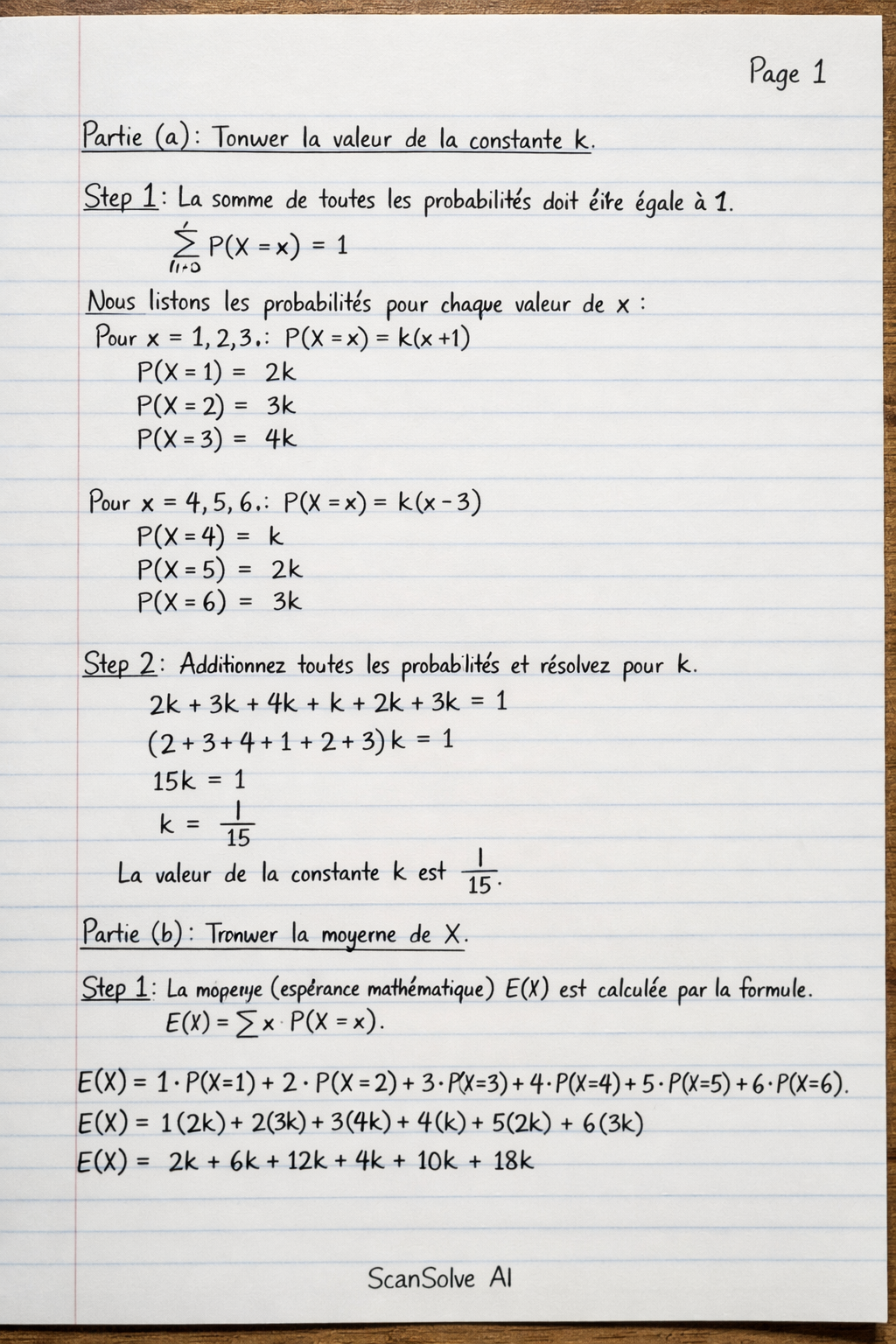
Voici les étapes pour résoudre le problème : Partie (a) : Trouver la valeur de la constante k. Step 1: La somme de toutes les probabilités dans une distribution de probabilité discrète doit être égale à 1. P(X=x) = 1 Nous listons les probabilités pour chaque valeur de x : Pour x=1, 2, 3: P(X=x) = k(x+1) P(X=1) = k(1+1) = 2k P(X=2) = k(2+1) = 3k P(X=3) = k(3+1) = 4k Pour x=4, 5, 6: P(X=x) = k(x-3) P(X=4) = k(4-3) = k P(X=5) = k(5-3) = 2k P(X=6) = k(6-3) = 3k Step 2: Additionnez toutes les probabilités et résolvez pour k. 2k + 3k + 4k + k + 2k + 3k = 1 (2+3+4+1+2+3)k = 1 15k = 1 k = (1)/(15) La valeur de la constante k est (1)/(15). Partie (b) : Trouver la moyenne de X. Step 1: La moyenne (espérance mathématique) E(X) est calculée par la formule E(X) = x · P(X=x). E(X) = 1 · P(X=1) + 2 · P(X=2) + 3 · P(X=3) + 4 · P(X=4) + 5 · P(X=5) + 6 · P(X=6) E(X) = 1(2k) + 2(3k) + 3(4k) + 4(k) + 5(2k) + 6(3k) E(X) = 2k + 6k + 12k + 4k + 10k + 18k Step 2: Additionnez les termes et substituez la valeur de k = (1)/(15). E(X) = (2+6+12+4+10+18)k E(X) = 52k E(X) = 52 · (1)/(15) E(X) = (52)/(15) La moyenne de X est (52)/(15). Partie (c) : Trouver la variance de X. Step 1: La variance Var(X) est donnée par la formule Var(X) = E(X^2) - (E(X))^2. Nous devons d'abord calculer E(X^2). E(X^2) = x^2 · P(X=x) E(X^2) = 1^2 P(X=1) + 2^2 P(X=2) + 3^2 P(X=3) + 4^2 P(X=4) + 5^2 P(X=5) + 6^2 P(X=6) E(X^2) = 1(2k) + 4(3k) + 9(4k) + 16(k) + 25(2k) + 36(3k) E(X^2) = 2k + 12k + 36k + 16k + 50k + 108k Step 2: Additionnez les termes et substituez la valeur de k = (1)/(15). E(X^2) = (2+12+36+16+50+108)k E(X^2) = 224k E(X^2) = 224 · (1)/(15) E(X^2) = (224)/(15) Step 3: Calculez la variance en utilisant E(X^2) et E(X) = (52)/(15). Var(X) = E(X^2) - (E(X))^2 Var(X) = (224)/(15) - ((52)/(15))^2 Var(X) = (224)/(15) - (2704)/(225) Pour soustraire, mettez les fractions sur un dénominateur commun (225). Var(X) = (224 × 15)/(15 × 15) - (2704)/(225) Var(X) = (3360)/(225) - (2704)/(225) Var(X) = (3360 - 2704)/(225) Var(X) = (656)/(225) La variance de X est (656)/(225).