

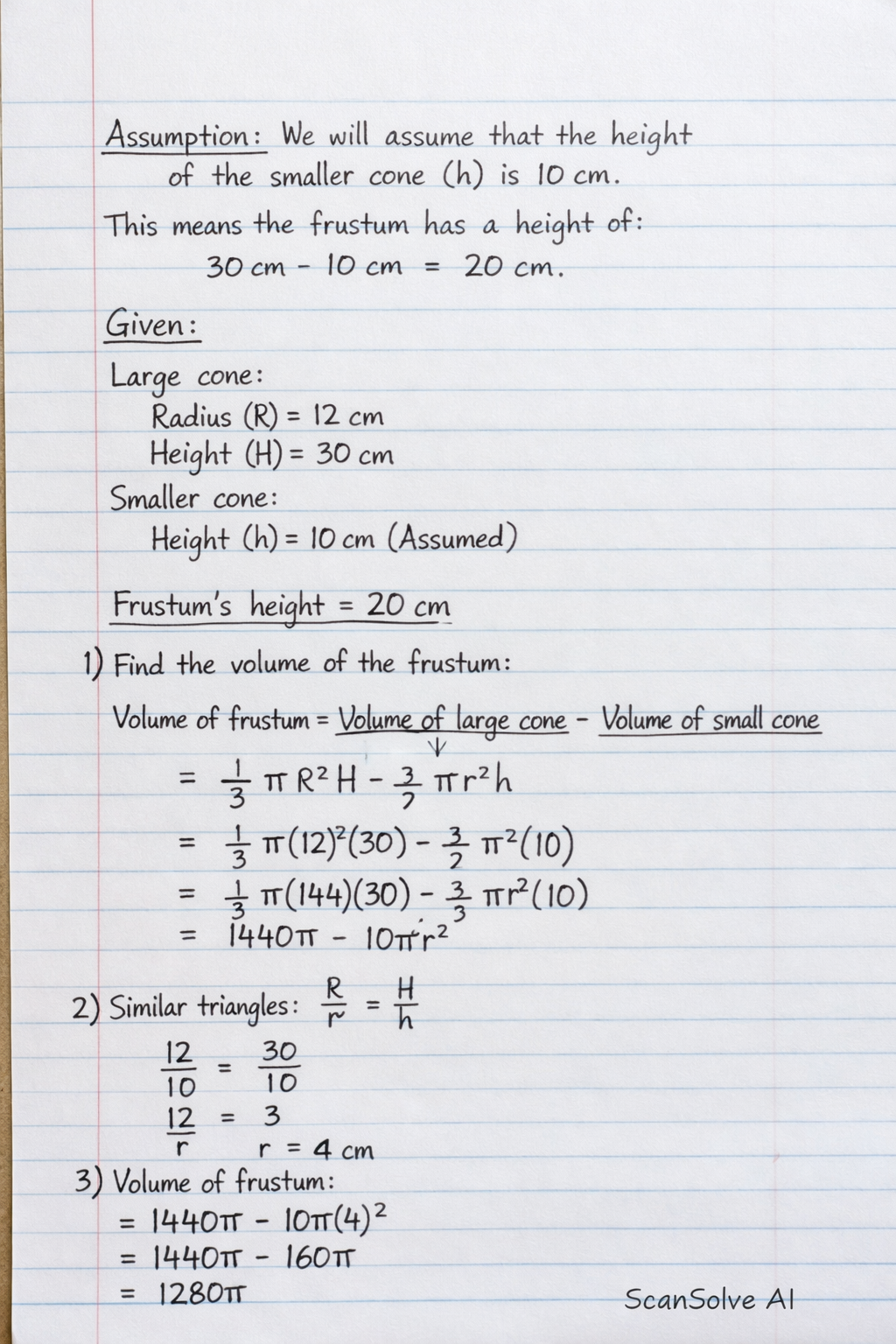
This mathematics problem involves applying core mathematical principles and formulas. Below you will find a complete step-by-step solution with detailed explanations for each step, helping you understand not just the answer but the method behind it.
ScanSolve AI Answer
The problem statement "The smaller cone which is" is incomplete. To solve the problem, we must assume a dimension for the smaller cone. A common assumption in such problems is that the height of the smaller cone is a specific value, or that the frustum has a specific height. Assumption: We will assume that the height of the smaller cone (h) is 10 cm. This means the frustum has a height of 30 cm - 10 cm = 20 cm. Given: Large cone: Radius (R) = 12 cm Height (H) = 30 cm Smaller cone: Height (h) = 10 cm (Assumed