

This mathematics problem involves applying core mathematical principles and formulas. Below you will find a complete step-by-step solution with detailed explanations for each step, helping you understand not just the answer but the method behind it.
ScanSolve AI Answer
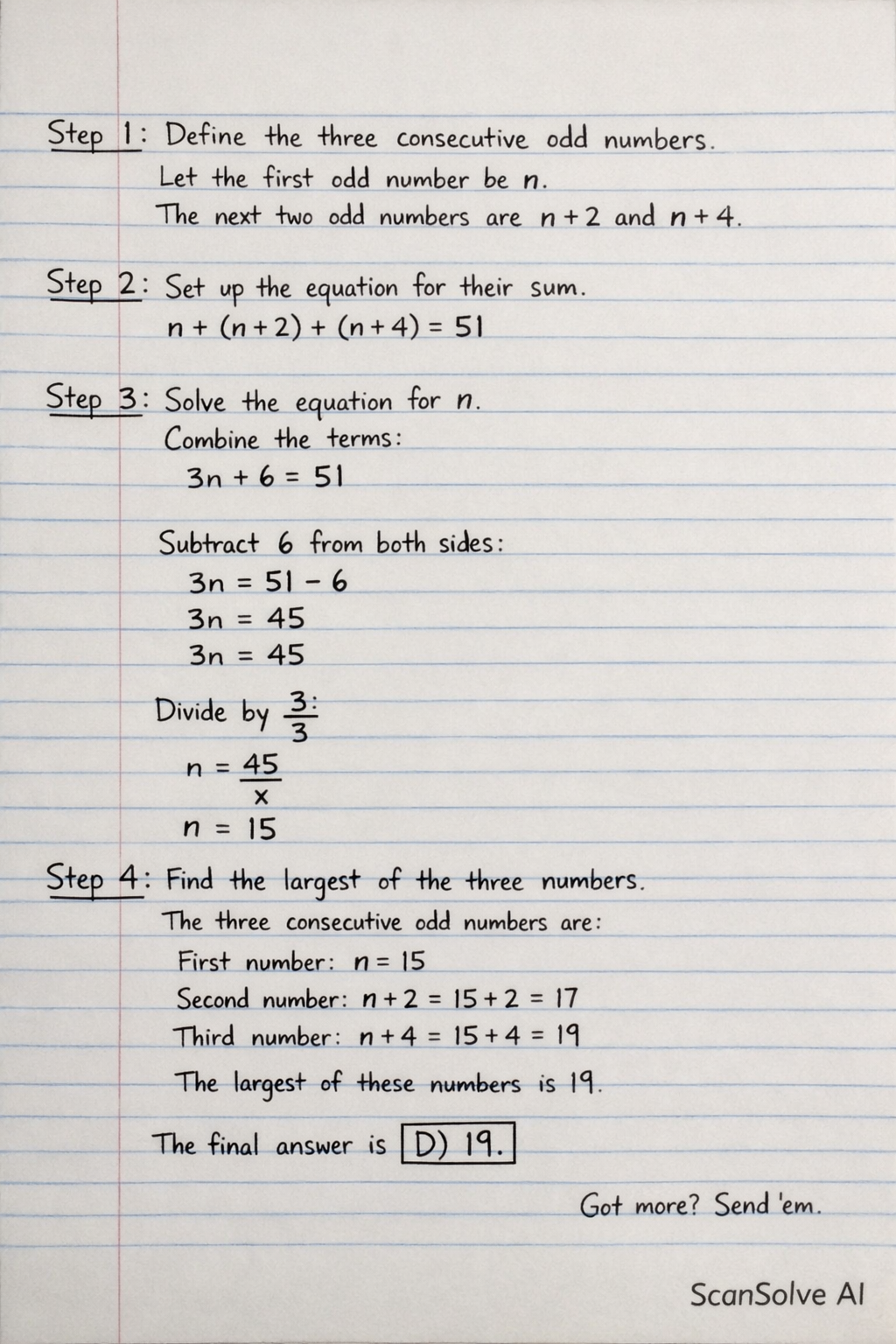
Step 1: Define the two numbers and their properties. Let the two numbers be x and y. From the problem, we know that the numbers differ by 5. Assuming x > y, we can write this as: x - y = 5 (Equation \ 1) We are also given that the ratio of their sum to their difference is 17:1. (x+y)/(x-y) = (17)/(1) Step 2: Substitute the difference into the ratio equation. Substitute x-y=5 into the ratio equation: (x+y)/(5) = 17 Multiply both sides by 5 to find the sum of the numbers: x+y = 17 × 5 x+y = 85 (Equation \ 2) Step 3: Solve the system of linear equations. We have two equations: 1) x - y = 5 2) x + y = 85 Add Equation 1 and Equation 2: (x - y) + (x + y) = 5 + 85 2x = 90 x = (90)/(2) x = 45 Substitute the value of x into Equation 1: 45 - y = 5 y = 45 - 5 y = 40 The two numbers are 45 and 40. The final answer is C) 40 & 45. --- Step 1: Define the three consecutive odd numbers. Let the first odd number be n. Since the numbers are consecutive odd numbers, the next two odd numbers will be n+2 and n+4. Step 2: Set up the equation for their sum. The sum of these three consecutive odd numbers is given as 51: n + (n+2) + (n+4) = 51 Step 3: Solve the equation for n. Combine the terms: 3n + 6 = 51 Subtract 6 from both sides: 3n = 51 - 6 3n = 45 Divide by 3: n = (45)/(3) n = 15 Step 4: Find the largest of the three numbers. The three consecutive odd numbers are: First number: n = 15 Second number: n+2 = 15+2 = 17 Third number: n+4 = 15+4 = 19 The largest of these numbers is 19. The final answer is D) 19.