
We read your photo as:
The second and fourth terms of a geometric progression are 6 and 1.5 respectively. Find the common ratio and the first term, S term, sum to infinity of the progression.
ScanSolve AI Answer
Answers
3 partsStep-by-step solution
8 stepsHere's how to solve the problem:
The -th term of a geometric progression is given by the formula , where is the first term and is the common ratio.
We are given:
The second term () is 6.
The fourth term () is 1.5.
Part a(i)· 3 steps
Find the common ratio and the first term.
Set up equations using the given information.
For the second term:
For the fourth term:
Solve for the common ratio .
Divide equation (2) by equation (1):
Taking the square root, .
Since the given terms (6 and 1.5) are positive, we assume the common ratio is positive unless otherwise specified, leading to a progression with all positive terms.Solve for the first term .
Substitute into equation (1):
The common ratio is and the first term is .
Part a(ii)
Find the 8th term.
Use the formula for the -th term, .
For the 8th term, .
Substitute the values of and .
Simplify the fraction.
The 8th term is .
Part a(iii)24
Find the sum to infinity of the progression.
Use the formula for the sum to infinity of a geometric progression, , which is valid when .
Here, and . Since , the sum to infinity exists.
Substitute the values of and into the formula.
The sum to infinity of the progression is .
Try one yourself
A new problem that tests the same skill.
Still stuck on this one?
Ask a follow-up, and the answer starts from this question.
More Mathematics Questions
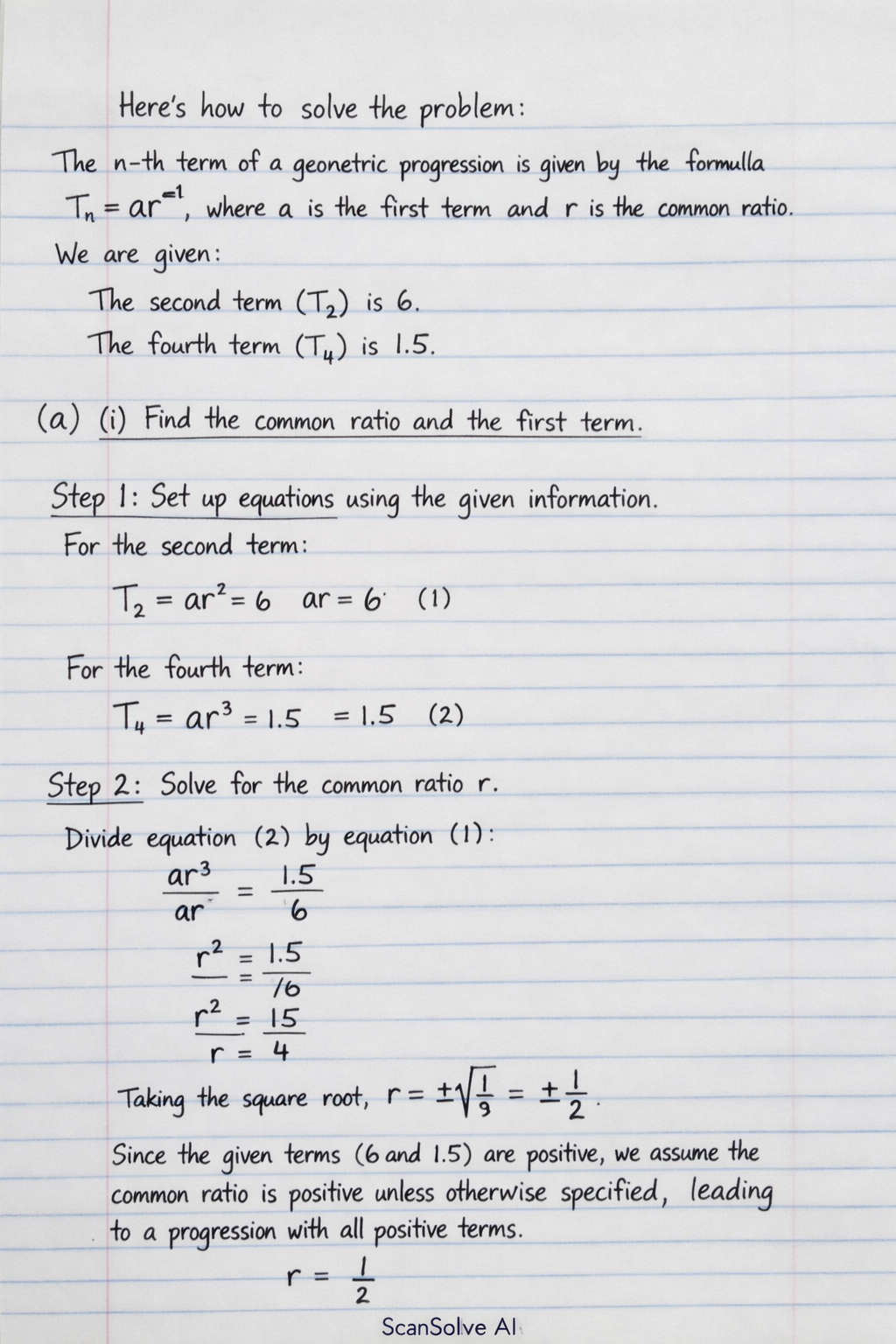
Handwritten Step-by-Step Solution
Get this as a handwritten image on WhatsApp — like a tutor wrote it for you.
Try on WhatsApp