

This mathematics problem involves applying core mathematical principles and formulas. Below you will find a complete step-by-step solution with detailed explanations for each step, helping you understand not just the answer but the method behind it.
ScanSolve AI Answer
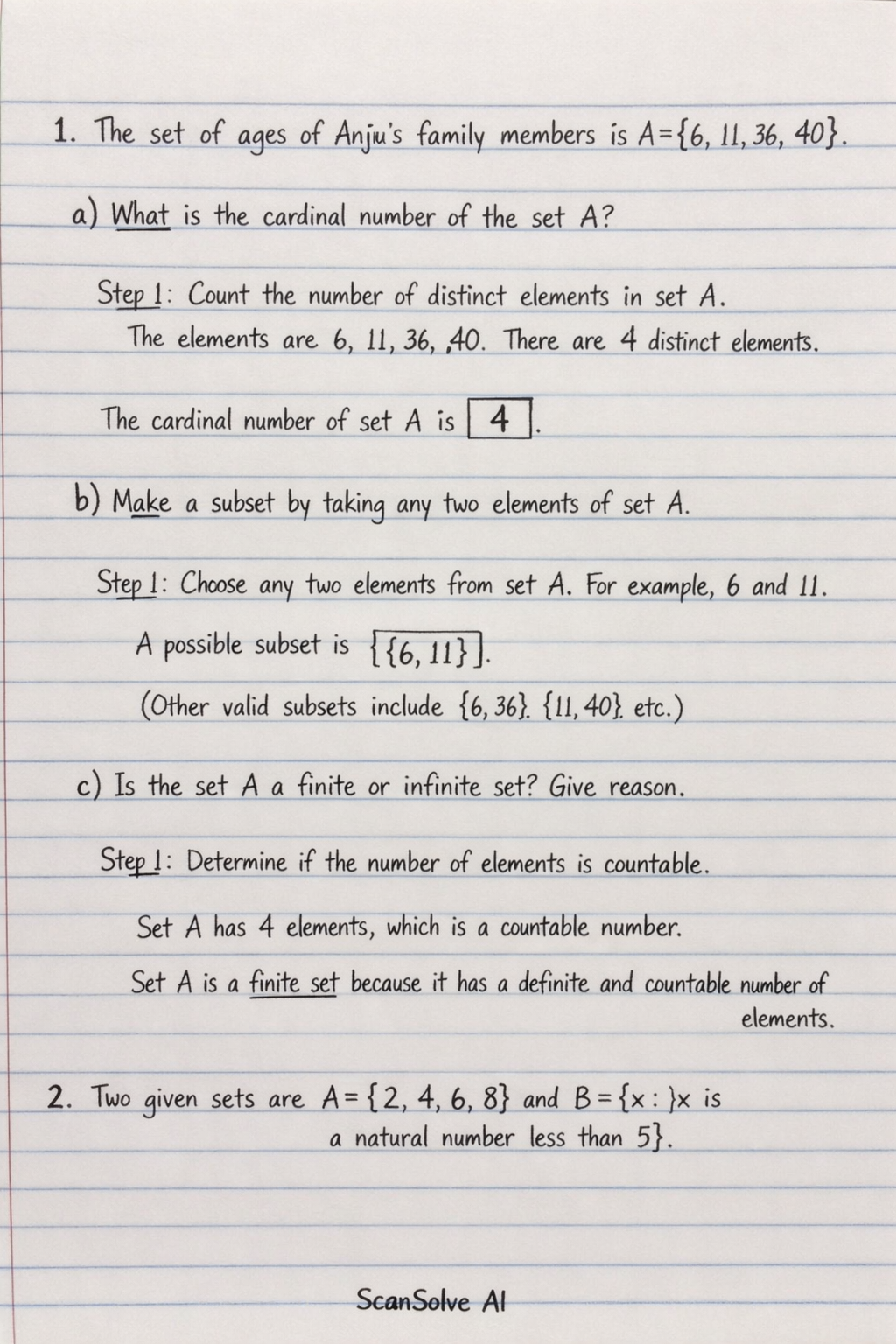
Here are the solutions to the problems from the image. 1. The set of ages of Anju's family members is A = 6, 11, 36, 40. a) What is the cardinal number of the set A? Step 1: Count the number of distinct elements in set A. The elements are 6, 11, 36, 40. There are 4 distinct elements. The cardinal number of set A is 4. b) Make a subset by taking any two elements of set A. Step 1: Choose any two elements from set A. For example, 6 and 11. A possible subset is 6, 11. (Other valid subsets include 6, 36, 11, 40, etc.) c) Is the set A finite or infinite set? Give reason. Step 1: Determine if the number of elements is countable. Set A has 4 elements, which is a countable number. Set A is a finite set because it has a definite and countable number of elements. 2. Two given sets are A = 2, 4, 6, 8 and B = x: x is a natural number less than 5. a) List the elements of the set B. Step 1: Identify natural numbers less than 5. Natural numbers are positive integers starting from 1. So, numbers less than 5 are 1, 2, 3, 4. The elements of set B are 1, 2, 3, 4. b) Write whether A and B are the equal or equivalent sets. Step 1: Compare the elements of A and B. A = 2, 4, 6, 8 and B = 1, 2, 3, 4. The elements are not exactly the same, so they are not equal sets. Step 2: Compare the cardinal numbers of A and B. Cardinal number of A, n(A) = 4. Cardinal number of B, n(B) = 4. Since n(A) = n(B), sets A and B are equivalent sets. c) Are the sets A and B disjoint or overlapping? Give reason. Step 1: Check for common elements between A and B. A = 2, 4, 6, 8 and B = 1, 2, 3, 4. The common elements are 2 and 4. Since they have common elements, sets A and B are overlapping sets. 3. Three given sets are L = 2, 3, 5, 7, M = factors of 6 and N = 1, 2, 3, .... a) List the elements of set M. Step 1: Find the factors of 6. The numbers that divide 6 evenly are 1, 2, 3, and 6. The elements of set M are 1, 2, 3, 6. b) Which of the given sets is an infinite set? Step 1: Examine each set for countability. L = 2, 3, 5, 7 has 4 elements (finite). M = 1, 2, 3, 6 has 4 elements (finite). N = 1, 2, 3, ... indicates that the numbers continue indefinitely (uncountable). Set N is an infinite set. c) State with reason whether the sets L and M are equal or equivalent sets. Step 1: Compare the elements of L and M. L = 2, 3, 5, 7 and M = 1, 2, 3, 6. The elements are not exactly the same, so they are not equal sets. Step 2: Compare the cardinal numbers of L and M. Cardinal number of L, n(L) = 4. Cardinal number of M, n(M) = 4. Since n(L) = n(M), sets L and M are equivalent sets. 4. A given set is S = x: x is square number, 1 x < 5. a) How many subsets of S are possible? Step 1: List the elements of set S. Square numbers are 1^2=1, 2^2=4, 3^2=9, . For 1 x < 5, the square numbers are 1 and 4. So, S = 1, 4. Step 2: Find the cardinal number of S. n(S) = 2. Step 3: Calculate the number of possible subsets using the formula 2^n(S). Number of subsets = 2^2 = 4. There are 4 possible subsets of S. b) Write all possible subsets of S. Step 1: List the elements of S: S = 1, 4. Step 2: List all subsets, including the empty set and the set itself. The subsets are , \1\, \4\, \1, 4\. Last free one today — make it count tomorrow, or type /upgrade for unlimited.