
We read your photo as:
What are the solutions to the following questions: 1) The product of (3+sqrt(5))(3-sqrt(5)) is? 2) The base of common logarithm is? 3) If A = , then P(A) is? 4) If n(A U B) = 50, n(A) = 30 and n(B) =
ScanSolve AI Answer
Answer
Rational number
Step-by-step solution
22 stepsHere are the solutions to the questions:
1) The product of is:
Use the difference of squares formula, .
Here, and .
Calculate the squares.
The product is 4. This is not among the given options (Prime number, Odd number, Rational number, Irrational number). However, 4 is a rational number.
The correct option is D) Rational number.2) The base of common logarithm is:
The common logarithm, also known as the decimal logarithm, is the logarithm with base 10.
The correct option is C) 10.3) If , then is:
The power set of a set is the set of all subsets of .
If (the empty set), its only subset is the empty set itself.
The correct option is B) .
4) If , and , then is equal to:
Use the formula for the union of two sets
.
Substitute the given values into the formula.Solve for .
The correct option is B) 15.
5) The L.C.M. of , and is:
Find the LCM of the numerical coefficients
16, 4, and 30.
Prime factorization:
LCM of (16, 4, 30) = .Find the LCM of the variables
, , and .
For : the highest power is .
For : the highest power is .Combine the numerical and variable LCMs.
LCM = .
The correct option is A) .6) The factorization of is:
Find the greatest common factor (GCF) of $12x$ and 36.
The GCF of 12 and 36 is 12.
Factor out the GCF.
The correct option is D) .
7) Solution of is:
Add 10 to both sides of the equation.
Divide both sides by 5.
The correct option is B) 4.
8)
The value of is .
The correct option is A) .9)
This is a fundamental trigonometric identity.The correct option is C) 1.
10) Distance between two points and is:
Use the distance formula
.
Here, and .Calculate the differences and squares.
Take the square root.
The correct option is D) 5.
11) If the volume of two similar solids is and , the ratio of their corresponding heights is:
For similar solids, the ratio of their volumes is equal to the cube of the ratio of their corresponding linear dimensions (like heights, radii, or sides).
Let and be the volumes, and and be the corresponding heights.
Substitute the given volumes.
Take the cube root of both sides to find the ratio of the heights.
The ratio of their corresponding heights is .
The correct option is B) .12) Slope of the line is:
The equation of a line in slope-intercept form is , where is the slope and is the y-intercept.
Compare with .
The slope is 5.
The correct option is B) 5.13) An equilateral triangle:
An equilateral triangle is a triangle in which all three sides have the same length, and all three angles are equal to .- can be isosceles: An equilateral triangle is a special case of an isosceles triangle (where at least two sides are equal).
- can be right angled: A right-angled triangle has one angle of . An equilateral triangle has all angles , so it cannot be right-angled.
- can be obtuse angled: An obtuse-angled triangle has one angle greater than . An equilateral triangle has all angles , so it cannot be obtuse-angled.
- has each angle equal to : This is incorrect; each angle is . The most accurate description among the choices is that an equilateral triangle can be isosceles. The correct option is A) can be isosceles.
14) Which data takes only some specific values?
- Continuous data: Can take any value within a given range (e.g., height, temperature).
- Discrete data: Can only take specific, distinct values (e.g., number of students, shoe size).
- Grouped data: Data organized into groups or intervals.
- Ungrouped data: Raw data not yet organized. Data that takes only some specific values is discrete data. The correct option is B) Discrete data.
15) While rolling a pair of dice, what will be the probability of double 2?
When rolling a pair of dice, the total number of possible outcomes is .
"Double 2" means both dice show a 2.
There is only one outcome for this: (2, 2).
The probability is the number of favorable outcomes divided by the total number of outcomes.
The correct option is A) .
Try one yourself
A new problem that tests the same skill.
Still stuck on this one?
Ask a follow-up, and the answer starts from this question.
More Mathematics Questions
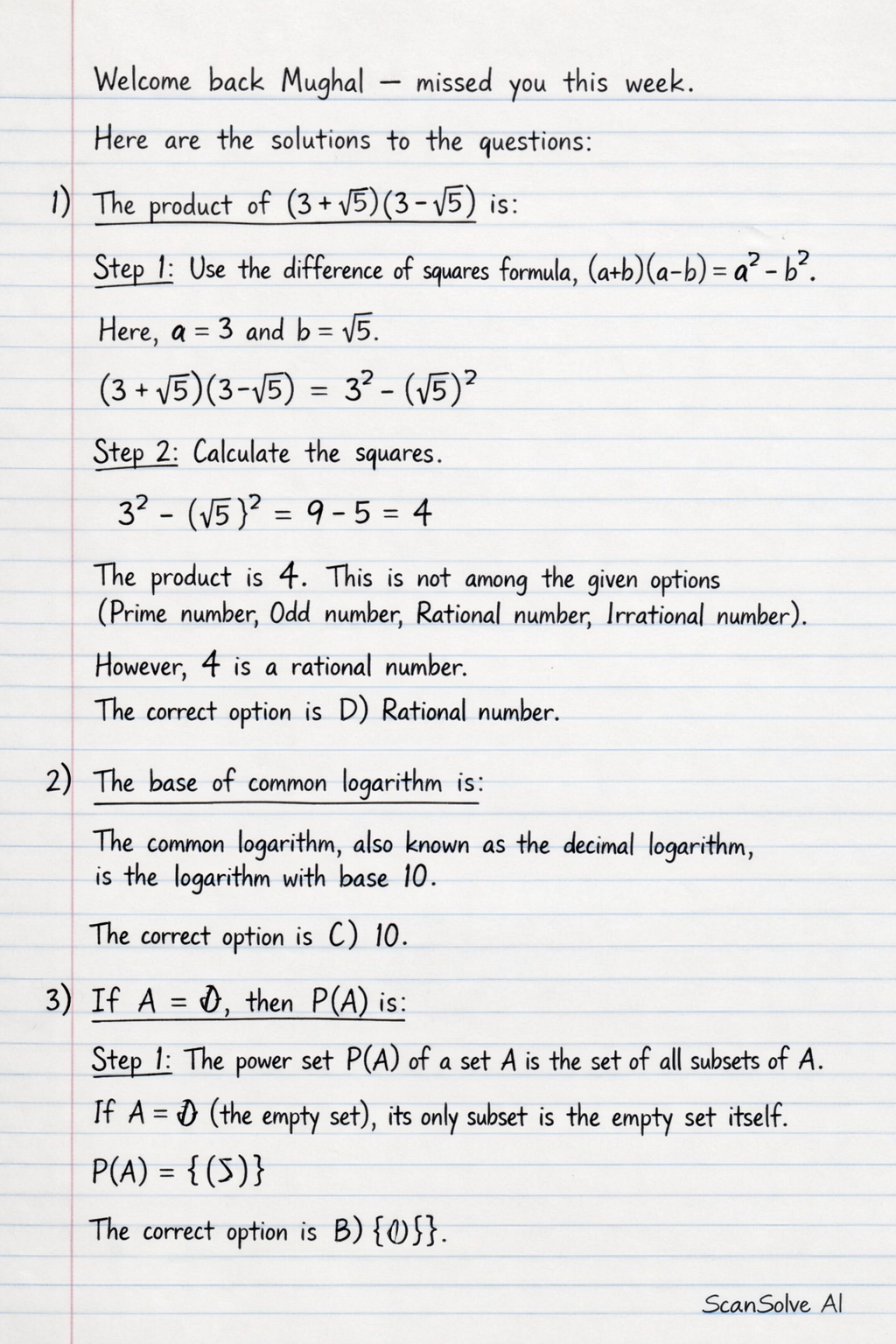
Handwritten Step-by-Step Solution
Get this as a handwritten image on WhatsApp — like a tutor wrote it for you.
Try on WhatsApp