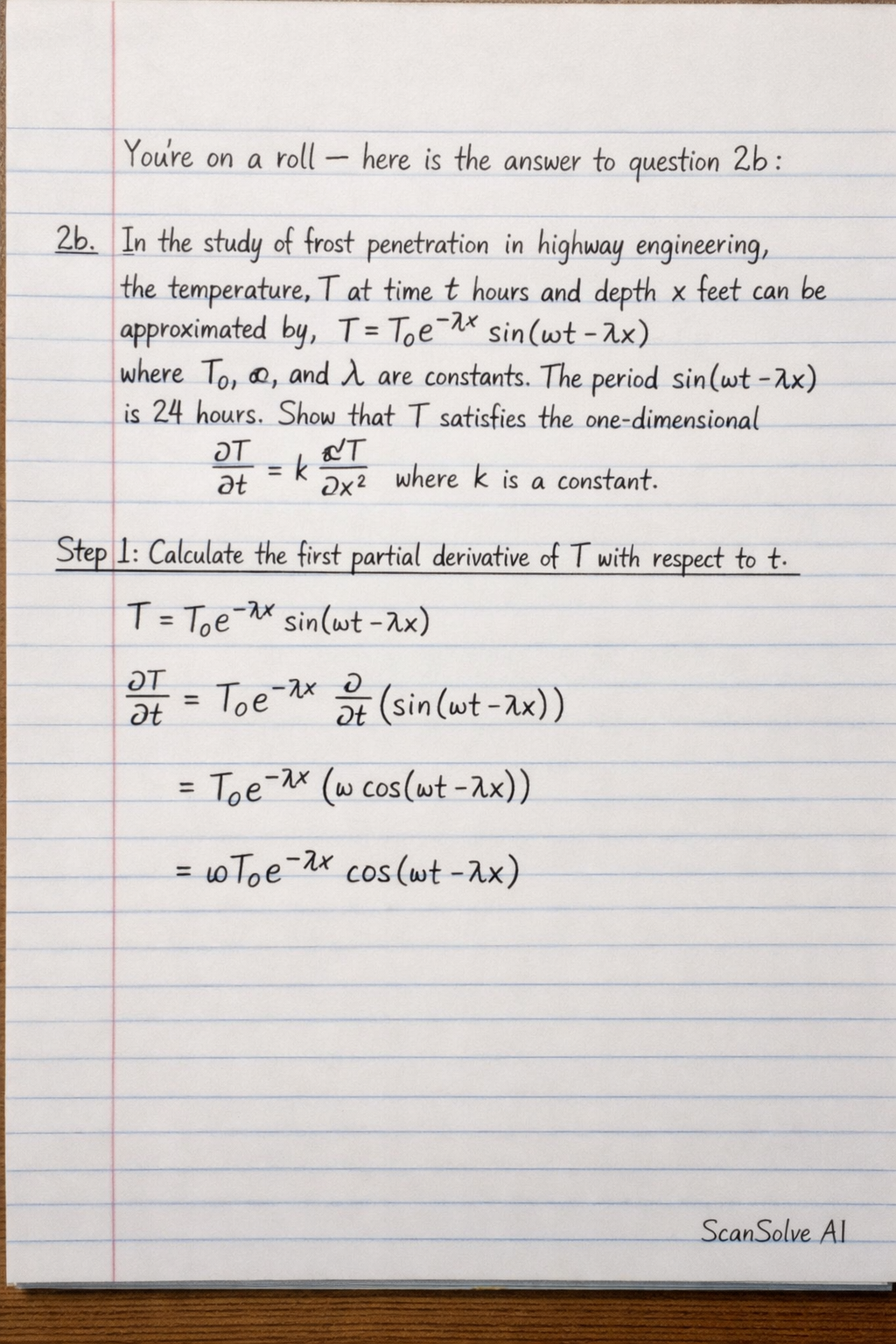
here is the answer to question 2b:
2b. The study of frost penetration in highway engineering, the temperature T at time t hours and depth x feet can be approximated by, T=T0e−λxsin(ωt−λx) where T0,ω, and λ are constants. The period sin(ωt−λx) is 24 hours. Show that T satisfies the one-dimensional ∂t∂T=k∂x2∂2T where k is a constant.
Step 1: Calculate the first partial derivative of T with respect to t.
T=T0e−λxsin(ωt−λx)
∂t∂T=T0e−λx∂t∂(sin(ωt−λx))
∂t∂T=T0e−λx(ωcos(ωt−λx))
∂t∂T=ωT0e−λxcos(ωt−λx)
Step 2: Calculate the first partial derivative of T with respect to x.
Using the product rule:
∂x∂T=∂x∂(T0e−λx)sin(ωt−λx)+T0e−λx∂x∂(sin(ωt−λx))
∂x∂T=(−λT0e−λx)sin(ωt−λx)+T0e−λx(−λcos(ωt−λx))
∂x∂T=−λT0e−λx(sin(ωt−λx)+cos(ωt−λx))
Step 3: Calculate the second partial derivative of T with respect to x.
Again, using the product rule:
∂x2∂2T=∂x∂(−λT0e−λx)(sin(ωt−λx)+cos(ωt−λx))+(−λT0e−λx)∂x∂(sin(ωt−λx)+cos(ωt−λx))
∂x2∂2T=(−λ)(−λT0e−λx)(sin(ωt−λx)+cos(ωt−λx))+(−λT0e−λx)(−λcos(ωt−λx)+λsin(ωt−λx))
∂x2∂2T=λ2T0e−λx(sin(ωt−λx)+cos(ωt−λx))+λ2T0e−λx(cos(ωt−λx)−sin(ωt−λx))
Factor out λ2T0e−λx:
∂x2∂2T=λ2T0e−λx[sin(ωt−λx)+cos(ωt−λx)+cos(ωt−λx)−sin(ωt−λx)]
∂x2∂2T=λ2T0e−λx[2cos(ωt−λx)]
∂x2∂2T=2λ2T0e−λxcos(ωt−λx)
Step 4: Show that ∂t∂T=k∂x2∂2T for some constant k.
Substitute the expressions for ∂t∂T and ∂x2∂2T into the given equation:
ωT0e−λxcos(ωt−λx)=k(2λ2T0e−λxcos(ωt−λx))
Assuming T0e−λxcos(ωt−λx)=0, we can divide both sides by this common factor:
ω=k(2λ2)
Solve for k:
k=2λ2ω
Since ω and λ are constants, k is also a constant.
Therefore, T=T0e−λxsin(ωt−λx) satisfies the one-dimensional heat equation with k=2λ2ω.
Drop the next question.