
We read your photo as:
What is the sum of interior angles of a polygon and problems involving supplementary angles and complex numbers?
ScanSolve AI Answer
Answer
Step-by-step solution
15 stepsHere are the solutions to the problems.
47.
Recall the formula for the sum of interior angles of a polygon.
The sum of the interior angles of a polygon with sides is given by the formula:
Set up the equation using the given sum.
We are given that the sum of the interior angles is .
Solve for .
Divide both sides by 180:
Add 2 to both sides:
Identify the polygon with sides.
A polygon with 8 sides is an octagon.
The correct option is A.
The name of the polygon is an .48.
Define the angle and its supplement.
Let the angle be .
The supplement of the angle is .Set up the equation based on the given condition.
The problem states that the supplement of an angle is twice as large as the angle.
Solve for .
Add to both sides of the equation:
Divide by 3:
The correct option is C.
The measure of the angle is .49.
Rewrite the division as a fraction.
Multiply the numerator and denominator by the conjugate of the denominator.
The conjugate of is .
Perform the multiplication in the numerator.
Substitute :
Perform the multiplication in the denominator.
This is in the form .
Combine the simplified numerator and denominator.
The correct option is A.
The simplified expression is .50.
Write the given equation.
Isolate the term containing .
Subtract from both sides of the equation:
Solve for .
Divide both sides by :
So, .
The correct option is B.
Making the subject of the equation gives .
Try one yourself
A new problem that tests the same skill.
Still stuck on this one?
Ask a follow-up, and the answer starts from this question.
More Mathematics Questions
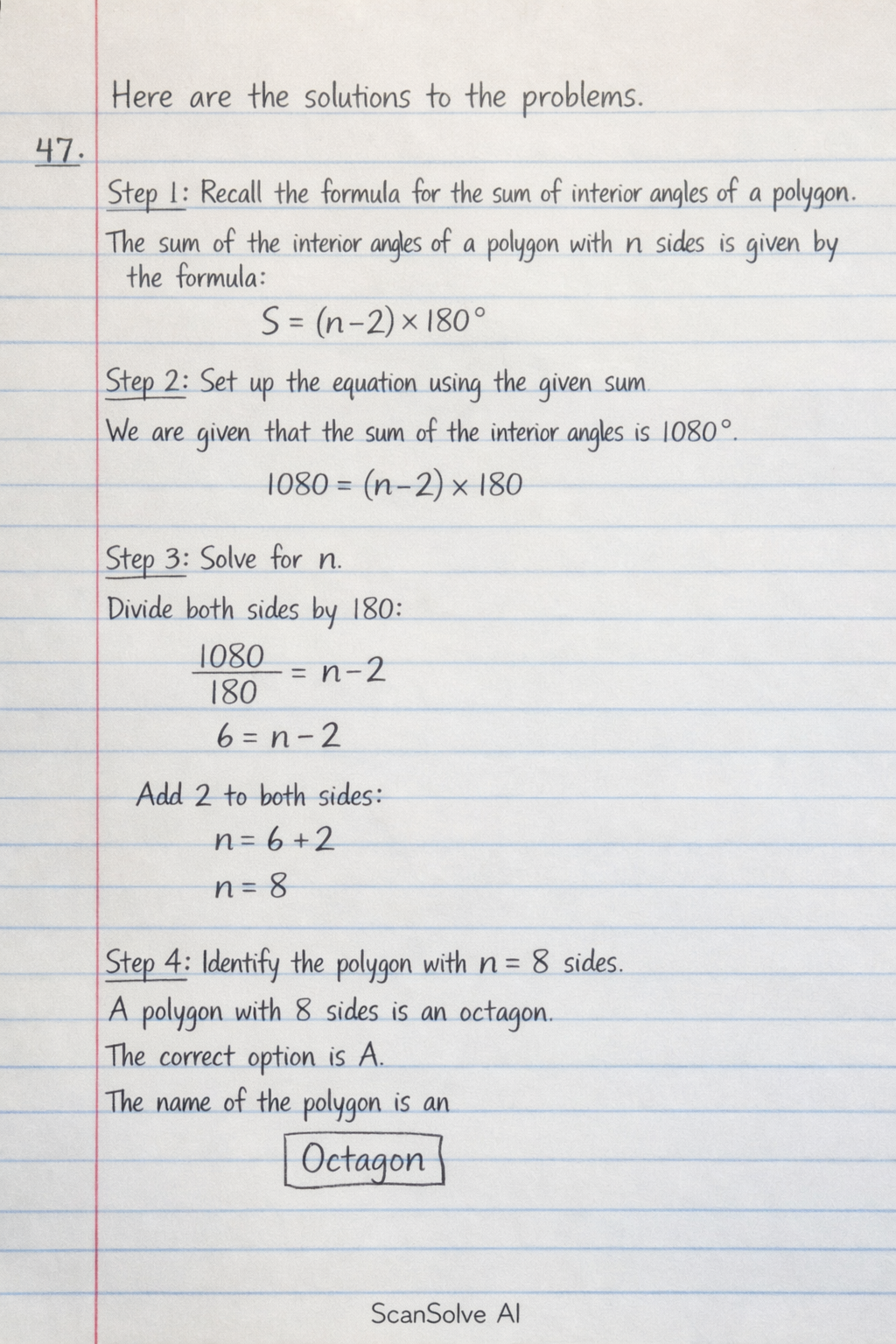
Handwritten Step-by-Step Solution
Get this as a handwritten image on WhatsApp — like a tutor wrote it for you.
Try on WhatsApp