We read your photo as:

The user has not provided a question for problem 3, but problems 1 and 2 are: "What is the perimeter of the pentagon below?" and "Calculate the surface area of the rectangular prism."

Mathematics

ScanSolve AI Answer

Step-by-step solution

12 steps

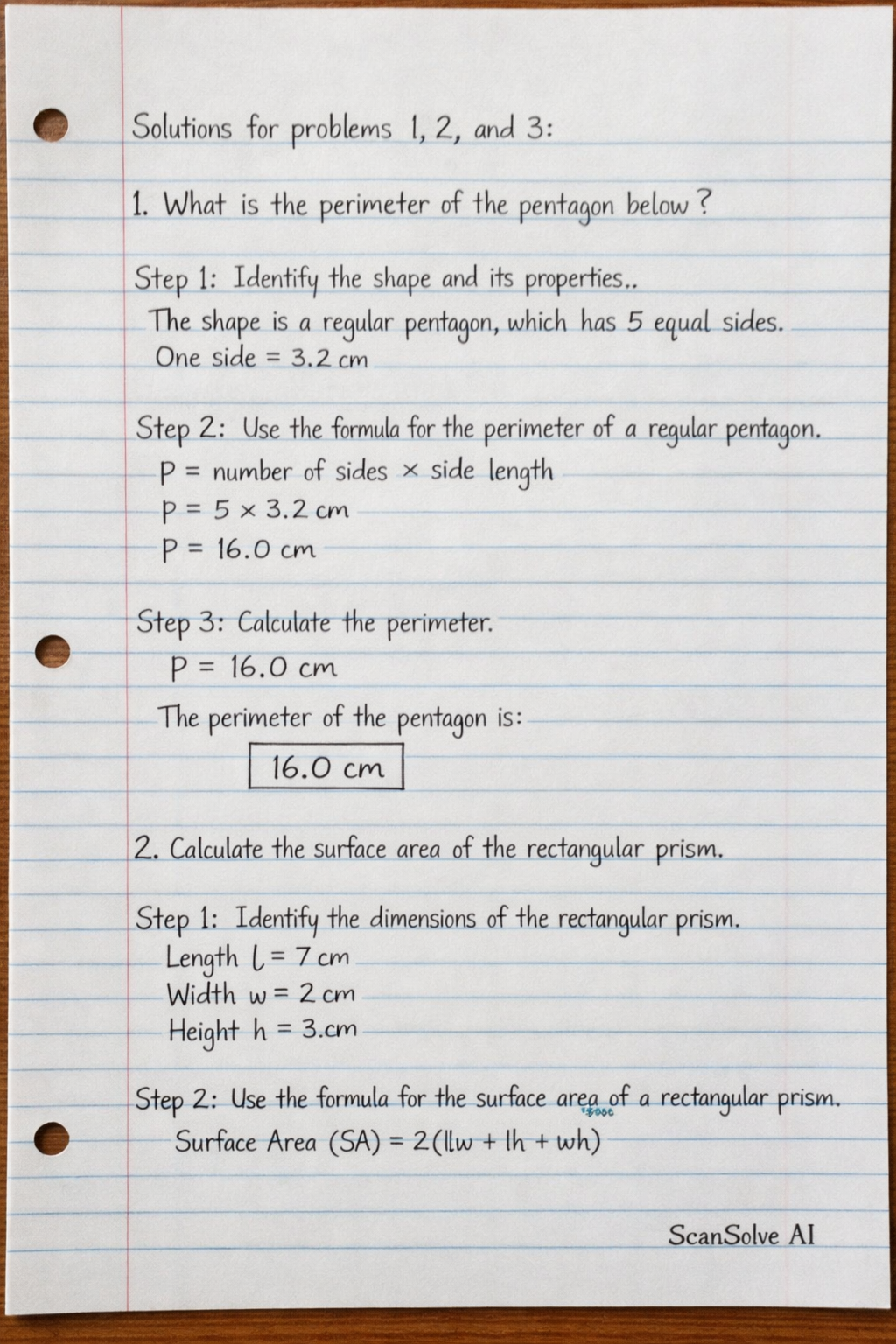
Here are the solutions for problems 1, 2, and 3:

1. What is the perimeter of the pentagon below?

  1. Identify the shape and its properties.

    The shape is a regular pentagon, which has 5 equal sides. The length of one side is given as 3.2 cm.

  2. Use the formula for the perimeter of a regular pentagon.

    The perimeter PP is the sum of the lengths of all sides.

    P=number of sides×side lengthP = \text{number of sides} \times \text{side length} P=5×3.2 cmP = 5 \times 3.2 \text{ cm}
  3. Calculate the perimeter.

    P=16.0 cmP = 16.0 \text{ cm}

    The perimeter of the pentagon is:

    16.0 cm\boxed{16.0 \text{ cm}}

    2. Calculate the surface area of the rectangular prism.

  4. Identify the dimensions of the rectangular prism.

    Length l=7l = 7 cm
    Width w=2w = 2 cm
    Height h=3h = 3 cm

  5. Use the formula for the surface area of a rectangular prism.

    Surface Area (SA)=2(lw+lh+wh)\text{Surface Area (SA)} = 2(lw + lh + wh)
  6. Substitute the dimensions into the formula and calculate.

    SA=2((7 cm×2 cm)+(7 cm×3 cm)+(2 cm×3 cm))\text{SA} = 2((7 \text{ cm} \times 2 \text{ cm}) + (7 \text{ cm} \times 3 \text{ cm}) + (2 \text{ cm} \times 3 \text{ cm})) SA=2(14 cm2+21 cm2+6 cm2)\text{SA} = 2(14 \text{ cm}^2 + 21 \text{ cm}^2 + 6 \text{ cm}^2) SA=2(41 cm2)\text{SA} = 2(41 \text{ cm}^2) SA=82 cm2\text{SA} = 82 \text{ cm}^2

    The surface area of the rectangular prism is:

    82 cm2\boxed{82 \text{ cm}^2}

    3. Calculate surface area of the open cylinder. Use π=3.14\pi = 3.14.

  7. Identify the given values and ensure consistent units.

    Radius r=50r = 50 cm
    Height h=1.2h = 1.2 m
    Convert height to centimeters: h=1.2 m×100 cm/m=120h = 1.2 \text{ m} \times 100 \text{ cm/m} = 120 cm
    Use π=3.14\pi = 3.14.

  8. Determine the formula for the surface area of an open cylinder.

    An open cylinder has one circular base and a curved surface, but no top.

    Surface Area (SA)=Area of base+Area of curved surface\text{Surface Area (SA)} = \text{Area of base} + \text{Area of curved surface} SA=πr2+2πrh\text{SA} = \pi r^2 + 2\pi rh
  9. Substitute the values into the formula.

    SA=(3.14×(50 cm)2)+(2×3.14×50 cm×120 cm)\text{SA} = (3.14 \times (50 \text{ cm})^2) + (2 \times 3.14 \times 50 \text{ cm} \times 120 \text{ cm})
  10. Calculate the area of the base.

    Area of base=3.14×2500 cm2=7850 cm2\text{Area of base} = 3.14 \times 2500 \text{ cm}^2 = 7850 \text{ cm}^2
  11. Calculate the area of the curved surface.

    Area of curved surface=2×3.14×50×120 cm2\text{Area of curved surface} = 2 \times 3.14 \times 50 \times 120 \text{ cm}^2 Area of curved surface=3.14×100×120 cm2\text{Area of curved surface} = 3.14 \times 100 \times 120 \text{ cm}^2 Area of curved surface=3.14×12000 cm2=37680 cm2\text{Area of curved surface} = 3.14 \times 12000 \text{ cm}^2 = 37680 \text{ cm}^2
  12. Add the areas to find the total surface area.

    SA=7850 cm2+37680 cm2\text{SA} = 7850 \text{ cm}^2 + 37680 \text{ cm}^2 SA=45530 cm2\text{SA} = 45530 \text{ cm}^2

    The surface area of the open cylinder is:

    45530 cm2\boxed{45530 \text{ cm}^2}
Was this helpful?

Still stuck on this one?

Ask a follow-up, and the answer starts from this question.

Got a different question?Ask your own question
Handwritten step-by-step solution preview

Handwritten Step-by-Step Solution

Get this as a handwritten image on WhatsApp — like a tutor wrote it for you.

Try on WhatsApp