
We read your photo as:
What is the value of (7)/(8) - (1)/(6)?
ScanSolve AI Answer
Answers
3 partsStep-by-step solution
8 stepsHere are the solutions to the questions:
Part 1· 2 steps
In the above working, which number is called the divisor?
(This refers to the long division problem from a previous context: with a remainder of 7)
Understand the terms in a division problem.
In a division with remainder , is the dividend, is the divisor, is the quotient, and is the remainder.
Identify the divisor from the given context.
The number that divides the dividend (259) is 12.
The divisor is .
Part 2
What is the value of ?
Find the least common multiple (LCM) of the denominators, 8 and 6.
Multiples of 8:
Multiples of 6:
The LCM of 8 and 6 is 24.Convert the fractions to equivalent fractions with a common denominator of 24.
For :
For :
Subtract the equivalent fractions.
The value is .
Part 3
Find the least common multiple of 18 and 24.
List the multiples of 18.
Multiples of 18:
List the multiples of 24.
Multiples of 24:
Identify the smallest common multiple from both lists.
The least common multiple (LCM) of 18 and 24 is 72.
The least common multiple of 18 and 24 is .
Try one yourself
A new problem that tests the same skill.
Still stuck on this one?
Ask a follow-up, and the answer starts from this question.
More Mathematics Questions
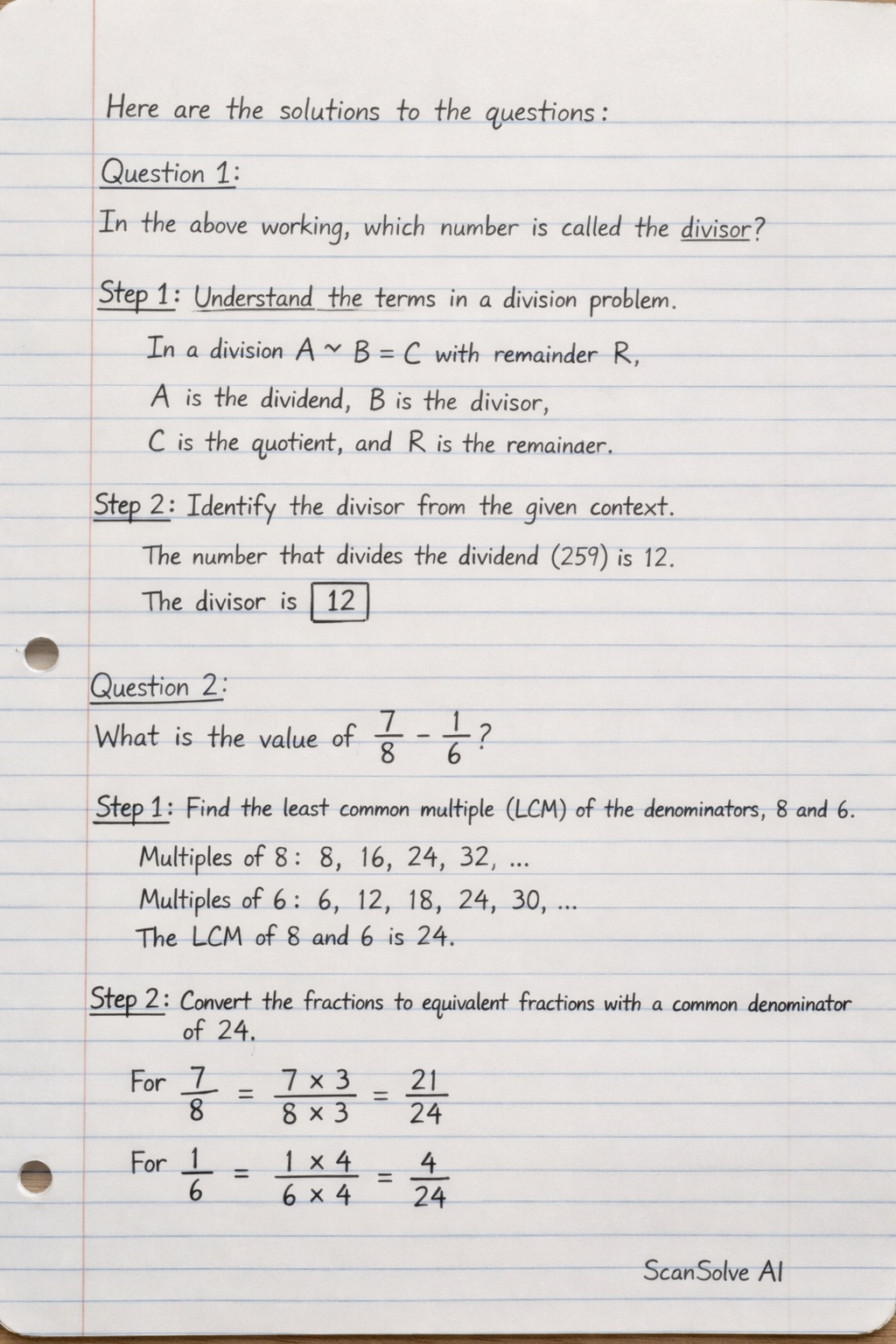
Handwritten Step-by-Step Solution
Get this as a handwritten image on WhatsApp — like a tutor wrote it for you.
Try on WhatsApp