
We read your photo as:
The vertices of ABCD are A(2, 8), B(2, 4), C(8, 4), and D(8, 8). Draw ABCD. Find the image A1B1C1D1 of ABCD under a reflection in the y-axis. Find the image A2B2C2D2 of A1B1C1D1 under a reflection in
ScanSolve AI Answer
Answers
2 partsStep-by-step solution
12 stepsHere's the solution for question 6.
Part a
The vertices of are given as , , , and .
To draw , plot these points on a graph sheet with perpendicular axes and , using a scale of to (which means represents ) for intervals and . Then connect the points to , to , to , and to .
Part b
To find the image of under a reflection in the y-axis, we use the transformation rule .
Apply the rule to point $A(2, 8)$.
Apply the rule to point $B(2, 4)$.
Apply the rule to point $C(8, 4)$.
Apply the rule to point $D(8, 8)$.
The vertices of are .
c) To find the image of under a reflection in the line , we use the transformation rule , where . So the rule is .
Apply the rule to point .
Apply the rule to point .
Apply the rule to point .
Apply the rule to point .
The vertices of are .
Part d
To find the image of under a reflection in the x-axis, we use the transformation rule .
Apply the rule to point .
Apply the rule to point .
Apply the rule to point .
Apply the rule to point .
The vertices of are .
Try one yourself
A new problem that tests the same skill.
Still stuck on this one?
Ask a follow-up, and the answer starts from this question.
More Mathematics Questions
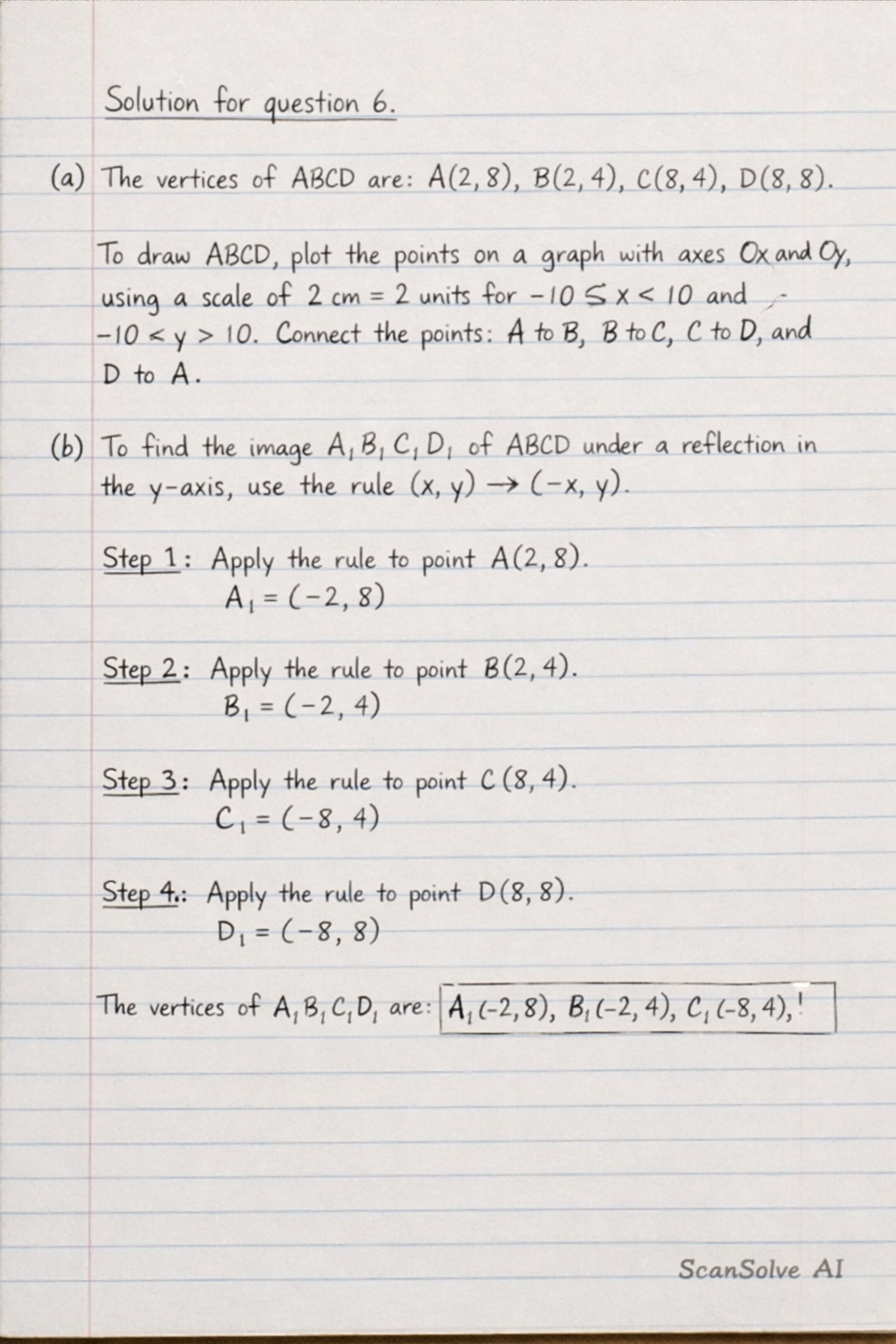
Handwritten Step-by-Step Solution
Get this as a handwritten image on WhatsApp — like a tutor wrote it for you.
Try on WhatsApp