
We read your photo as:
There are 91 oranges in a basket. If 2/7 of the oranges are bad, how many are good? If P - 3/8 = 5/8, find P. Express 15 cm as a decimal of 1 km. If 9.8 X 1.89 = 18.522, find 98 X 189.
ScanSolve AI Answer
Step-by-step solution
16 stepsCalculate the number of bad oranges.
Total oranges = 91.
Fraction of bad oranges = .
Number of bad oranges .There are 26 bad oranges.
Calculate the number of good oranges.
Number of good oranges = Total oranges - Number of bad oranges.
There are 65 good oranges.
Compare with the given options.
The calculated number of good oranges is 65, which corresponds to option C.
The final answer is .
Isolate in the equation.
The given equation is .
To find , add to both sides of the equation.Add the fractions.
Since the fractions have the same denominator, add the numerators.
Simplify the result.
Compare with the given options.
The calculated value of is 1, which corresponds to option C.
The final answer is .
Convert 1 km to cm.
We know that .
We also know that .
Therefore, .Express 15 cm as a decimal of 1 km.
This means we need to find the value of in decimal form.
Convert the fraction to a decimal.
Compare with the given options.
The calculated value is 0.00015, which corresponds to option D.
The final answer is .
Analyze the relationship between the given multiplication and the required multiplication.
We are given .
We need to find .Express 98 and 189 in terms of 9.8 and 1.89.
Substitute these expressions into the required multiplication.
Rearrange the terms:
Use the given information to calculate the product.
We know .
We also know .Perform the final multiplication.
Multiplying by 1000 shifts the decimal point three places to the right.
The final answer is .
Still stuck on this one?
Ask a follow-up, and the answer starts from this question.
More Mathematics Questions
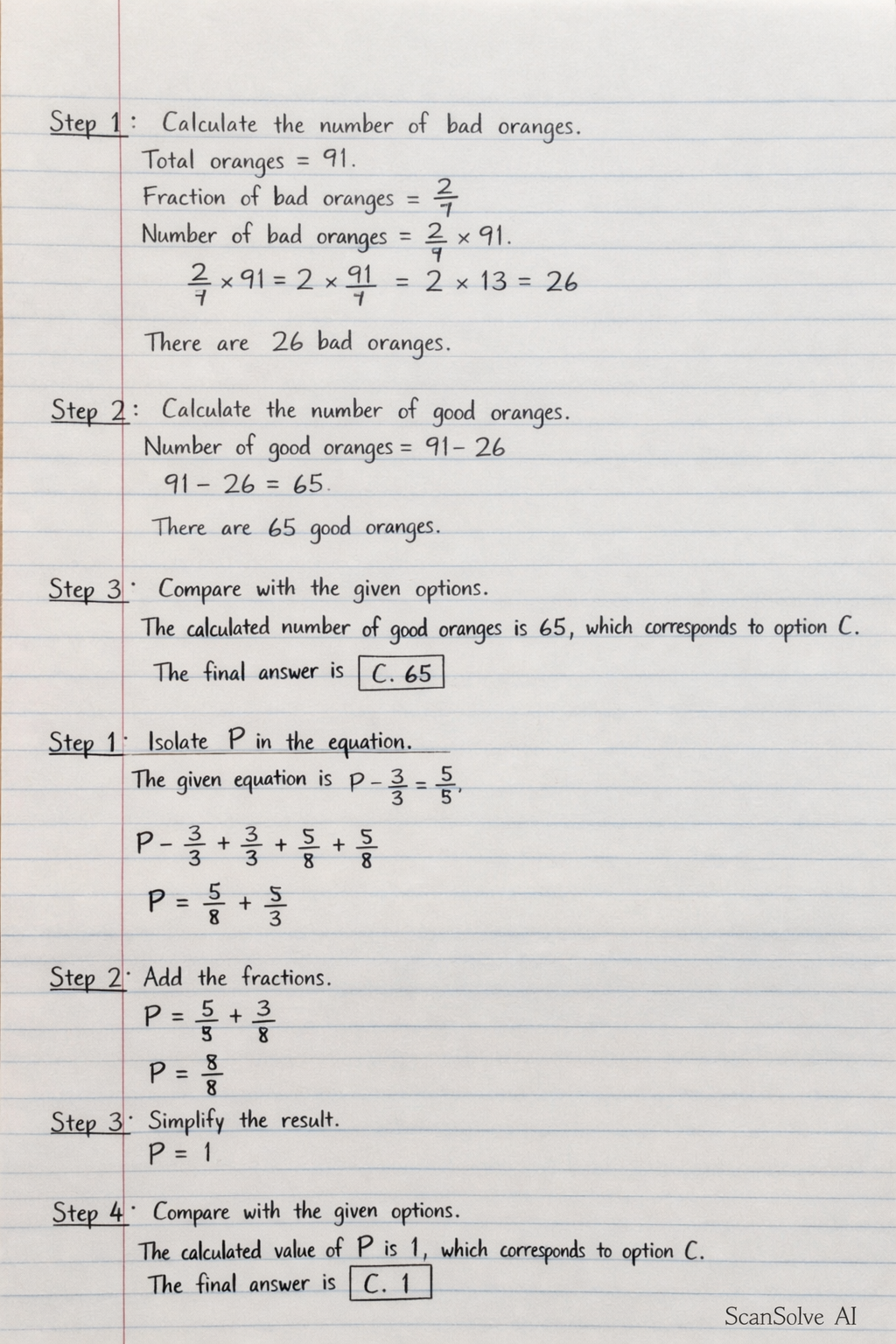
Handwritten Step-by-Step Solution
Get this as a handwritten image on WhatsApp — like a tutor wrote it for you.
Try on WhatsApp