

This mathematics problem involves applying core mathematical principles and formulas. Below you will find a complete step-by-step solution with detailed explanations for each step, helping you understand not just the answer but the method behind it.
ScanSolve AI Answer
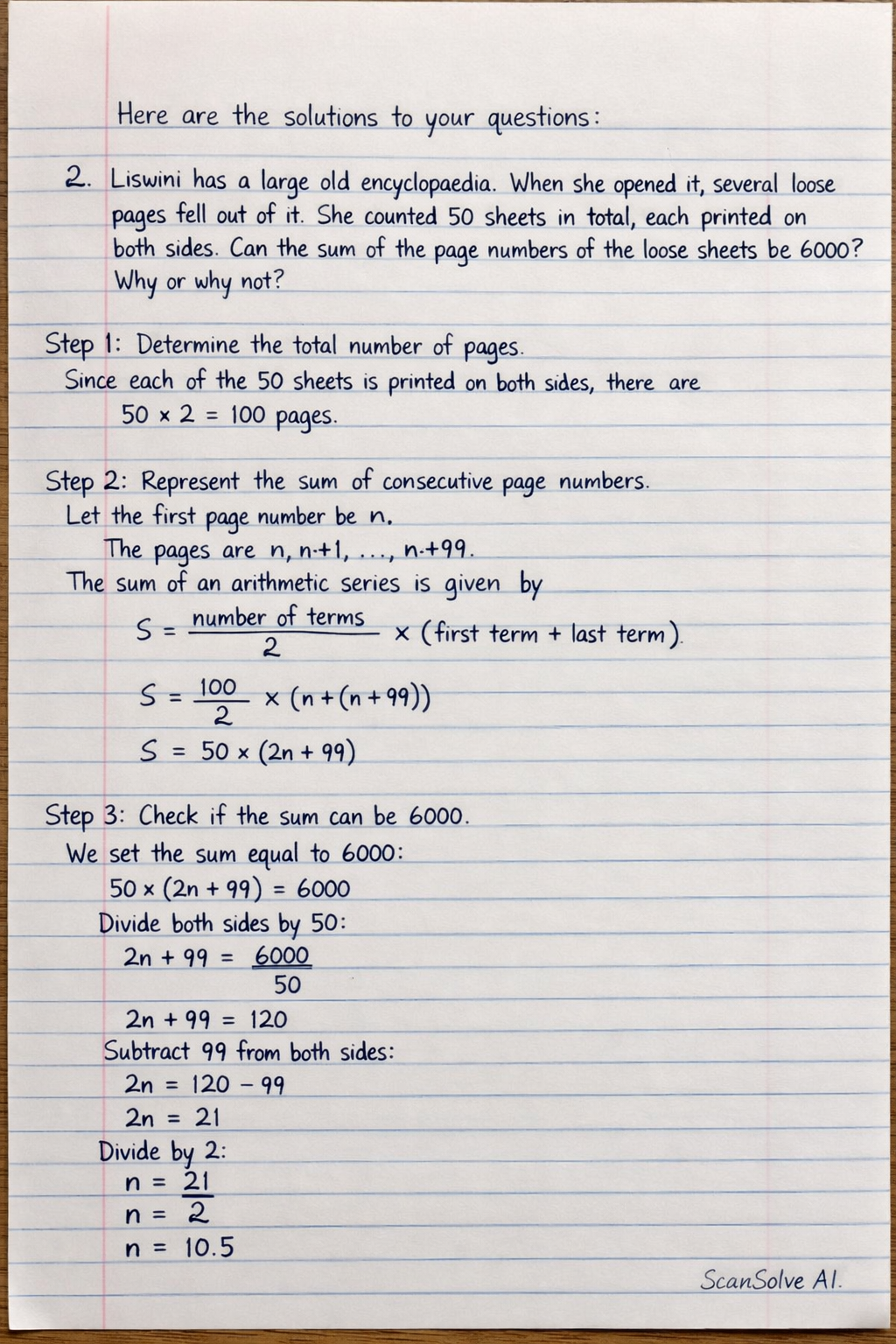
Here are the solutions to your questions: 2. Liswini has a large old encyclopaedia. When she opened it, several loose pages fell out of it. She counted 50 sheets in total, each printed on both sides. Can the sum of the page numbers of the loose sheets be 6000? Why or why not? Step 1: Determine the total number of pages. Since each of the 50 sheets is printed on both sides, there are 50 × 2 = 100 pages. Step 2: Represent the sum of consecutive page numbers. Let the first page number be n. The pages are n, n+1, , n+99. The sum of an arithmetic series is given by S = number of terms2 × (first term + last term). S = (100)/(2) × (n + (n+99)) = 50 × (2n + 99) Step 3: Check if the sum can be 6000. We set the sum equal to 6000: 50 × (2n + 99) = 6000 Divide both sides by 50: 2n + 99 = (6000)/(50) 2n + 99 = 120 Subtract 99 from both sides: 2n = 120 - 99 2n = 21 Divide by 2: n = (21)/(2) = 10.5 Step 4: Conclude based on the result. Since page numbers must be whole integers, n cannot be 10.5. Therefore, the sum of the page numbers of the loose sheets cannot be 6000. No, the sum cannot be 6000. Page numbers must be integers. 3. Here is a 2 x 3 grid. For each row and column, the parity of the sum is written in the circle, 'e' for even and 'o' for odd. Fill the 6 boxes with 3 odd numbers ('o') and 3 even numbers ('e') to satisfy the parity of the row and column sums. The grid has 2 rows and 3 columns. Row 1 sum parity: Even (e) Row 2 sum parity: Even (e) Column 1 sum parity: Even (e) Column 2 sum parity: Even (e) Column 3 sum parity: Odd (o) Step 1: Determine the parity of the total sum of all elements in the grid by summing the row parities. Total sum parity (from rows) = (Row 1 sum parity) + (Row 2 sum parity) = Even + Even = Even. Step 2: Determine the parity of the total sum of all elements in the grid by summing the column parities. Total sum parity (from columns) = (Col 1 sum parity) + (Col 2 sum parity) + (Col 3 sum parity) = Even + Even + Odd = Odd. Step 3: Compare the total sum parities. The total sum of all elements in the grid must have a consistent parity, regardless of whether it's calculated by summing rows or summing columns. However, we found that the total sum parity from rows is Even, and the total sum parity from columns is Odd. Since Even ≠ Odd, there is a contradiction. Step 4: Conclude that it is impossible to fill the grid under these conditions. It is impossible to fill the 6 boxes with 3 odd numbers and 3 even numbers to satisfy the given row and column sum parities because the sum of the row parities does not match the sum of the column parities. It is impossible to fill the grid as the sum of row parities (Even) does not match the sum of column parities (Odd). 4. Make a 3 x 3 magic square with 0 as the magic sum. All numbers can not be zero. Use negative numbers, as needed. Step 1: Understand the properties of a magic square. In a 3x3 magic square, the sum of numbers in each row, column, and main diagonal is the same (the magic sum). For a 3x3 square, the center element is equal to the magic sum divided by 3. Given magic sum = 0. So, the center element e = (0)/(3) = 0. Step 2: Set up the square with the center element. Let the square be: a & b & c \\ d & 0 & f \\ g & h & i Step 3: Use the magic sum property to find relationships between elements. Since the sum of each row, column, and diagonal is 0: • d + 0 + f = 0 f = -d • b + 0 + h = 0 h = -b • a + 0 + i = 0 i = -a • c + 0 + g = 0 g = -c Step 4: Substitute these relationships into the square. a & b & c \\ d & 0 & -d \\ -c & -b & -a Step 5: Use the remaining sum conditions to find values for a, b, c, d. We need a+b+c = 0 (Row 1 sum) and a+d-c = 0 (Column 1 sum). We need to choose values such that not all numbers are zero. Let's choose a=1. From a+d-c=0, we have 1+d-c=0 c = d+1. From a+b+c=0, we have 1+b+(d+1)=0 b+d+2=0 b = -d-2. Let's pick a value for d. Let d=2. Then c = 2+1 = 3. And b = -2-2 = -4. Step 6: Fill in all the elements of the magic square. a=1 b=-4 c=3 d=2 e=0 f=-d = -2 g=-c = -3 h=-b = 4 i=-a = -1 Step 7: Construct the final magic square. 1 & -4 & 3 \\ 2 & 0 & -2 \\ -3 & 4 & -1 5. Fill in the following blanks with 'odd' or 'even': a) Sum of an odd number of even numbers is An even number is always of the form 2k. The sum of any number of even numbers is always even. Example: 2+4+6 = 12 (Even). Even b) Sum of an even number of odd numbers is An odd number is always of the form 2k+1. The sum of two odd numbers is even (O+O=E). If there is an even number of odd numbers, they can be paired up, and each pair sums to an even number. The sum of even numbers is even. Example: 1+3+5+7 = 16 (Even). Even c) Sum of an even number of even numbers is The sum of any number of even numbers is always even. Example: 2+4 = 6 (Even). Even d) Sum of an odd number of odd numbers is The sum of two odd numbers is even (O+O=E). If there is an odd number of odd numbers, all but one can be paired up, resulting in a sum of even numbers plus one remaining odd number. An even number plus an odd number is odd (E+O=O). Example: 1+3+5 = 9 (Odd). Odd 6. What is the parity of the sum of the numbers from 1 to 100? Step 1: Use the formula for the sum of the first n natural numbers. The sum S of the first n natural numbers is given by S = (n(n+1))/(2). For n=100: S = (100(100+1))/(2) S = (100 × 101)/(2) Step 2: Calculate the sum. S = 50 × 101 S = 5050 Step 3: Determine the parity of the sum. The number 5050 is divisible by 2, so it is an even number. Alternatively, an even number (50) multiplied by an odd number (101) always results in an even number. Even 7. Two consecutive numbers in the Virahānka sequence are 987 and 1597. What are the next 2 numbers in the sequence? What are the previous 2 numbers in the sequence? The Virahānka sequence is another name for the Fibonacci sequence, where each number is the sum of the two preceding ones (F_n = F_n-1 + F_n-2). Step 1: Find the next 2 numbers. Given F_k = 987 and F_k+1 = 1597. The next number, F_k+2, is the sum of the two given numbers: F_k+2 = F_k+1 + F_k = 1597 + 987 = 2584 The number after that, F_k+3, is the sum of F_k+2 and F_k+1: F_k+3 = F_k+2 + F_k+1 = 2584 + 1597 = 4181 Step 2: Find the previous 2 numbers. To find the previous number, F_k-1, we subtract F_k from F_k+1: F_k-1 = F_k+1 - F_k = 1597 - 987 = 610 To find the number before that, F_k-2, we subtract F_k-1 from F_k: F_k-2 = F_k - F_k-1 = 987 - 610 = 377 Next 2 numbers: 2584, 4181 Previous 2 numbers: 610, 377 8. Angaan wants to climb an 8-step staircase. His playful rule is that he can take either 1 step or 2 steps at a time. For example, one of his paths is 1, 2, 2, 1, 2. In how many different ways can he reach the top? This is a classic problem that can be solved using the Fibonacci sequence. Let W(n) be the number of ways to climb n steps. • To reach step n, Angaan must have come from either step n-1 (by taking 1 step) or step n-2 (by taking 2 steps). • So, the number of ways to reach step n is W(n) = W(n-1) + W(n-2). Step 1: Establish base cases. • For 1 step: W(1) = 1 (path: 1) • For 2 steps: W(2) = 2 (paths: 1,1; 2) Step 2: Calculate the number of ways for each subsequent step up to 8. • W(3) = W(2) + W(1) = 2 + 1 = 3 • W(4) = W(3) + W(2) = 3 + 2 = 5 • W(5) = W(4) + W(3) = 5 + 3 = 8 • W(6) = W(5) + W(4) = 8 + 5 = 13 • W(7) = W(6) + W(5) = 13 + 8 = 21 • W(8) = W(7) + W(6) = 21 + 13 = 34 34 different ways 9. What is the parity of the 20th term of the Virahānka sequence? The Virahānka (Fibonacci) sequence starts with F_1=1, F_2=1. Let's list the terms and their parities: F_1 = 1 (Odd) F_2 = 1 (Odd) F_3 = F_1 + F_2 = 1+1 = 2 (Even) F_4 = F_2 + F_3 = 1+2 = 3 (Odd) F_5 = F_3 + F_4 = 2+3 = 5 (Odd) F_6 = F_4 + F_5 = 3+5 = 8 (Even) F_7 = F_5 + F_6 = 5+8 = 13 (Odd) F_8 = F_6 + F_7 = 8+13 = 21 (Odd) F_9 = F_7 + F_8 = 13+21 = 34 (Even) Step 1: Observe the pattern of parities. The pattern of parities is: Odd, Odd, Even, Odd, Odd, Even, ... This pattern repeats every 3 terms (O, O, E). Step 2: Determine the parity of the 20th term. To find the parity of the 20th term, we can find the remainder when 20 is divided by 3. 20 ÷ 3 = 6 with a remainder of 2. This means the 20th term will have the same parity as the 2nd term in the repeating pattern (O, O, E). The 2nd term in the pattern is Odd. Odd 10. Identify the statements that are true. a) The expression 4m - 1 always gives odd numbers. Step 1: Analyze the expression. 4m is always an even number (since 4 is even, 4 × any integer is even). Subtracting 1 from an even number (E - 1) always results in an odd number. Example: If m=1, 4(1)-1 = 3 (Odd). If m=2, 4(2)-1 = 7 (Odd). This statement is True. b) All even numbers can be expressed as 6j - 4. Step 1: Analyze the expression. 6j - 4 is always an even number (since 6j is even and 4 is even, E-E=E). Step 2: Check if all even numbers can be expressed this way. Let's test some even numbers. If j=1, 6(1)-4 = 2. If j=2, 6(2)-4 = 8. If j=0, 6(0)-4 = -4. If j=-1, 6(-1)-4 = -10. This expression generates even numbers, but not all of them. For example, 4 cannot be expressed as 6j-4 for any integer j (6j-4=4 6j=8 j=8/6, not an integer). This statement is False. c) Both expressions 2p + 1 and 2q - 1 describe all odd numbers. Step 1: Analyze the expressions. 2p+1 describes all odd numbers (where p is any integer). 2q-1 also describes all odd numbers (where q is any integer). Example: For p=0, 2(0)+1=1. For p=1, 2(1)+1=3. For p=-1, 2(-1)+1=-1. For q=1, 2(1)-1=1. For q=2, 2(2)-1=3. For q=0, 2(0)-1=-1. Both expressions correctly generate all odd numbers. This statement is True. d) The expression 2f + 3 gives both even and odd numbers. Step 1: Analyze the expression. 2f is always an even number (since 2 is even, 2 × any integer is even). Adding 3 (an odd number) to an even number (E+O) always results in an odd number. Example: If f=1, $2(1)+3 = ✂️ _That answer was long and got cut off. Reply continue and I'll finish it._