
This homework is Mark I want in maths not Hindi
ScanSolve AI Answer
Step-by-step solution
17 stepsHere are the solutions to your questions in English, with mathematical notation:
1. Using your understanding, find the parity of the following sums:
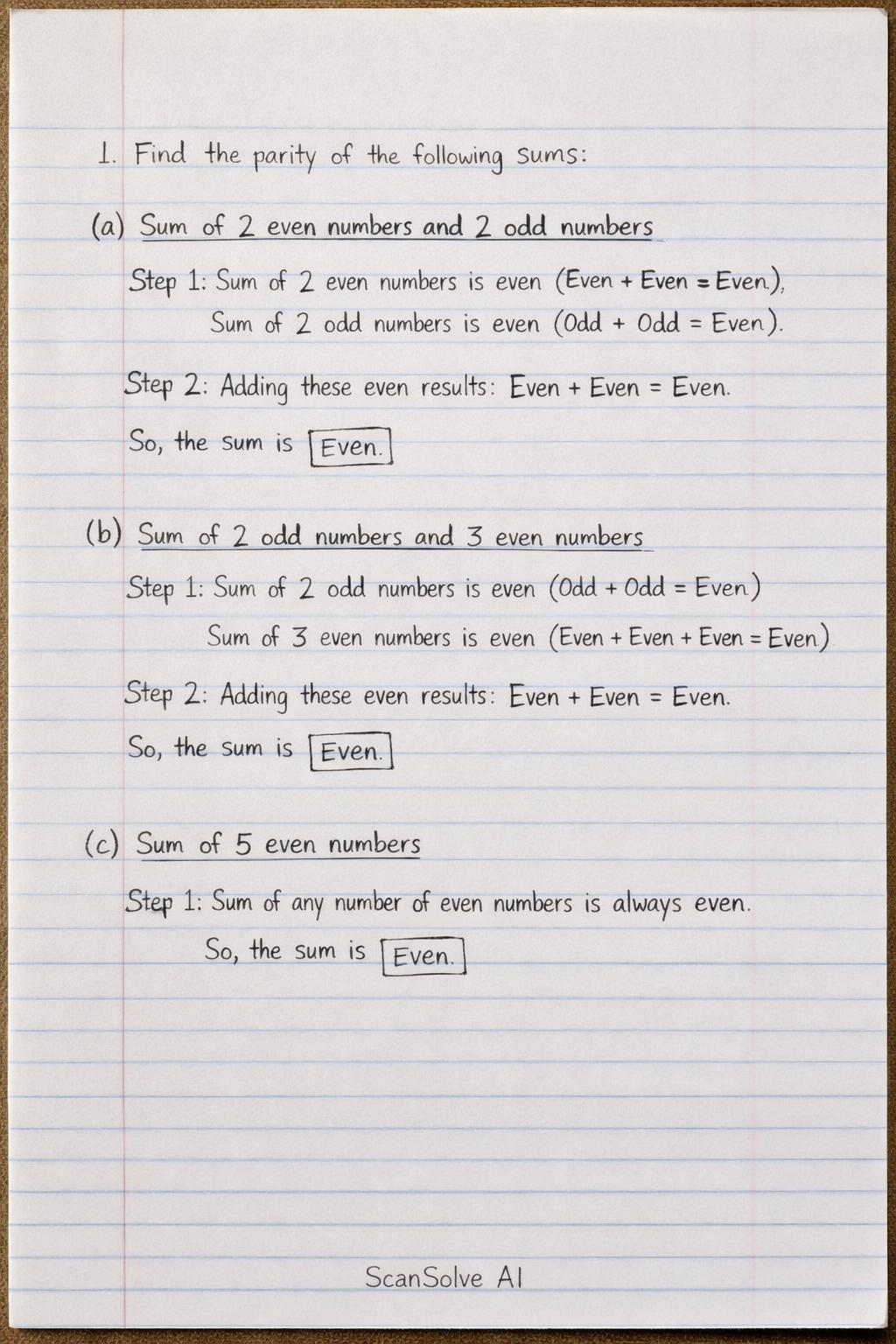
a) Sum of 2 even numbers and 2 odd numbers
The sum of two even numbers is even (Even + Even = Even).
The sum of two odd numbers is also even (Odd + Odd = Even).
When we add these two even results, we get an even number (Even + Even = Even).
Thus, the sum will be even.
b) Sum of 2 odd numbers and 3 even numbers
The sum of 2 odd numbers is even (Odd + Odd = Even).
The sum of 3 even numbers is also even (Even + Even + Even = Even).
When we add these two even results, we get an even number (Even + Even = Even).
Thus, the sum will be even.
c) Sum of 5 even numbers
The sum of any number of even numbers is always even.
Thus, the sum will be even.
d) Sum of 8 odd numbers
The sum of each pair of odd numbers is even (Odd + Odd = Even).
8 odd numbers form 4 pairs.
The sum of 4 even numbers is always even (Even + Even + Even + Even = Even).
Thus, the sum will be even.
2. Lakpa has an odd number of ₹1 coins, an odd number of ₹5 coins, and an even number of ₹10 coins. She calculated a total of ₹205. Did she make a mistake? If not, how many coins of each type could she have?
Determine the parity of the value from each type of coin
- The number of ₹1 coins is odd, so the total value from ₹1 coins () will be odd.
- The number of ₹5 coins is odd, so the total value from ₹5 coins () will be odd.
- The number of ₹10 coins is even, so the total value from ₹10 coins () will be even.
Determine the parity of the total amount
Total amount = (Value from ₹1 coins) + (Value from ₹5 coins) + (Value from ₹10 coins)
Parity of total amount = Odd + Odd + Even- Odd + Odd = Even
- Even + Even = Even Therefore, the total amount should be even.
Check Lakpa's calculation
Lakpa stated the total amount as ₹205, which is an odd number.
Since the total amount should be even, Lakpa made a mistake.3. We know that:
(a) Even + Even = Even
(b) Odd + Odd = Even
(c) Even + Odd = Odd
Similarly, find the parity for the following scenarios:
d) Even - Even
The difference between two even numbers is always even.
e) Odd - Odd
The difference between two odd numbers is always even.
f) Even - Odd
The difference between an even number and an odd number is always odd.
g) Odd - Even
The difference between an odd number and an even number is always odd.
Small squares in a grid
Given the dimensions of a grid, can you tell the parity of the number of small squares without calculating the product?Yes, we can tell the parity of the number of small squares without calculating the product.
The number of small squares in a grid is the product of its number of rows and number of columns.
The rules for the parity of a product are:
- Even Even = Even
- Even Odd = Even
- Odd Even = Even
- Odd Odd = Odd
If at least one dimension of the grid (rows or columns) is an even number, the total number of small squares will be even.
If both dimensions (rows and columns) are odd numbers, the total number of small squares will be odd.
Still stuck on this one?
Ask a follow-up, and the answer starts from this question.
More Mathematics Questions
Handwritten Step-by-Step Solution
Get this as a handwritten image on WhatsApp — like a tutor wrote it for you.
Try on WhatsApp