

This mathematics problem involves applying core mathematical principles and formulas. Below you will find a complete step-by-step solution with detailed explanations for each step, helping you understand not just the answer but the method behind it.
ScanSolve AI Answer
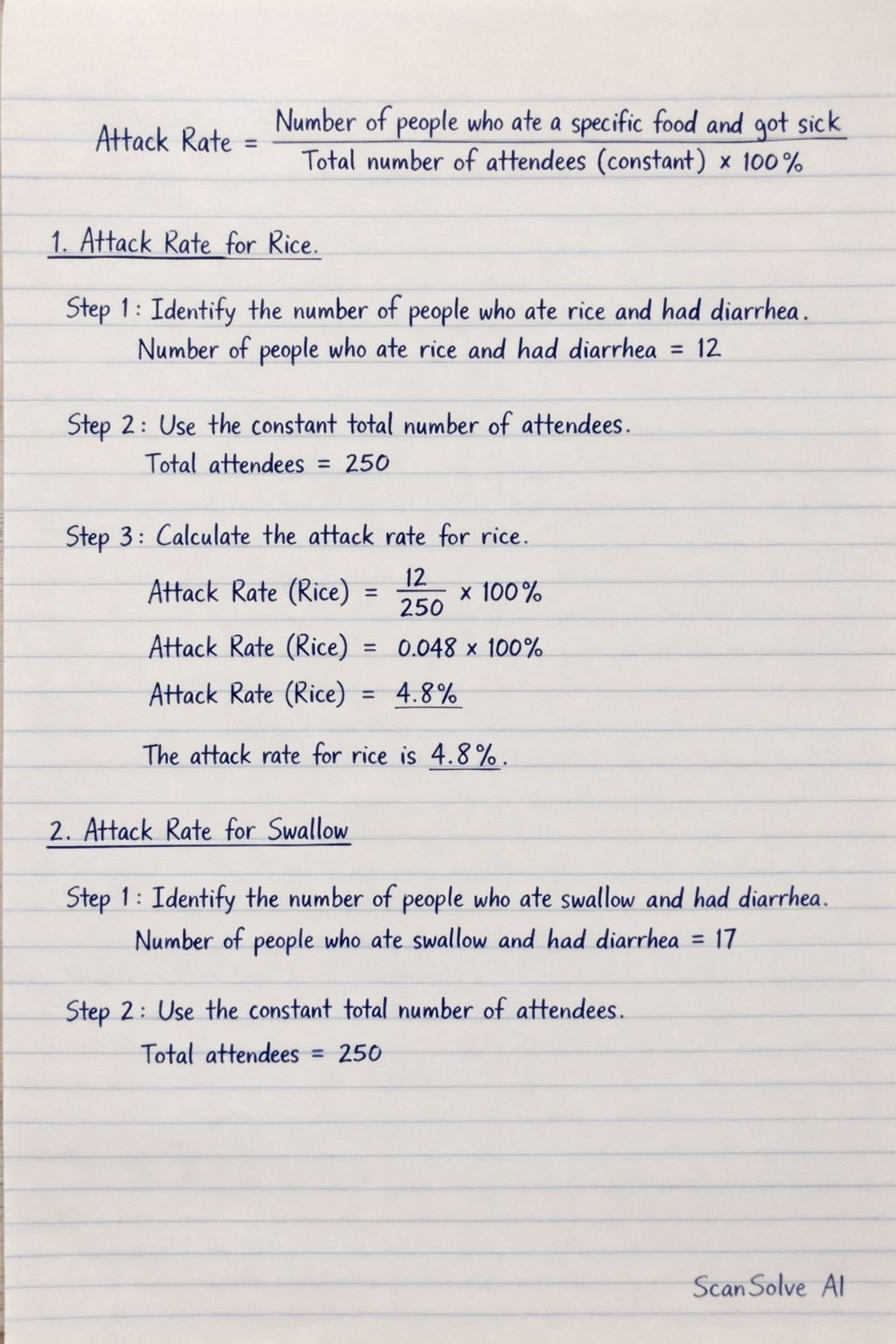
To calculate the attack rate for each food item using 250 as a constant denominator, we use the formula: Attack Rate = Number of people who ate a specific food and got sickTotal number of attendees (constant) × 100\% 1. Attack Rate for Rice Step 1: Identify the number of people who ate rice and had diarrhea. Number of people who ate rice and had diarrhea = 12 Step 2: Use the constant total number of attendees. Total attendees = 250 Step 3: Calculate the attack rate for rice. Attack Rate (Rice) = (12)/(250) × 100\% Attack Rate (Rice) = 0.048 × 100\% Attack Rate (Rice) = 4.8\% The attack rate for rice is 4.8\%. 2. Attack Rate for Swallow Step 1: Identify the number of people who ate swallow and had diarrhea. Number of people who ate swallow and had diarrhea = 17 Step 2: Use the constant total number of attendees. Total attendees = 250 Step 3: Calculate the attack rate for swallow. Attack Rate (Swallow) = (17)/(250) × 100\% Attack Rate (Swallow) = 0.068 × 100\% Attack Rate (Swallow) = 6.8\% The attack rate for swallow is 6.8\%. 3. Attack Rate for Beans Porridge Step 1: Identify the number of people who ate beans porridge and had diarrhea. Number of people who ate beans porridge and had diarrhea = 7 Step 2: Use the constant total number of attendees. Total attendees = 250 Step 3: Calculate the attack rate for beans porridge. Attack Rate (Beans Porridge) = (7)/(250) × 100\% Attack Rate (Beans Porridge) = 0.028 × 100\% Attack Rate (Beans Porridge) = 2.8\% The attack rate for beans porridge is 2.8\%. 3 done, 2 left today. You're making progress.