
We read your photo as:
Describe how to shade the region (A B ext') C in a Venn diagram.
ScanSolve AI Answer
Step-by-step solution
3 stepsTo shade the region , we break it down into steps:
Identify .
represents all the area outside of circle B.
Identify .
This is the union of circle A and all the area outside of circle B. Imagine shading the entire circle A, and then shading everything that is not in circle B. The combined shaded area is .
Identify .
This is the intersection of the region found in Step 2 with circle C. We are looking for the parts of circle C that are also within the region.
This means we shade the parts of C that are either in A, or outside B.Let's consider the regions within C:
- The part of C that is only in C (not in A or B): This region is outside B, so it is included.
- The part of C that overlaps with A but not B: This region is in A and outside B, so it is included.
- The part of C that overlaps with A and B (the center region): This region is in A, so it is included.
- The part of C that overlaps with B but not A: This region is not in A and is in B. Therefore, it is not included in , and thus not included in .
Therefore, the region to be shaded is all of circle C, except for the portion that is exclusively shared by C and B (i.e., the part of C that is in B but not in A).
Shaded Diagram Description:
On the provided Venn diagram, shade the following areas:- The portion of circle C that does not overlap with circle B.
- The portion where circle A and circle C overlap (this includes the central region where A, B, and C all overlap).
This means you will shade all of circle C, excluding the small segment of C that is inside B but outside A.
Still stuck on this one?
Ask a follow-up, and the answer starts from this question.
More Mathematics Questions
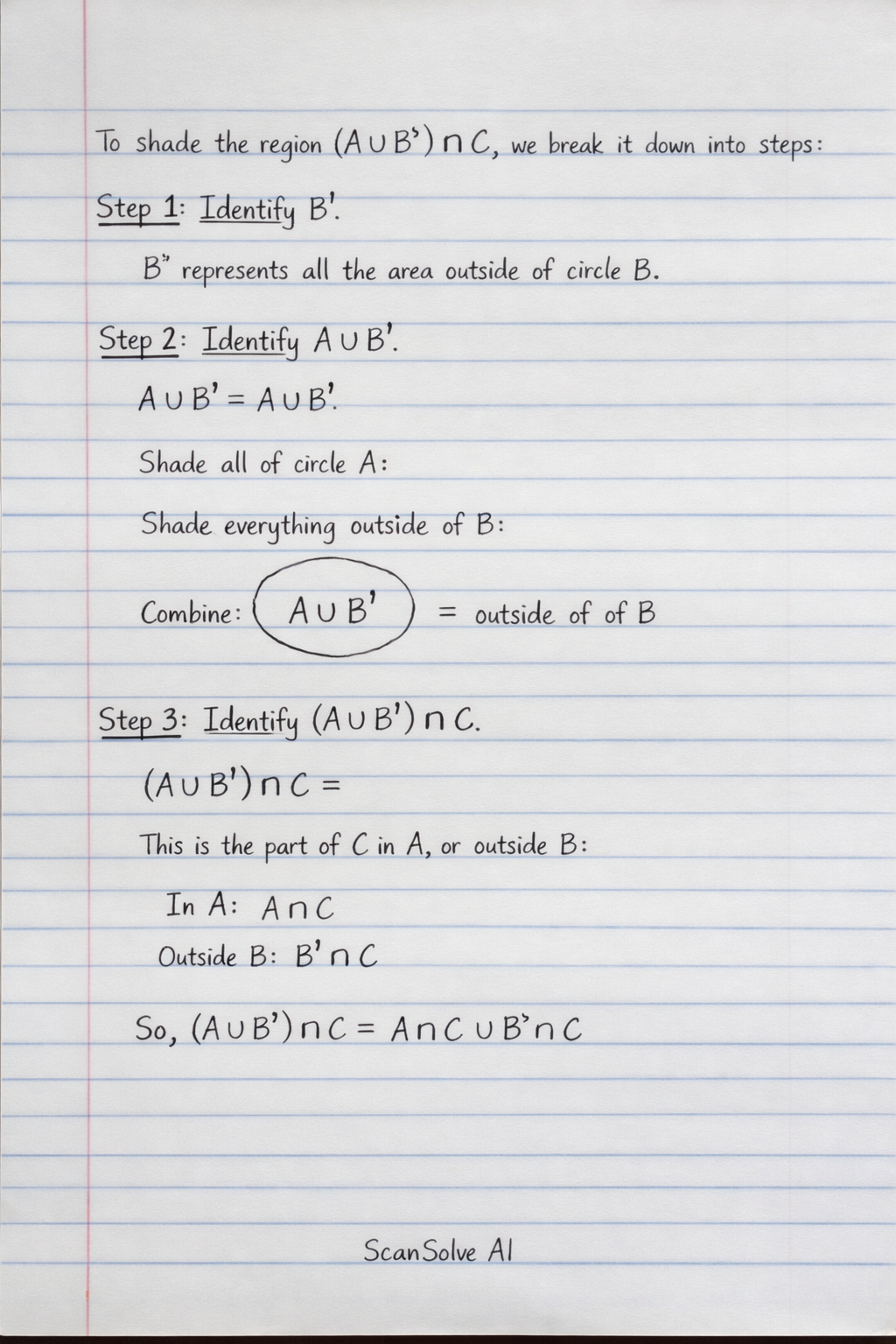
Handwritten Step-by-Step Solution
Get this as a handwritten image on WhatsApp — like a tutor wrote it for you.
Try on WhatsApp