A beam is supported at its ends and carries a point load of 10 kN at mid-span and a UDL of 18 kN/m over its full length. Calculate the position of the neutral axis, the moment of inertia about the xx-axis, and the moment of inertia about the yy-axis.

Physics
A beam is supported at its ends and carries a point load of 10 kN at mid-span and a UDL of 18 kN/m over its full length. Calculate the position of the neutral axis, the moment of inertia about the xx-axis, and the moment of inertia about the yy-axis.

ScanSolve AI Answer

Answer

the neutral axis (centroidal x-axis) is located at half the total

5.1.1 The position of a neutral axis from the bottom.

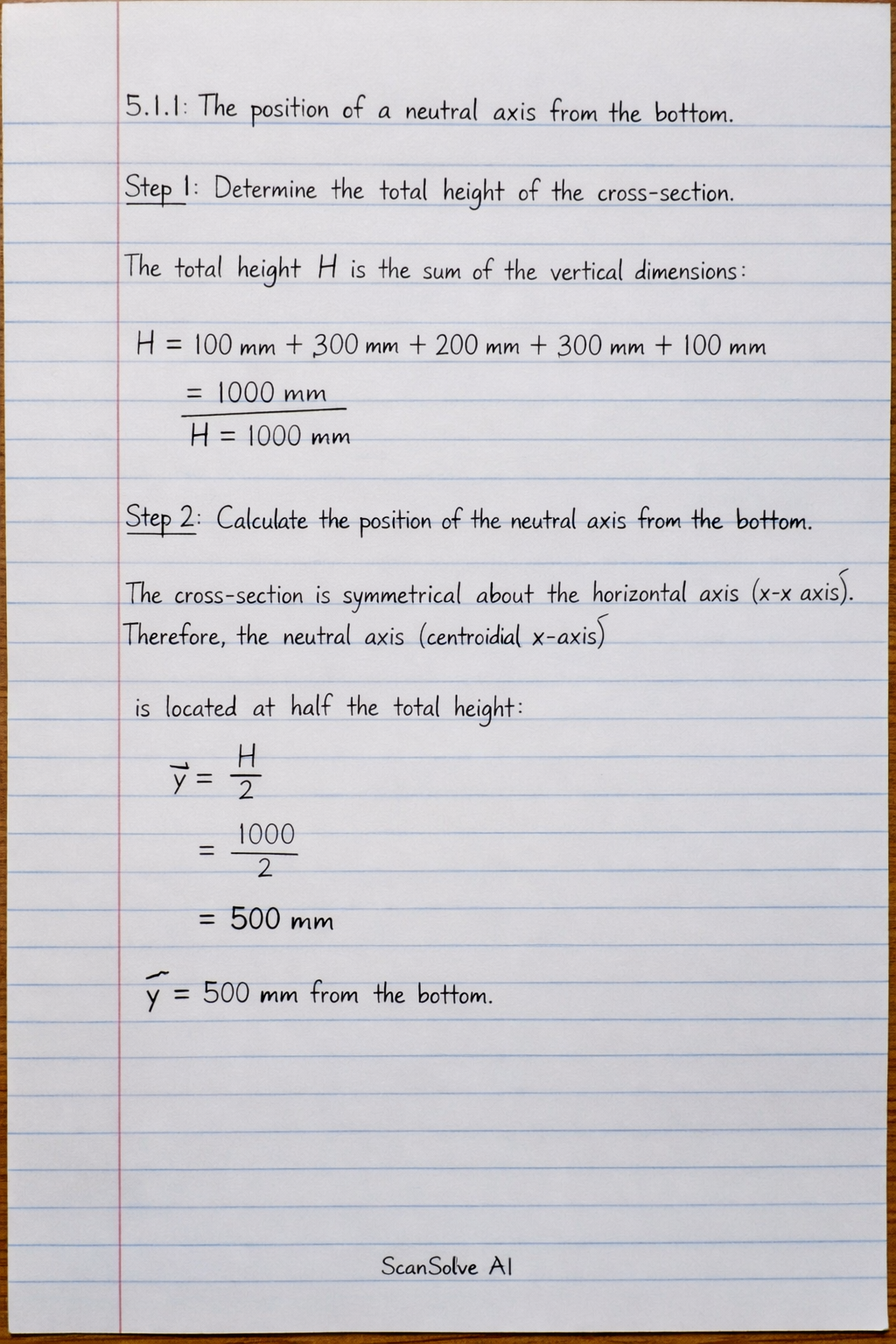
Step 1: Determine the total height of the cross-section. The total height HH is the sum of the vertical dimensions: H=100mm+300mm+200mm+300mm+100mm=1000mmH = 100 mm + 300 mm + 200 mm + 300 mm + 100 mm = 1000 mm

Step 2: Calculate the position of the neutral axis from the bottom. The cross-section is symmetrical about the horizontal axis (x-x axis). Therefore, the neutral axis (centroidal x-axis) is located at half the total

Was this helpful?

Need help with your own homework?

Get instant step-by-step solutions to any question. Free to start.

Ask Your Question
Handwritten step-by-step solution preview

Handwritten Step-by-Step Solution

Get this as a handwritten image on WhatsApp — like a tutor wrote it for you.

Try on WhatsApp

Still have questions?

Quick Answer

5.1.1 The position of a neutral axis from the bottom. Step 1: Determine the total height of the cross-section.

A beam is supported at its ends and carries a point load of 10 kN at mid-span and a UDL of 18 kN/m over its full length. Calculate the position of the neutral axis, the moment of inertia about the xx-axis, and the moment of inertia about the yy-axis.
Physics

This physics problem tests your understanding of fundamental physical laws and their applications. The step-by-step solution below breaks down the problem using relevant equations and physical reasoning.

ScanSolve AI Answer
5.1.1 The position of a neutral axis from the bottom. Step 1: Determine the total height of the cross-section. The total height H is the sum of the vertical dimensions: H = 100 mm + 300 mm + 200 mm + 300 mm + 100 mm = 1000 mm Step 2: Calculate the position of the neutral axis from the bottom. The cross-section is symmetrical about the horizontal axis (x-x axis). Therefore, the neutral axis (centroidal x-axis) is located at half the total