
We read your photo as:
Evaluate the truthfulness of the following set theory statements: 1. A - B ⊆ A 2. B - A ⊆ B 3. If A = B, then A + B = ∅ 4. A - B ≠ B - A
Mathematics
ScanSolve AI Answer
Step-by-step solution
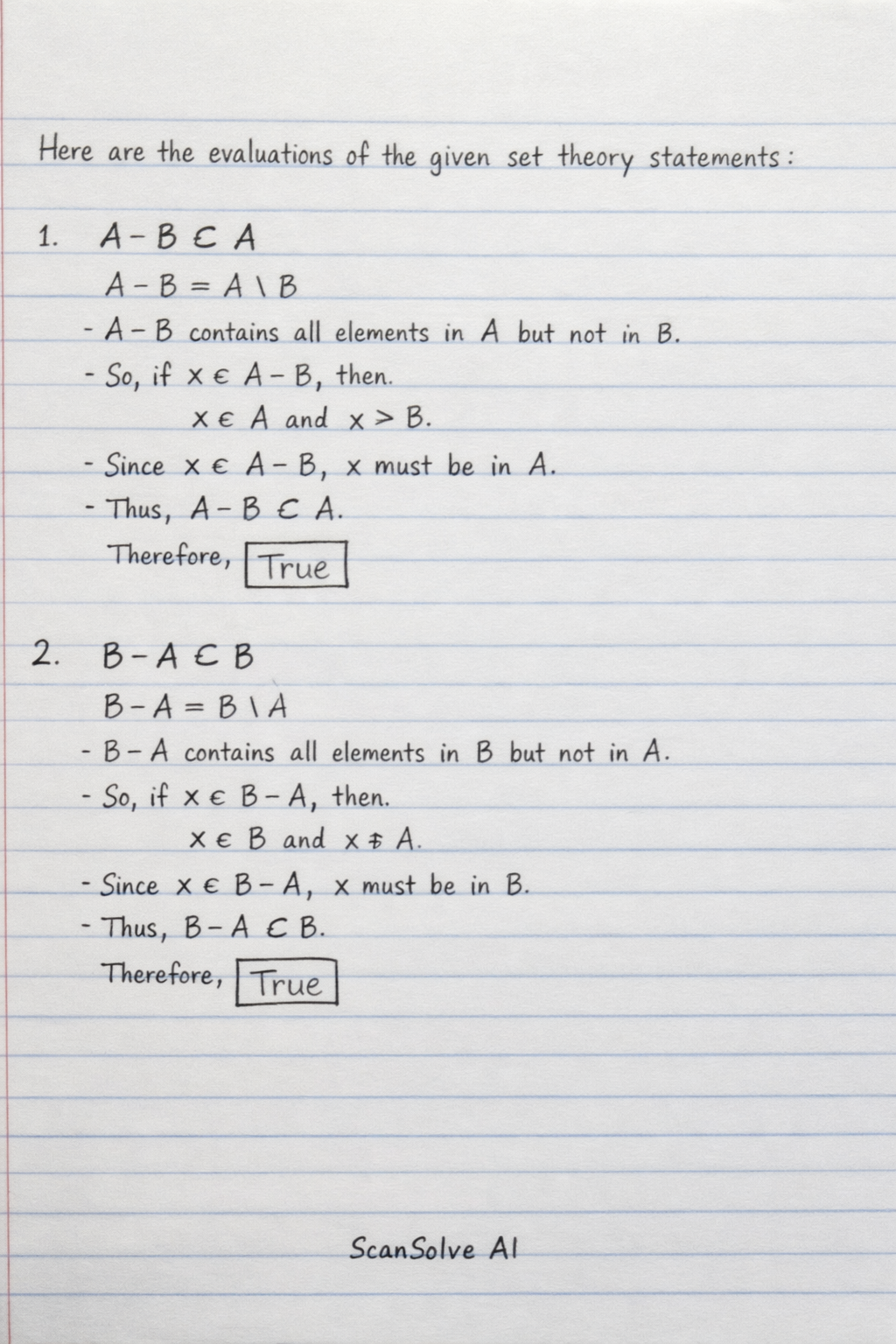
6 stepsHere are the evaluations of the given set theory statements:
Statement
- Explanation: The set (also written as ) contains all elements that are in set but not in set . By definition, every element in must be an element of . Therefore, is a subset of .
- Truth Value:
Statement
- Explanation: Similarly, the set contains all elements that are in set but not in set . Every element in must be an element of . Therefore, is a subset of .
- Truth Value:
Statement
If , then
- Explanation: Assuming denotes the symmetric difference . If , then (since all elements of are also in ) and (since all elements of are also in ). Therefore, .
- Truth Value:
Statement
- Explanation: This statement claims that is always not equal to . This is not universally true. For example, if and , then and . In this case, . Since we found a counterexample, the statement is false.
- Truth Value:
Statement
- Explanation: The set contains elements in but not in . The set contains elements in but not in the intersection of and . An element is in and not in if and only if is in and is not in . This is a fundamental identity in set theory.
- Truth Value:
Statement
- Explanation: This statement consists of two parts:
- : The set contains elements in that are not in the empty set
- Explanation: This statement consists of two parts:
Was this helpful?
Still stuck on this one?
Ask a follow-up, and the answer starts from this question.
Got a different question?Ask your own question
More Mathematics Questions
QIf A is a subset of B (A B), which of the following statements is false?QVerify whether each of the following statements is a tautology or contradiction: iv) (A B) ( A B) v)…QVerify whether the following statements are tautologies or contradictions and show the equivalence…QIf A, B, and C are any three sets, prove that: A ∩(B∪C) ⊆ (A∩B)∪(A∩C) A∪(B∩C) ⊆ (A∪B)∩(A∪C)QSolve the following short questions: a) Prove (A − B) (A B) = A using set identities. b) Given X =…
Browse by topic:Discrete Math
Handwritten Step-by-Step Solution
Get this as a handwritten image on WhatsApp — like a tutor wrote it for you.
Try on WhatsApp