
We read your photo as:
Two bags, A and B, contain red (R) and white (W) balls. Bag A has 4 R and 2 W. Bag B has 3 R and 3 W. A die roll determines which bag to use: score > 4 means Bag A, score <= 4 means Bag B. Two balls a
ScanSolve AI Answer
This answer stops before the end.
It was cut off when it was first written. Ask ScanSolve this question again for the full working.
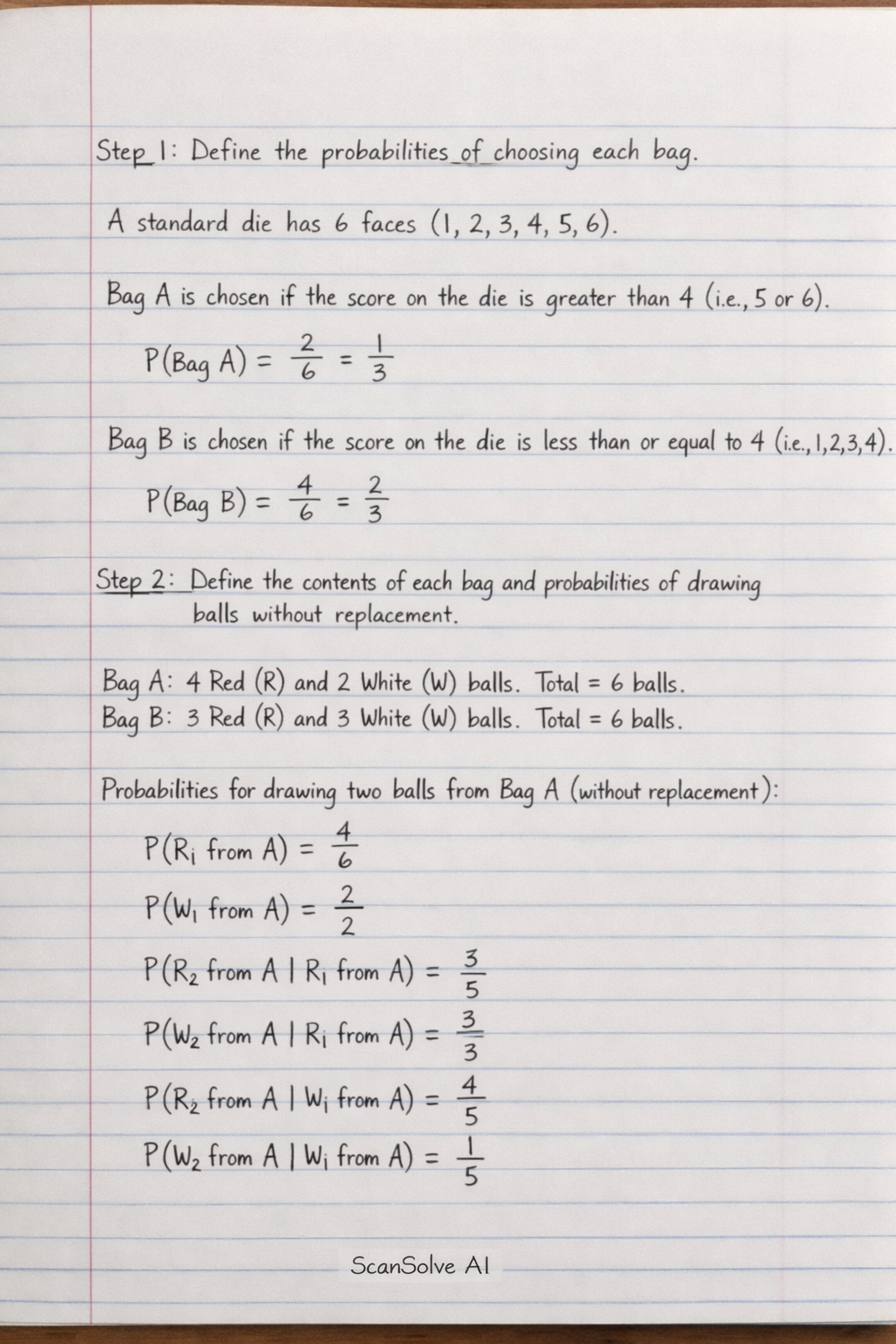
Step 1: Define the probabilities of choosing each bag.
A standard die has 6 faces (1, 2, 3, 4, 5, 6).
Bag A is chosen if the score on the die is greater than 4 (i.e., 5 or 6).
Bag B is chosen if the score on the die is less than or equal to 4 (i.e., 1, 2, 3, 4).
Step 2: Define the contents of each bag and probabilities of drawing balls without replacement.
Bag A contains 4 red (R) and 2 white (W) balls. Total = 6 balls.
Bag B contains 3 red (R) and 3 white (W) balls. Total = 6 balls.
Probabilities for drawing two balls from Bag A (without replacement):
Probabilities for drawing two balls from Bag B (without replacement):
a) Calculate the probability that one ball of each color is drawn.
This means drawing one red and one white ball (RW or WR).
Probability of drawing one of each color from Bag A:
Probability of choosing Bag A and drawing one of each color:
Probability of drawing one of each color from Bag B:
Probability of choosing Bag B and drawing one of each color:
Total probability of drawing one ball of each color:
Still stuck on this one?
Ask a follow-up, and the answer starts from this question.
More Mathematics Questions
Handwritten Step-by-Step Solution
Get this as a handwritten image on WhatsApp — like a tutor wrote it for you.
Try on WhatsApp