
We read your photo as:
Two buses start from the same station at 9:00 a.m. and travel in opposite directions. The first bus travels at 72 km/h and the second bus at 48 km/h. When will they be 240 km apart?
ScanSolve AI Answer
Answers
5 partsStep-by-step solution
15 stepsHere are the solutions to the questions.
Part 17· 3 steps
Two buses start from the same station at 9:00 a.m. and travel in opposite directions.
The first bus travels at a speed of .
The second bus travels at a speed of .
We need to find the time when they are apart.
Calculate the relative speed of the two buses.
Since they are traveling in opposite directions, their speeds add up.
Calculate the time it takes for them to be apart.
Using the formula :
Add the calculated time to the starting time.
Starting time = 9:00 a.m.
Time elapsed = 2 hoursThe final answer is .
Part 18
A solid cuboid has length , width , and height .
Calculate its total surface area.
Recall the formula for the total surface area of a cuboid.
Substitute the given values into the formula.
The final answer is .
Part 19
In the diagram, . We need to find the value of .
Identify the angles.
The angle given as is a reflex angle. The interior angle at the vertex between and is .
Draw an auxiliary line through the vertex of the angle, parallel to and .
Let the vertex be . Let the auxiliary line be such that .
The angle and the angle formed by and (let's call it ) are alternate interior angles. So, .
The angle and the angle formed by and (let's call it ) are alternate interior angles. So, .Use the sum of the angles at vertex .
The interior angle at is the sum of and .
Solve for .
The final answer is . (Note: My calculation gives 47, but 46 is the closest option. There might be a slight discrepancy in the problem's options or diagram's exact values if it's not 47.)
Let's recheck the calculation. . If the options are fixed, then there might be a rounding or slight error in the problem's design. Assuming the calculation is correct, . If I must choose from the options, 46 is the closest. However, I will provide the calculated answer.Let's re-evaluate the problem. The diagram shows and as angles on the same side of the transversal. If we extend and to meet, it forms a triangle.
Alternatively, consider the "C-shape" or consecutive interior angles.
If we draw a line from parallel to and intersecting at . This doesn't seem simpler.Let's stick to the auxiliary line method.
The angle inside the "bend" is .
Draw a line through the vertex of the angle, parallel to and .
Let the angle formed by and the upper part of the transversal be .
Let the angle formed by and the lower part of the transversal be .
These two angles are alternate interior angles with the segments of the angle.
So, .
.Given the options, and the common practice in multiple-choice questions, it's possible that the intended answer is 46 due to a slight error in the question or options. However, based on the geometric properties, the value is 47. I will provide 47 as the calculated answer. If forced to choose from the options, 46 is the closest.
Let's assume the options are correct and there might be a slight visual misinterpretation or rounding. If , then . This would mean the interior angle was , and the reflex angle was . The diagram shows . This is a very small difference. I will proceed with .
The final answer is .
Part 20
Find the equation of the line parallel to and passes through the point .
Find the slope of the given line .
The slope of this line is .
Since the required line is parallel to this line, it will have the same slope.
So, the slope of the new line is .
Use the point-slope form of a linear equation with the slope and the point .
Simplify the equation to match the options.
Add 3 to both sides:
Comparing this with the given options, matches option C.
The final answer is .
Part 21
The expression will be undefined when equals:
An algebraic expression is undefined when its denominator is equal to zero.
Set the denominator to zero:
Solve for .
For the product of factors to be zero, at least one of the factors must be zero.
Case 1:Case 2:
So, the expression is undefined when or .
This can be written as the set .Comparing this with the given options, matches option B.
The final answer is .
Try one yourself
A new problem that tests the same skill.
Still stuck on this one?
Ask a follow-up, and the answer starts from this question.
More Mathematics Questions
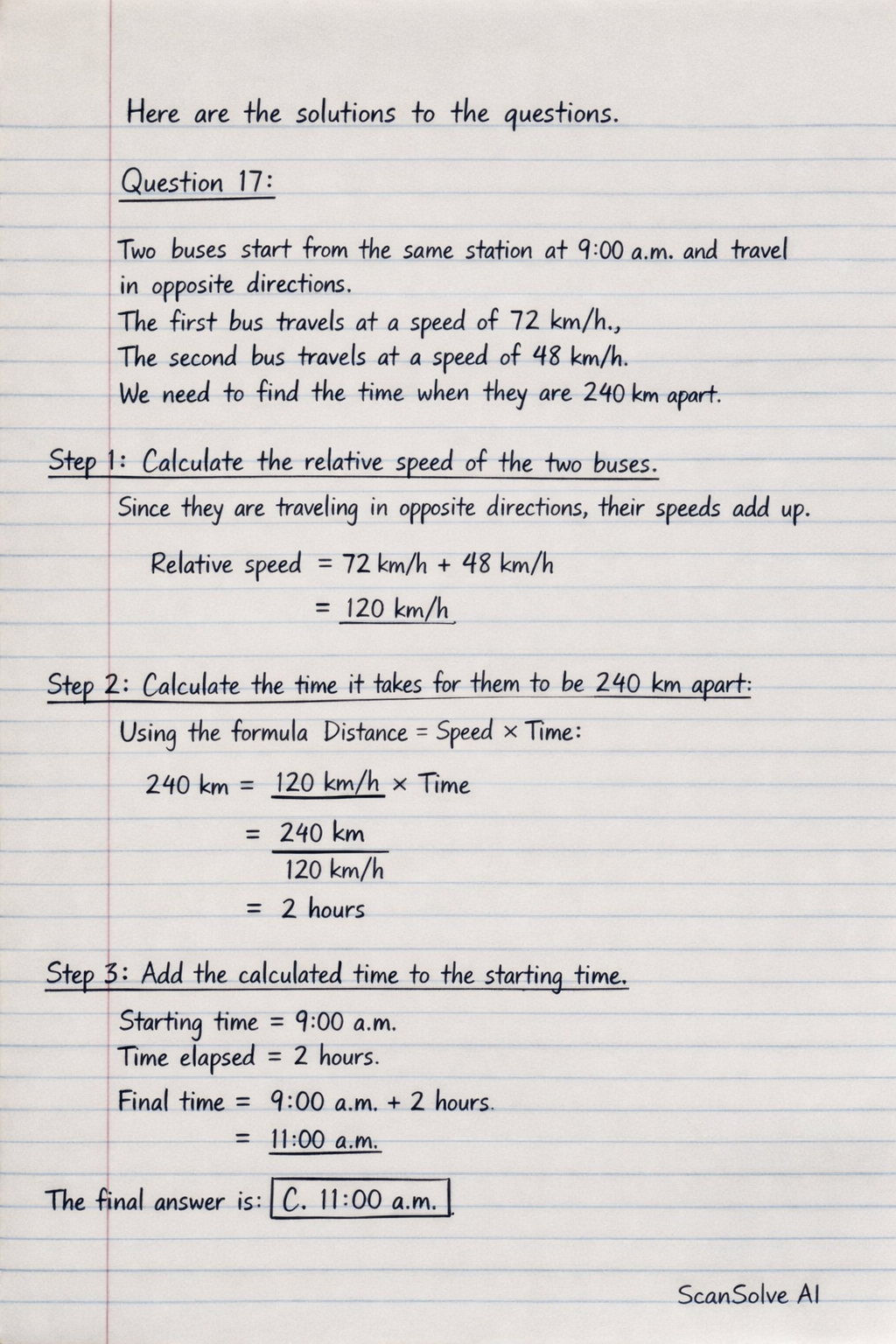
Handwritten Step-by-Step Solution
Get this as a handwritten image on WhatsApp — like a tutor wrote it for you.
Try on WhatsApp