
We read your photo as:
Two dice are rolled. List all possible Sample spaces. Taka adding of each possiblities which are get the highest odd?
ScanSolve AI Answer
Step-by-step solution
6 stepsHere are the solutions to your questions:
1) Two dice are rolled. List all possible sample spaces. When adding up each possibility, which one got the highest total?
List all possible sample spaces when two dice are rolled.
Each die has 6 faces (1, 2, 3, 4, 5, 6). When two dice are rolled, the sample space consists of all ordered pairs , where is the result of the first die and is the result of the second die.
There are possible outcomes in the sample space.
Determine which possibility got the highest total when adding up each possibility.
The total for each possibility is the sum of the numbers on the two dice ().
The minimum sum is .
The maximum sum is .
The possibility that yields the highest total is when both dice show the highest possible number.
The highest total is obtained from the outcome , which sums to .The possibility with the highest total is .
2) If three dice are tossed, what is the probability of obtaining an even number on all three?
Determine the total number of possible outcomes.
Each die has 6 possible outcomes (1, 2, 3, 4, 5, 6).
For three dice, the total number of possible outcomes is .Determine the number of favorable outcomes (even number on all three dice).
For a single die, the even numbers are {2, 4, 6}. There are 3 even outcomes.
For three dice to show an even number on all three, each die must land on an even number.Calculate the probability.
The probability of an event is given by the ratio of favorable outcomes to the total number of possible outcomes.
Simplify the probability.
The probability of obtaining an even number on all three dice is .
Still stuck on this one?
Ask a follow-up, and the answer starts from this question.
More Mathematics Questions
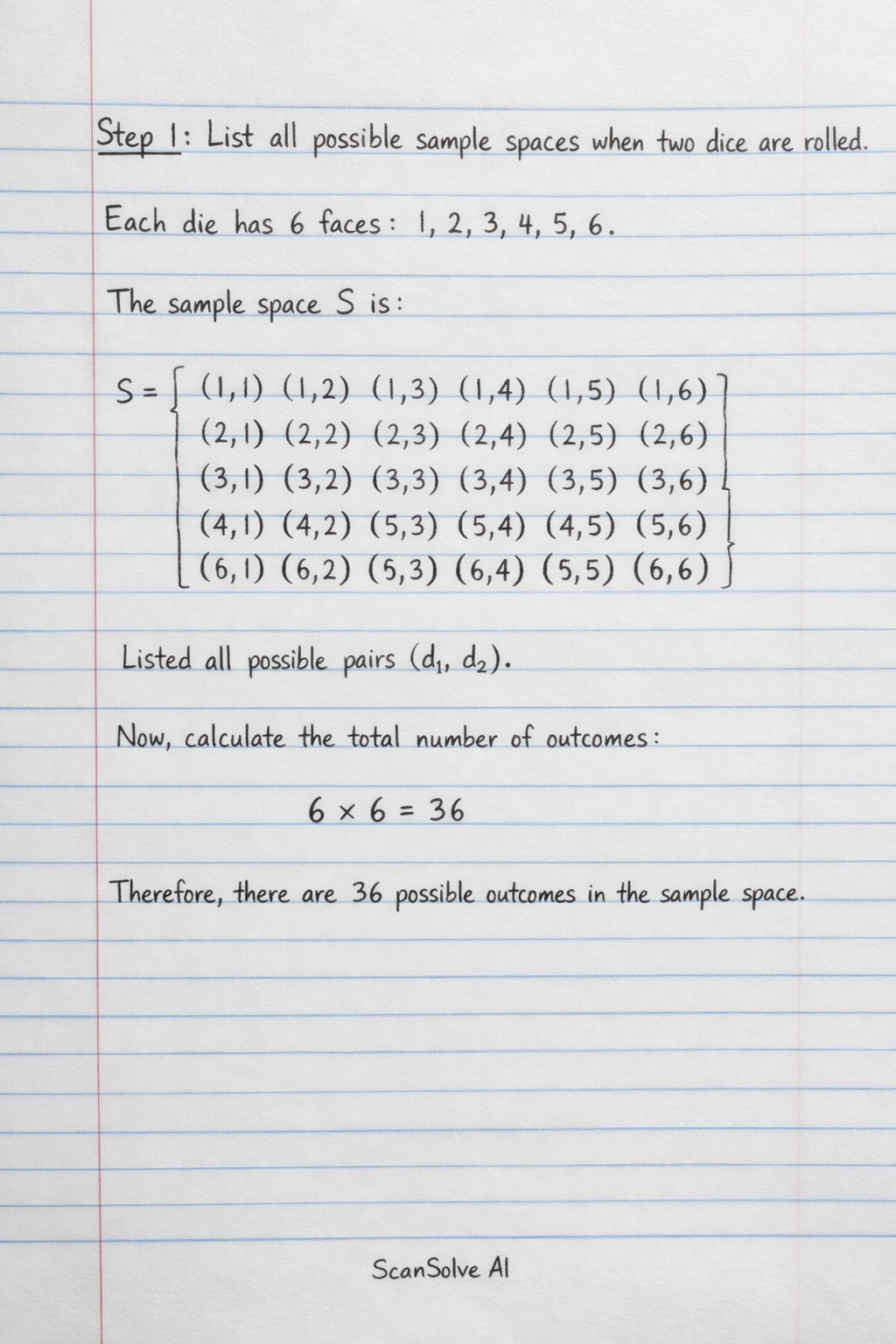
Handwritten Step-by-Step Solution
Get this as a handwritten image on WhatsApp — like a tutor wrote it for you.
Try on WhatsApp