

This mathematics problem involves applying core mathematical principles and formulas. Below you will find a complete step-by-step solution with detailed explanations for each step, helping you understand not just the answer but the method behind it.
ScanSolve AI Answer
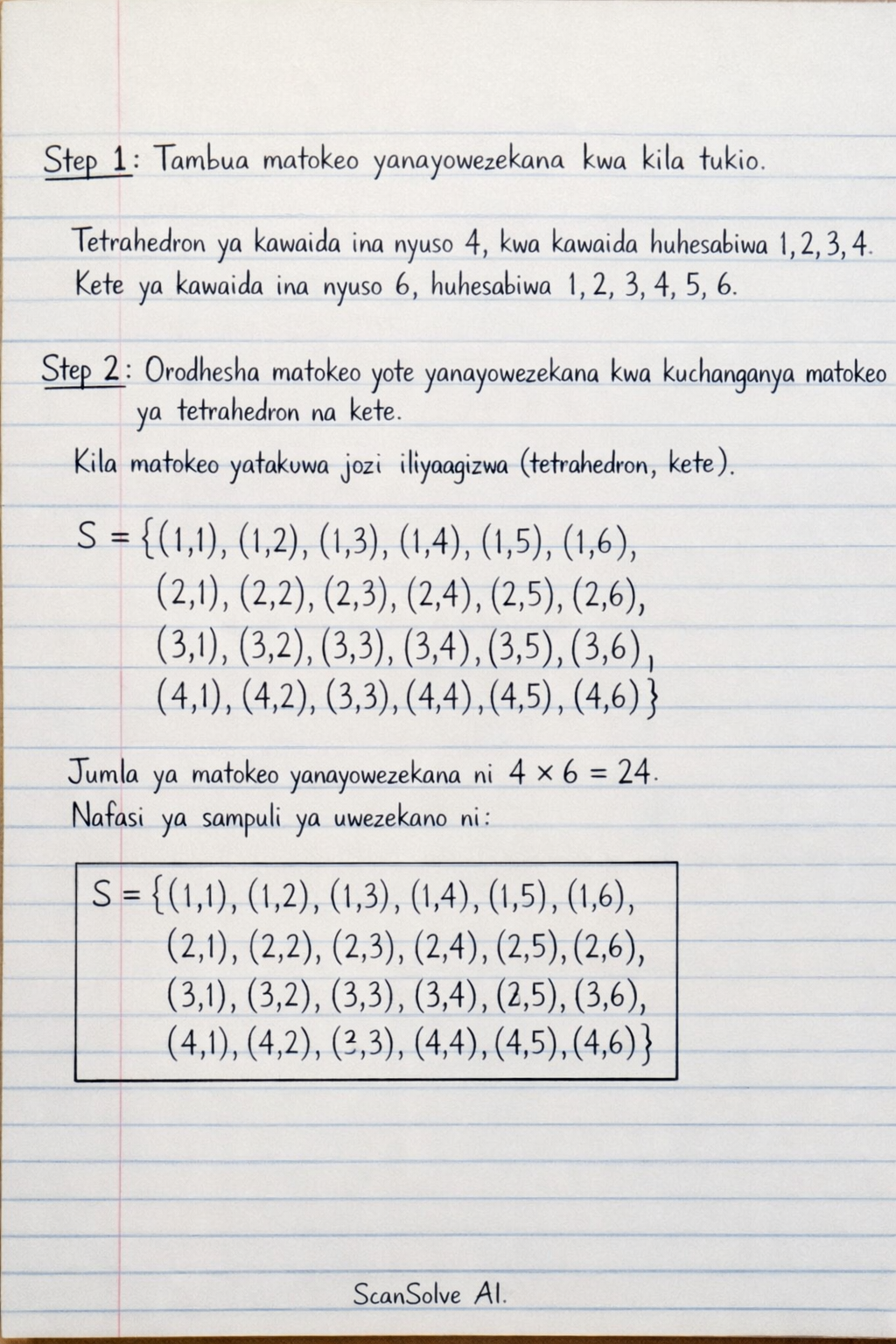
Step 1: Tambua matokeo yanayowezekana kwa kila tukio. Tetrahedron ya kawaida ina nyuso 4, kwa kawaida huhesabiwa 1, 2, 3, 4. Kete ya kawaida ina nyuso 6, huhesabiwa 1, 2, 3, 4, 5, 6. Step 2: Orodhesha matokeo yote yanayowezekana kwa kuchanganya matokeo ya tetrahedron na kete. Kila matokeo yatakuwa jozi iliyoagizwa (tetrahedron, kete). S = \(1,1), (1,2), (1,3), (1,4), (1,5), (1,6), \\ (2,1), (2,2), (2,3), (2,4), (2,5), (2,6), \\ (3,1), (3,2), (3,3), (3,4), (3,5), (3,6), \\ (4,1), (4,2), (4,3), (4,4), (4,5), (4,6)\ Jumla ya matokeo yanayowezekana ni 4 × 6 = 24. Nafasi ya sampuli ya uwezekano ni: S = \(1,1), (1,2), (1,3), (1,4), (1,5), (1,6), (2,1), (2,2), (2,3), (2,4), (2,5), (2,6), (3,1), (3,2), (3,3), (3,4), (3,5), (3,6), (4,1), (4,2), (4,3), (4,4), (4,5), (4,6)\ Tuma swali linalofuata 📸