
We read your photo as:
Two patients are randomly selected. The probability that a patient tests positive for malaria is 0.6. What is the probability that exactly one of the patients tests negative?
ScanSolve AI Answer
Answers
2 partsStep-by-step solution
5 stepsLet be the event that a patient tests positive for malaria, and be the event that a patient tests negative for malaria.
From the problem, we are given:
This can be written as a fraction:
The probability that a patient tests negative is:
As a fraction:
Part a· 3 steps
The probability that one patient tested negative while the other tested positive.
This means one patient is positive and the other is negative. Since the order is not specified, there are two possibilities: (Patient 1 positive AND Patient 2 negative) OR (Patient 1 negative AND Patient 2 positive). Since the selections are random, the events are independent.
Identify the probabilities for positive and negative tests.
Calculate the probability for each specific order.
The probability of Patient 1 positive and Patient 2 negative is .
The probability of Patient 1 negative and Patient 2 positive is .Sum the probabilities for the two possible orders.
Part b0.16
The probability that both patients tested negative.
This means Patient 1 tested negative AND Patient 2 tested negative. Since the selections are random, the events are independent.
Identify the probability for a negative test.
Calculate the probability that both patients test negative.
Still stuck on this one?
Ask a follow-up, and the answer starts from this question.
More Mathematics Questions
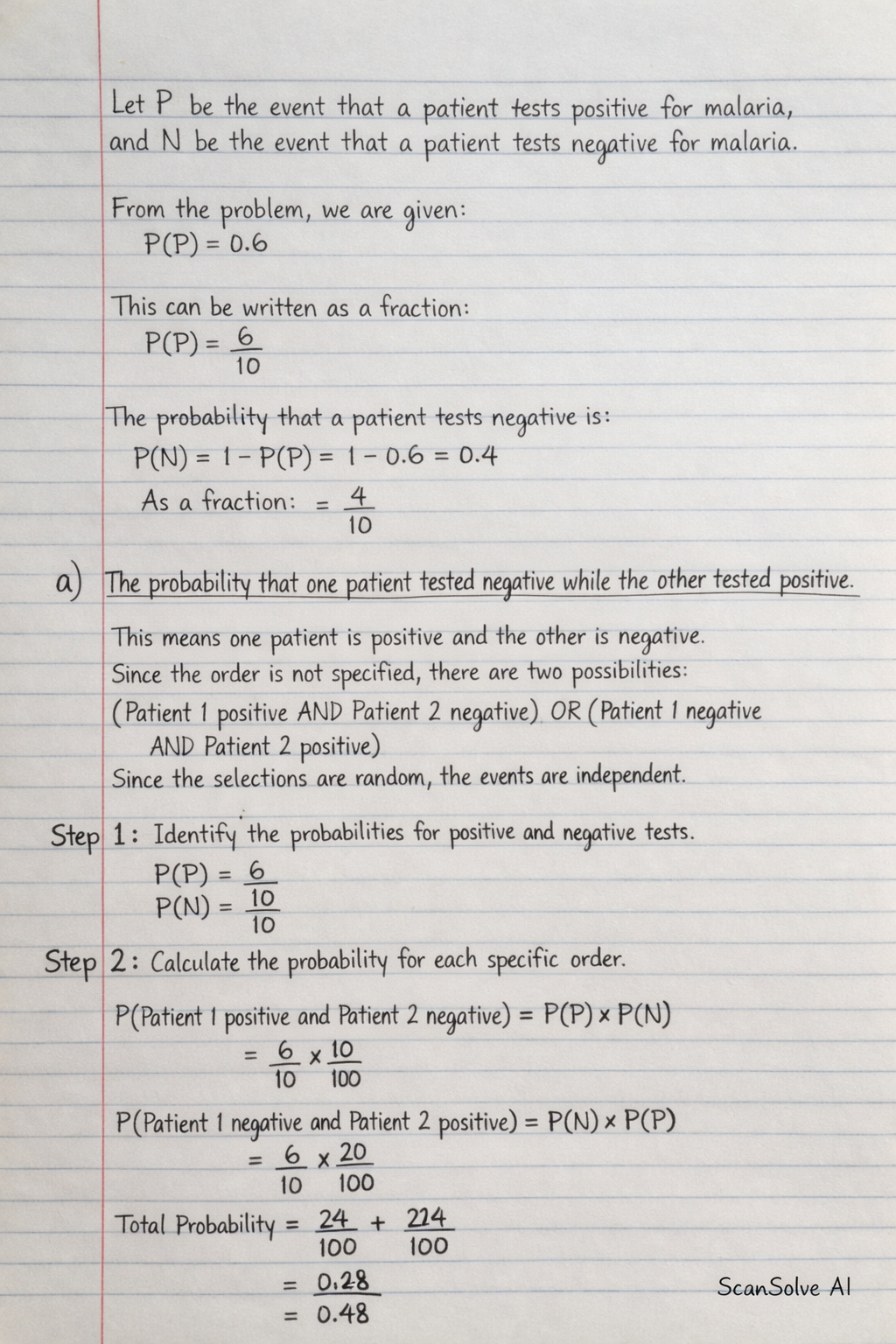
Handwritten Step-by-Step Solution
Get this as a handwritten image on WhatsApp — like a tutor wrote it for you.
Try on WhatsApp