

This mathematics problem involves applying core mathematical principles and formulas. Below you will find a complete step-by-step solution with detailed explanations for each step, helping you understand not just the answer but the method behind it.
ScanSolve AI Answer
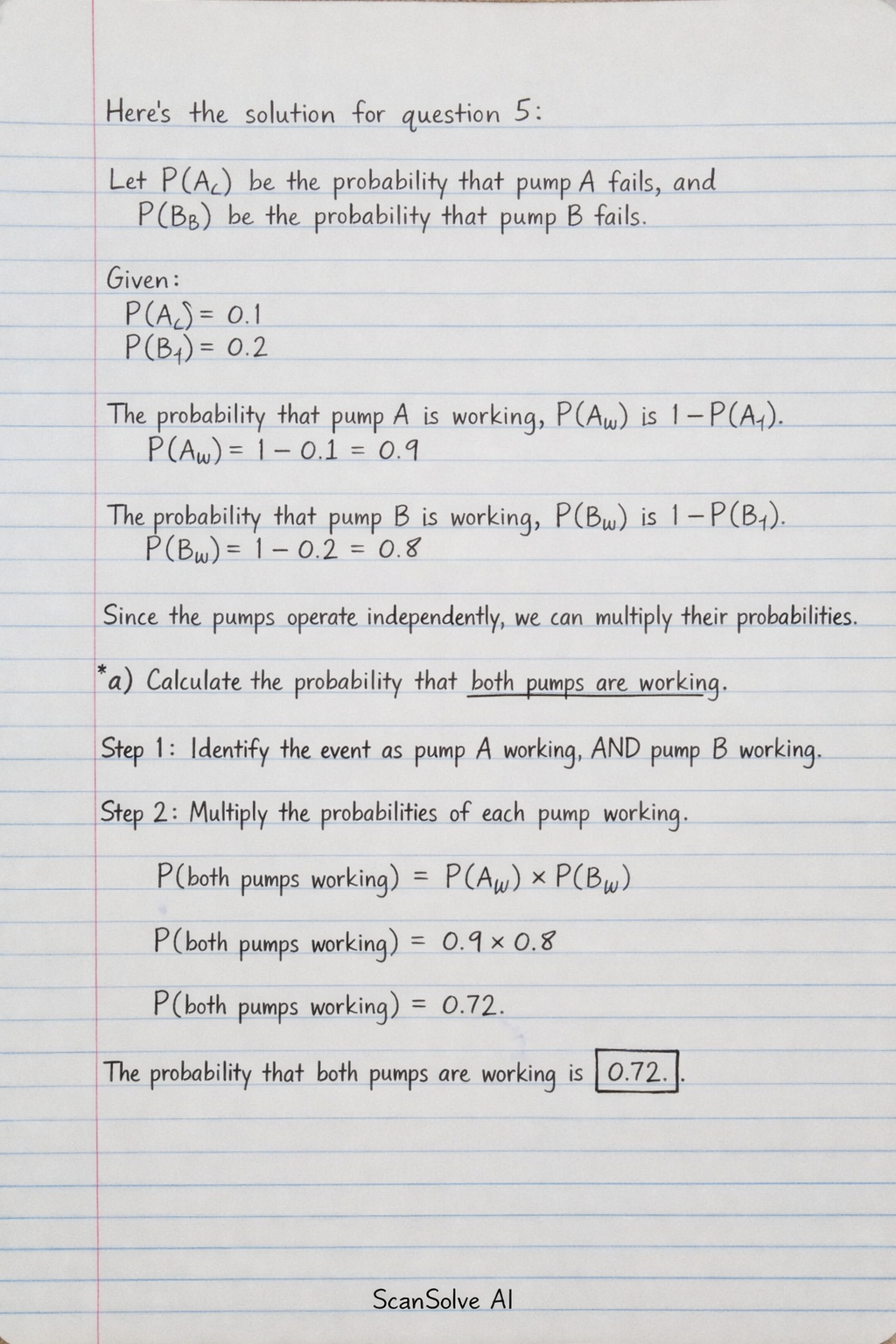
You're on a roll — Here's the solution for question 5: Let P(A_f) be the probability that pump A fails, and P(B_f) be the probability that pump B fails. Given: P(A_f) = 0.1 P(B_f) = 0.2 The probability that pump A is working, P(A_w), is 1 - P(A_f). P(A_w) = 1 - 0.1 = 0.9 The probability that pump B is working, P(B_w), is 1 - P(B_f). P(B_w) = 1 - 0.2 = 0.8 Since the pumps operate independently, we can multiply their probabilities. a) Calculate the probability that both pumps are working. Step 1: Identify the event as pump A working AND pump B working. Step 2: Multiply the probabilities of each pump working. P(both pumps working) = P(A_w) × P(B_w) P(both pumps working) = 0.9 × 0.8 P(both pumps working) = 0.72 The probability that both pumps are working is 0.72. b) Calculate the probability that there is no water in the town. Step 1: No water in the town means both pumps A and B have failed. Step 2: Multiply the probabilities of each pump failing. P(no water) = P(A_f) × P(B_f) P(no water) = 0.1 × 0.2 P(no water) = 0.02 The probability that there is no water in the town is 0.02. c) Calculate the probability that only one pump is working. Step 1: This can happen in two mutually exclusive ways: • Pump A is working AND pump B is failing. • Pump A is failing AND pump B is working. Step 2: Calculate the probability for each case. • P(A_w and B_f) = P(A_w) × P(B_f) = 0.9 × 0.2 = 0.18 • P(A_f and B_w) = P(A_f) × P(B_w) = 0.1 × 0.8 = 0.08 Step 3: Add the probabilities of these two cases. P(only one pump working) = P(A_w and B_f) + P(A_f and B_w) P(only one pump working) = 0.18 + 0.08 P(only one pump working) = 0.26 The probability that only one pump is working is 0.26. d) Calculate the probability that there is some water in the town. Step 1: "Some water in the town" means at least one pump is working. This is the complement of "no water in the town". Step 2: Use the complement rule: P(some water) = 1 - P(no water). P(some water) = 1 - P(A_f and B_f) P(some water) = 1 - 0.02 P(some water) = 0.98 Alternatively, we can sum the probabilities of the cases where at least one pump is working: P(some water) = P(both working) + P(only A working) + P(only B working) P(some water) = P(both working) + P(A_w and B_f) + P(A_f and B_w) P(some water) = 0.72 + 0.18 + 0.08 P(some water) = 0.98 The probability that there is some water in the town is 0.98. Got more? Send 'em!