We read your photo as:

Two triangles are similar with sides in the ratio 4:9. If the area of the smaller triangle is 64 ext cm2, find the area of the larger triangle. Define the term circle and state the relationship betwee

Mathematics

ScanSolve AI Answer

Answers

3 parts
a

154 cm2\text{154 cm}^2

b

113.14 cm2\text{113.14 cm}^2

c

78.57 cm2\text{78.57 cm}^2

454.55 revolutions\text{454.55 revolutions}

Step-by-step solution

12 steps

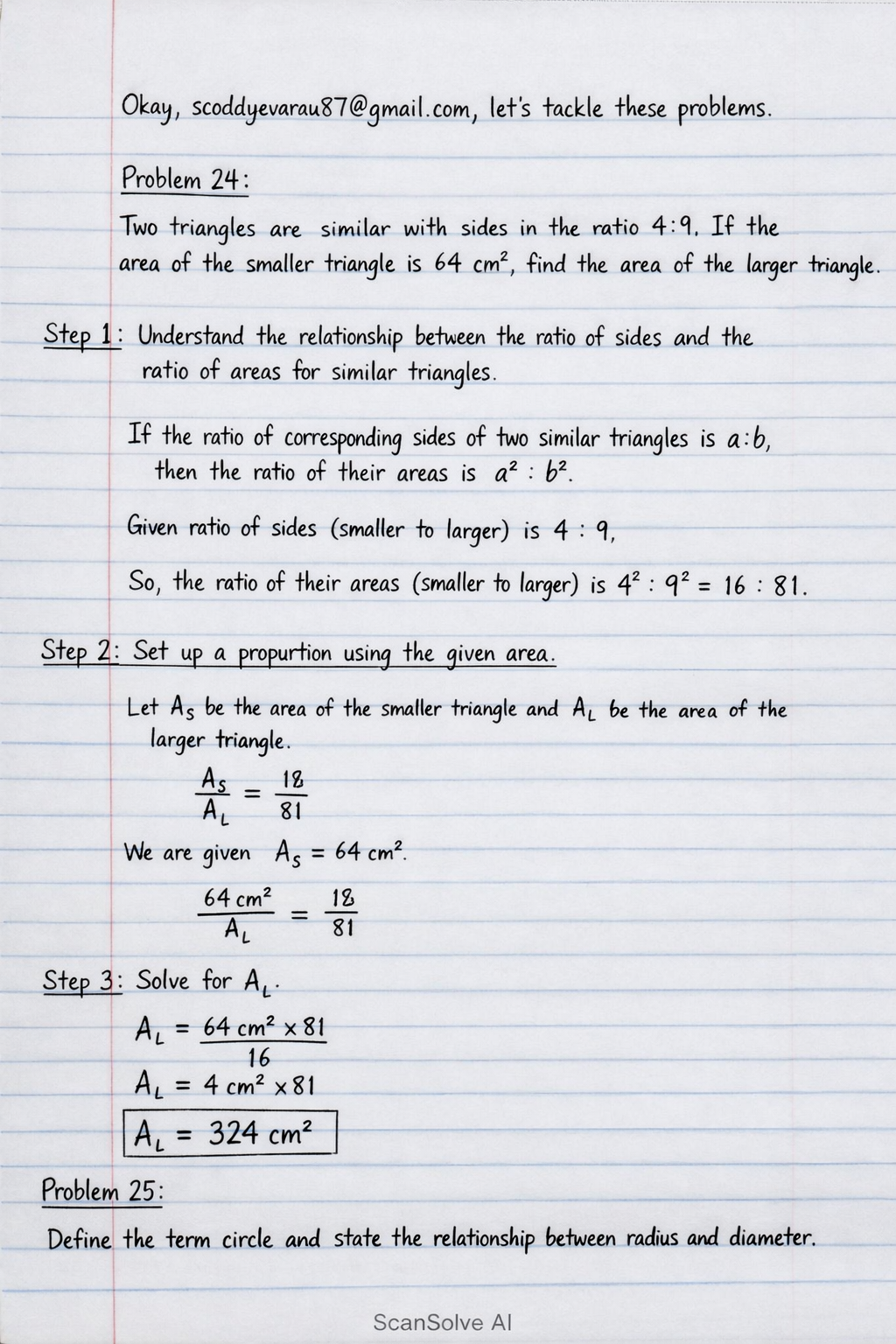
Okay, scoddyevarau87@gmail.com, let's tackle these problems.

:
Two triangles are similar with sides in the ratio 4:94:9. If the area of the smaller triangle is 64 cm264 \text{ cm}^2, find the area of the larger triangle.

Step 1: Understand the relationship between the ratio of sides and the ratio of areas for similar triangles.
If the ratio of corresponding sides of two similar triangles is a:ba:b, then the ratio of their areas is a2:b2a^2:b^2.
Given ratio of sides (smaller to larger) is 4:94:9.
So, the ratio of their areas (smaller to larger) is 42:92=16:814^2:9^2 = 16:81.

Step 2: Set up a proportion using the given area.
Let ASA_S be the area of the smaller triangle and ALA_L be the area of the larger triangle.

ASAL=1681\frac{A_S}{A_L} = \frac{16}{81}

We are given AS=64 cm2A_S = 64 \text{ cm}^2.

64 cm2AL=1681\frac{64 \text{ cm}^2}{A_L} = \frac{16}{81}

Step 3: Solve for ALA_L.

AL=64 cm2×8116A_L = \frac{64 \text{ cm}^2 \times 81}{16} AL=4 cm2×81A_L = 4 \text{ cm}^2 \times 81 AL=324 cm2A_L = \boxed{\text{324 cm}^2}

:
Define the term circle and state the relationship between radius and diameter.

A circle is a set of all points in a plane that are equidistant from a fixed point called the center. The radius (rr) is the distance from the center to any point on the circle. The diameter (DD) is the distance across the circle passing through its center. The relationship is that the diameter is twice the radius, or D=2rD = 2r.

:
Find the circumference of a Circle with a radius of 7 cm7 \text{ cm}. (π=227\pi = \frac{22}{7})

Step 1: Write the formula for the circumference of a circle.

C=2πrC = 2\pi r

Step 2: Substitute the given values.
Given r=7 cmr = 7 \text{ cm} and π=227\pi = \frac{22}{7}.

C=2×227×7 cmC = 2 \times \frac{22}{7} \times 7 \text{ cm}

Step 3: Calculate the circumference.

C=2×22 cmC = 2 \times 22 \text{ cm} C=44 cmC = \boxed{\text{44 cm}}

:
Calculate the area of the following use π=227\pi = \frac{22}{7}.

Part a· 3 steps

Circle with diameter 14 cm14 \text{ cm}.

  1. Find the radius.

    The diameter D=14 cmD = 14 \text{ cm}, so the radius r=D2=14 cm2=7 cmr = \frac{D}{2} = \frac{14 \text{ cm}}{2} = 7 \text{ cm}.

  2. Write the formula for the area of a circle.

    A=πr2A = \pi r^2
  3. Substitute the values and calculate.

    A=227×(7 cm)2A = \frac{22}{7} \times (7 \text{ cm})^2 A=227×49 cm2A = \frac{22}{7} \times 49 \text{ cm}^2 A=22×7 cm2A = 22 \times 7 \text{ cm}^2 A=154 cm2A = \boxed{\text{154 cm}^2}

Part b

113.14 cm2\text{113.14 cm}^2

Circle with diameter 12 cm12 \text{ cm}.

  1. Find the radius.

    The diameter D=12 cmD = 12 \text{ cm}, so the radius r=D2=12 cm2=6 cmr = \frac{D}{2} = \frac{12 \text{ cm}}{2} = 6 \text{ cm}.

  2. Write the formula for the area of a circle.

    A=πr2A = \pi r^2
  3. Substitute the values and calculate.

    A=227×(6 cm)2A = \frac{22}{7} \times (6 \text{ cm})^2 A=227×36 cm2A = \frac{22}{7} \times 36 \text{ cm}^2 A=7927 cm2A = \frac{792}{7} \text{ cm}^2 A≈113.14 cm2A \approx \boxed{\text{113.14 cm}^2}

Part c

78.57 cm2\text{78.57 cm}^2

Quadrant of a circle with radius 10 cm10 \text{ cm}.

  1. Write the formula for the area of a quadrant (quarter circle).

    A=14πr2A = \frac{1}{4} \pi r^2
  2. Substitute the values.

    Given r=10 cmr = 10 \text{ cm} and π=227\pi = \frac{22}{7}.

    A=14×227×(10 cm)2A = \frac{1}{4} \times \frac{22}{7} \times (10 \text{ cm})^2 A=14×227×100 cm2A = \frac{1}{4} \times \frac{22}{7} \times 100 \text{ cm}^2
  3. Calculate the area.

    A=220028 cm2A = \frac{2200}{28} \text{ cm}^2 A=5507 cm2A = \frac{550}{7} \text{ cm}^2 A≈78.57 cm2A \approx \boxed{\text{78.57 cm}^2}

    :
    The wheel of a bicycle has a radius of 35 cm35 \text{ cm}. How many revolutions will it make in covering 1 km1 \text{ km}?

  4. Calculate the circumference of the wheel.

    The circumference is the distance covered in one revolution. Use π=227\pi = \frac{22}{7}.

    C=2πrC = 2\pi r C=2×227×35 cmC = 2 \times \frac{22}{7} \times 35 \text{ cm} C=2×22×5 cmC = 2 \times 22 \times 5 \text{ cm} C=220 cmC = 220 \text{ cm}
  5. Convert the total distance to the same units as the circumference.

    Given total distance Dtotal=1 kmD_{total} = 1 \text{ km}.

    1 km=1000 m1 \text{ km} = 1000 \text{ m} 1000 m=1000×100 cm=100000 cm1000 \text{ m} = 1000 \times 100 \text{ cm} = 100000 \text{ cm}
  6. Calculate the number of revolutions.

    Number of revolutions=DtotalC\text{Number of revolutions} = \frac{D_{total}}{C} Number of revolutions=100000 cm220 cm\text{Number of revolutions} = \frac{100000 \text{ cm}}{220 \text{ cm}} Number of revolutions=1000022\text{Number of revolutions} = \frac{10000}{22} Number of revolutions=500011\text{Number of revolutions} = \frac{5000}{11} Number of revolutions≈454.55 revolutions\text{Number of revolutions} \approx \boxed{\text{454.55 revolutions}}
Was this helpful?

Try one yourself

A new problem that tests the same skill.

Still stuck on this one?

Ask a follow-up, and the answer starts from this question.

Got a different question?Ask your own question
Handwritten step-by-step solution preview

Handwritten Step-by-Step Solution

Get this as a handwritten image on WhatsApp — like a tutor wrote it for you.

Try on WhatsApp