
We read your photo as:
Use the complementary angle identity x = (90^ - x).
Mathematics
ScanSolve AI Answer
Answers
6 partsStep-by-step solution
22 stepsHere are the solutions to the equations:
Part a· 3 steps
Solve
Use the complementary angle identity .
Substitute this back into the equation.
Solve for .
The solution is .
Part b
Solve
Use the complementary angle identity .
Substitute this back into the equation.
Solve for .
The solution is .
Part c
Solve
Use the complementary angle identity .
Substitute this back into the equation.
Equate the angles.
Solve for .
The solution is .
Part d
Solve
Use the complementary angle identity .
Substitute this back into the equation.
Equate the angles.
Solve for .
The solution is .
Part e
Solve
Rearrange the equation.
Divide both sides by (assuming ).
Use the identity .
Solve for .
The solution is .
Part f
Solve
Use the complementary angle identity .
Substitute this back into the equation.
Equate the angles.
Solve for .
The solution is .
Was this helpful?
Try one yourself
A new problem that tests the same skill.
Still stuck on this one?
Ask a follow-up, and the answer starts from this question.
Got a different question?Ask your own question
More Mathematics Questions
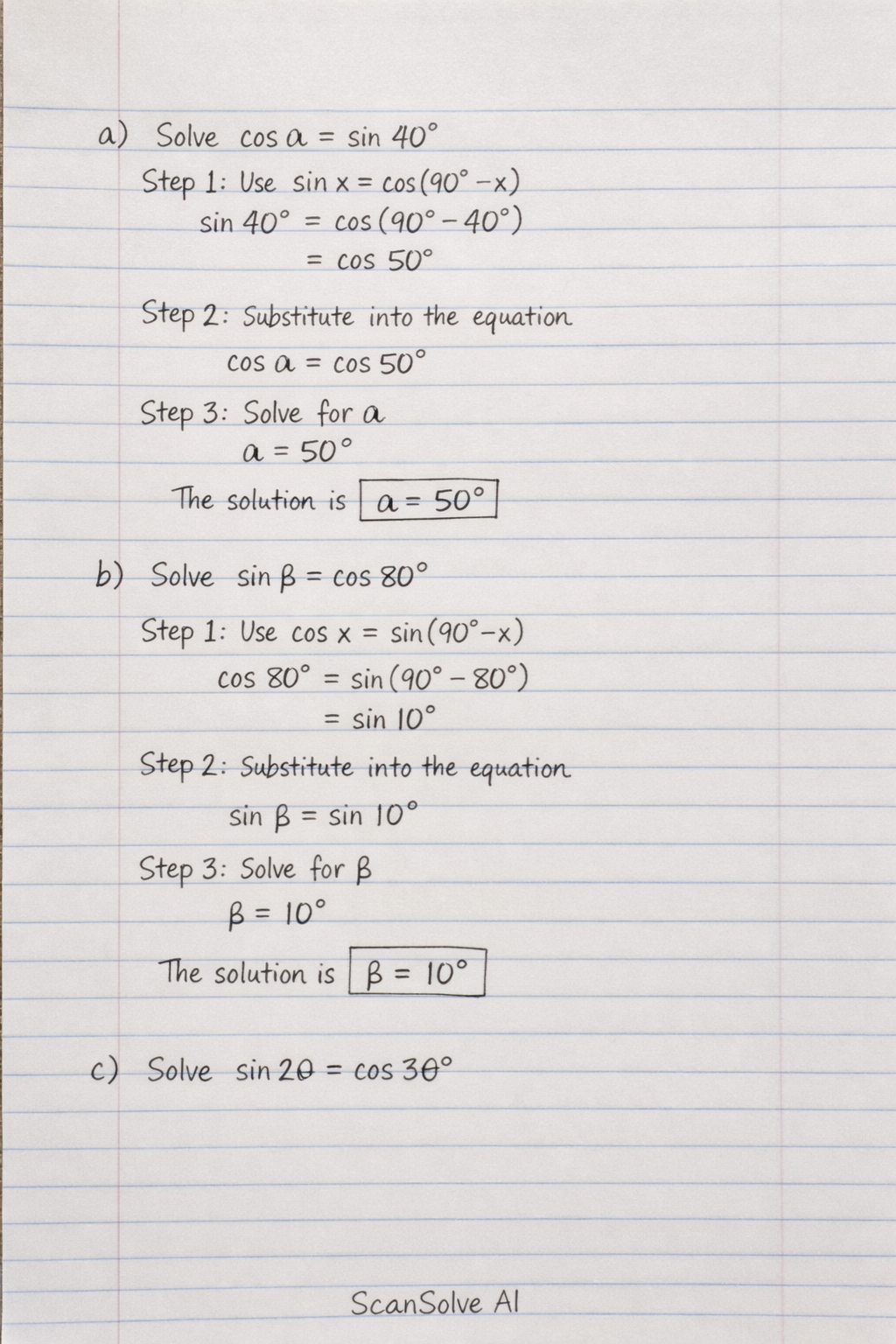
Handwritten Step-by-Step Solution
Get this as a handwritten image on WhatsApp — like a tutor wrote it for you.
Try on WhatsApp