
We read your photo as:
Using a ruler, a pencil and a pair of compasses only, construct a rhombus LMNO such that line LM = 6cm, angle LMN = 135°. Measure diagonal LN.
Mathematics
ScanSolve AI Answer
Answer
Step-by-step solution
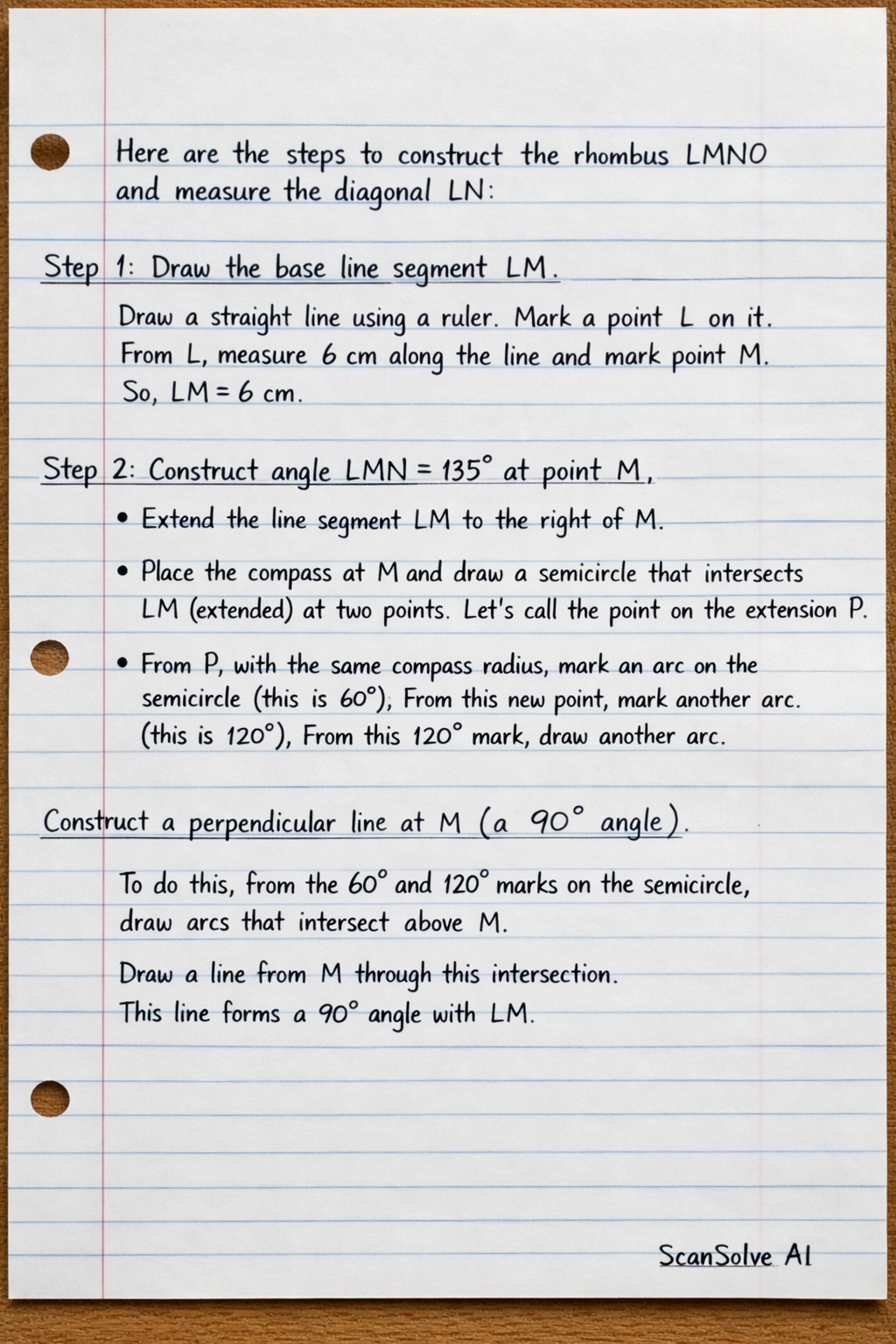
6 stepsHere are the steps to construct the rhombus LMNO and measure the diagonal LN:
Draw the base line segment LM.
Draw a straight line using a ruler. Mark a point L on it. From L, measure 6 cm along the line and mark point M. So, .
Construct angle LMN = at point M.
- Extend the line segment LM to the right of M.
- Place the compass at M and draw a semicircle that intersects LM (extended) at two points. Let's call the point on the extension P.
- From P, with the same compass radius, mark an arc on the semicircle (this is ). From this new point, mark another arc (this is ). From this mark, draw another arc.
- Construct a perpendicular line at M (a angle). To do this, from the and marks on the semicircle, draw arcs that intersect above M. Draw a line from M through this intersection. This line forms a angle with LM.
- The angle between the line and the extended line (to the right of M) is . Bisect this angle. The bisector will form an angle of with the line.
- The ray for will be the line formed by adding this to the line, measured from LM. So, the angle .
Mark point N.
- With M as the center and a radius of 6 cm (since all sides of a rhombus are equal), draw an arc that intersects the ray constructed in Step 2. Mark this intersection point as N. So, .
Locate point O.
- With L as the center and a radius of 6 cm, draw an arc above LM.
- With N as the center and a radius of 6 cm, draw another arc that intersects the previous arc. Mark this intersection point as O.
Complete the rhombus.
- Join points L to O and N to O with straight lines. You have now constructed the rhombus LMNO.
Measure diagonal LN.
- Draw a straight line connecting point L to point N.
- Measure the length of the line segment LN using a ruler.
Using the Law of Cosines for triangle LMN:
The measured length of diagonal LN is approximately .
2 zimekamilika. Zimebaki 3 leo — tuma inayofuata.
Was this helpful?
Try one yourself
A new problem that tests the same skill.
Still stuck on this one?
Ask a follow-up, and the answer starts from this question.
Got a different question?Ask your own question
More Mathematics Questions
QUsing ruler and a pair of compasses only, construct a triangle PQR such that PQ = 6cm and angle PQR…QL and M are two points 5 cm apart. N is another point such that NLM = 168° and NML = 80°. Construct…QConstruct LMN, LM = 7.5 cm, MN = 5 cm and LN = 8 cm. Locate its centroid. (OR) b) Construct PQR…QUsing a ruler and a pair of compass only construct a trapezium ABCD in which AB =5cm AD=6cm DC…QQ9. a. The diagram below shows a triangular piece of land LMN in which LM = 23.7m, MN = 16.6m and…
Browse by topic:Geometry
Handwritten Step-by-Step Solution
Get this as a handwritten image on WhatsApp — like a tutor wrote it for you.
Try on WhatsApp