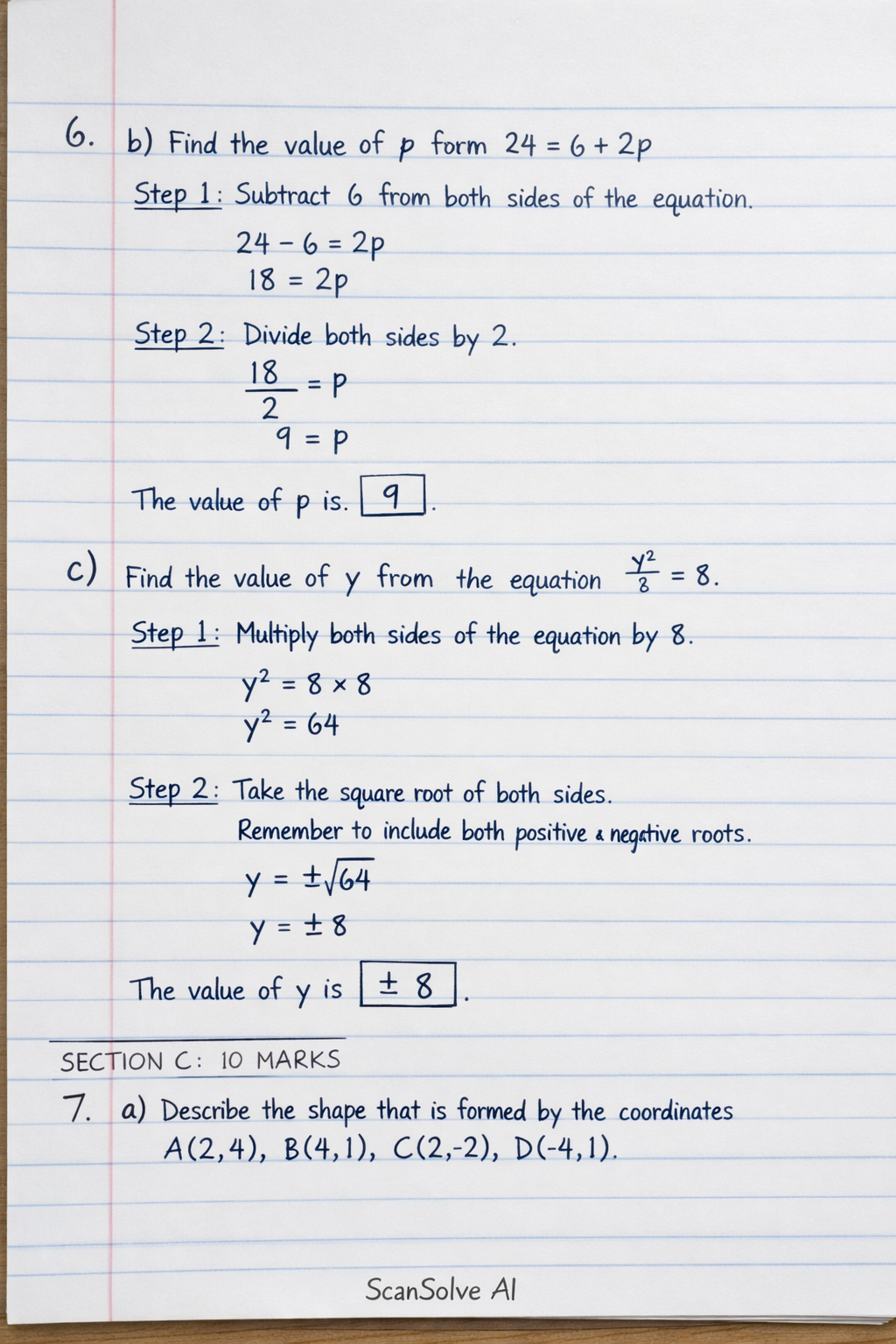
We read your photo as:

Find the value of p from 24 = 6 + 2p and the value of y from y2/8 = 8. Describe the shape formed by coordinates A(2,4), B(4,1), C(2,-2), D(-4,1).

Mathematics

ScanSolve AI Answer

Step-by-step solution

15 steps

Here are the solutions to the problems:

6.

b) Find the value of pp from 24=6+2p24 = 6 + 2p

  1. Subtract 6 from both sides of the equation.

    24−6=2p24 - 6 = 2p 18=2p18 = 2p
  2. Divide both sides by 2.

    182=p\frac{18}{2} = p 9=p9 = p

    The value of pp is 9\boxed{9}.

    c) Find the value of yy from equation y28=8\frac{y^2}{8} = 8

  3. Multiply both sides of the equation by 8.

    y2=8×8y^2 = 8 \times 8 y2=64y^2 = 64
  4. Take the square root of both sides.

    Remember to include both positive and negative roots.

    y=±64y = \pm\sqrt{64} y=±8y = \pm 8

    The value of yy is ±8\boxed{\pm 8}.

    SECTION C: 10 MARKS

    7.

    a) Describe the shape that is formed by the coordinates A(2,4), B(4,1), C(2,-2), D(-4,1).

  5. Calculate the lengths of the sides.

    Length AB: (4−2)2+(1−4)2=22+(−3)2=4+9=13\sqrt{(4-2)^2 + (1-4)^2} = \sqrt{2^2 + (-3)^2} = \sqrt{4+9} = \sqrt{13}
    Length BC: (2−4)2+(−2−1)2=(−2)2+(−3)2=4+9=13\sqrt{(2-4)^2 + (-2-1)^2} = \sqrt{(-2)^2 + (-3)^2} = \sqrt{4+9} = \sqrt{13}
    Length CD: (−4−2)2+(1−(−2))2=(−6)2+(3)2=36+9=45\sqrt{(-4-2)^2 + (1-(-2))^2} = \sqrt{(-6)^2 + (3)^2} = \sqrt{36+9} = \sqrt{45}
    Length DA: (2−(−4))2+(4−1)2=62+32=36+9=45\sqrt{(2-(-4))^2 + (4-1)^2} = \sqrt{6^2 + 3^2} = \sqrt{36+9} = \sqrt{45}

  6. Observe the side lengths.

    We have two pairs of equal-length adjacent sides: AB = BC and CD = DA. This is the definition of a kite.
    We can also check the diagonals:
    Diagonal AC connects (2,4) and (2,-2). This is a vertical line segment.
    Diagonal BD connects (4,1) and (-4,1). This is a horizontal line segment.
    Vertical and horizontal lines are perpendicular. In a kite, the diagonals are perpendicular.
    The shape formed by the coordinates is a kite\boxed{\text{kite}}.

    b) Find the average of 20 kg,35 kg,15 kg,10 kg,20 \text{ kg}, 35 \text{ kg}, 15 \text{ kg}, 10 \text{ kg}, and 20 kg20 \text{ kg}.

  7. Sum all the values.

    Sum=20+35+15+10+20=100 kg\text{Sum} = 20 + 35 + 15 + 10 + 20 = 100 \text{ kg}
  8. Count the number of values.

    There are 5 values.

  9. Divide the sum by the count.

    Average=100 kg5=20 kg\text{Average} = \frac{100 \text{ kg}}{5} = 20 \text{ kg}

    The average is 20 kg\boxed{20 \text{ kg}}.

    8.

    a) Find the size of angle EBD.

  10. Recognize that angles on a straight line sum to 180∘180^\circ.

    The angles ∠CBE\angle CBE, ∠EBD\angle EBD, and ∠DBA\angle DBA lie on the straight line CA.
    So, ∠CBE+∠EBD+∠DBA=180∘\angle CBE + \angle EBD + \angle DBA = 180^\circ.

  11. Substitute the given angle measures into the equation.

    100∘+2m+(4m+30∘)=180∘100^\circ + 2m + (4m + 30^\circ) = 180^\circ
  12. Combine like terms.

    100+30+2m+4m=180100 + 30 + 2m + 4m = 180 130+6m=180130 + 6m = 180
  13. Solve for mm.

    6m=180−1306m = 180 - 130 6m=506m = 50 m=506=253m = \frac{50}{6} = \frac{25}{3}
  14. Calculate the size of angle EBD, which is $2m$.

    ∠EBD=2m=2×253=503∘\angle EBD = 2m = 2 \times \frac{25}{3} = \frac{50}{3}^\circ

    The size of angle EBD is 503∘\boxed{\frac{50}{3}^\circ} or approximately 16.67∘16.67^\circ.

    b) Find the area of the shaded part.

    The shaded part is a right-angled triangle. The sides are (6x−2)(6x-2) m, (20−5x)(20-5x) m, and the hypotenuse is 26 m.

  15. Use the Pythagorean theorem to find the value of xx.

    (6x−2)2+(20−5x)2=262(6x-2)^2 + (20-5x)^2 = 26^2 (36x2−24x+4)+(400−200x+25x2)=676(36x^2 - 24x + 4) + (400 - 200x + 25x^2) = 676 61x2−224x+404=67661x^2 - 224x + 404 = 676 61x2−224x+404−676=061x^2 - 224x + 404 - 676 = 0 61x2−224x−272=061x^2 - 224x - 272 = 0

    This quadratic equation is difficult to factor directly. Let's check for integer solutions by testing small integer values for xx.
    If x=4x=4:
    61(42)−224(4)−272=61(16)−896−272=976−896−272=80−272=−192≠061(4^2) - 224(4) - 272 = 61(16) - 896 - 272 = 976 - 896 - 272 = 80 - 272 = -192 \neq 0.
    If x=5x=5:
    61(52)−224(5)−272=61(25)−1120−272=1525−1120−272=405−272=133≠061(5^2) - 224(5) - 272 = 61(25) - 1120 - 272 = 1525 - 1120 - 272 = 405 - 272 = 133 \neq 0.

    Let's re-examine the problem. It's possible there's a simpler way or an integer value for xx that makes the sides work out.
    If the sides are integers, we could look for Pythagorean triples. 26 is 2×132 \times 13. Common triples are (5,12,13)(5,12,13), so (10,24,26)(10,24,26) is a possibility.
    If the legs are 10 and 24:
    Case 1: 6x−2=10  ⟹  6x=12  ⟹  x=26x-2 = 10 \implies 6x = 12 \implies x=2.
    Then 20−5x=20−5(2)=20−10=1020-5x = 20-5(2) = 20-10 = 10. This doesn't match 24.
    Case 2: $6x-2 = 24 \implies

Was this helpful?

Still stuck on this one?

Ask a follow-up, and the answer starts from this question.

Got a different question?Ask your own question
Handwritten step-by-step solution preview

Handwritten Step-by-Step Solution

Get this as a handwritten image on WhatsApp — like a tutor wrote it for you.

Try on WhatsApp