We read your photo as:

Calculate the values of the following expressions, using reciprocals from tables where necessary.

Mathematics

ScanSolve AI Answer

Answers

3 parts
c

73.9396\text{73.9396}

d

2.2048\text{2.2048}

e

0.3165625\text{0.3165625}

Step-by-step solution

9 steps

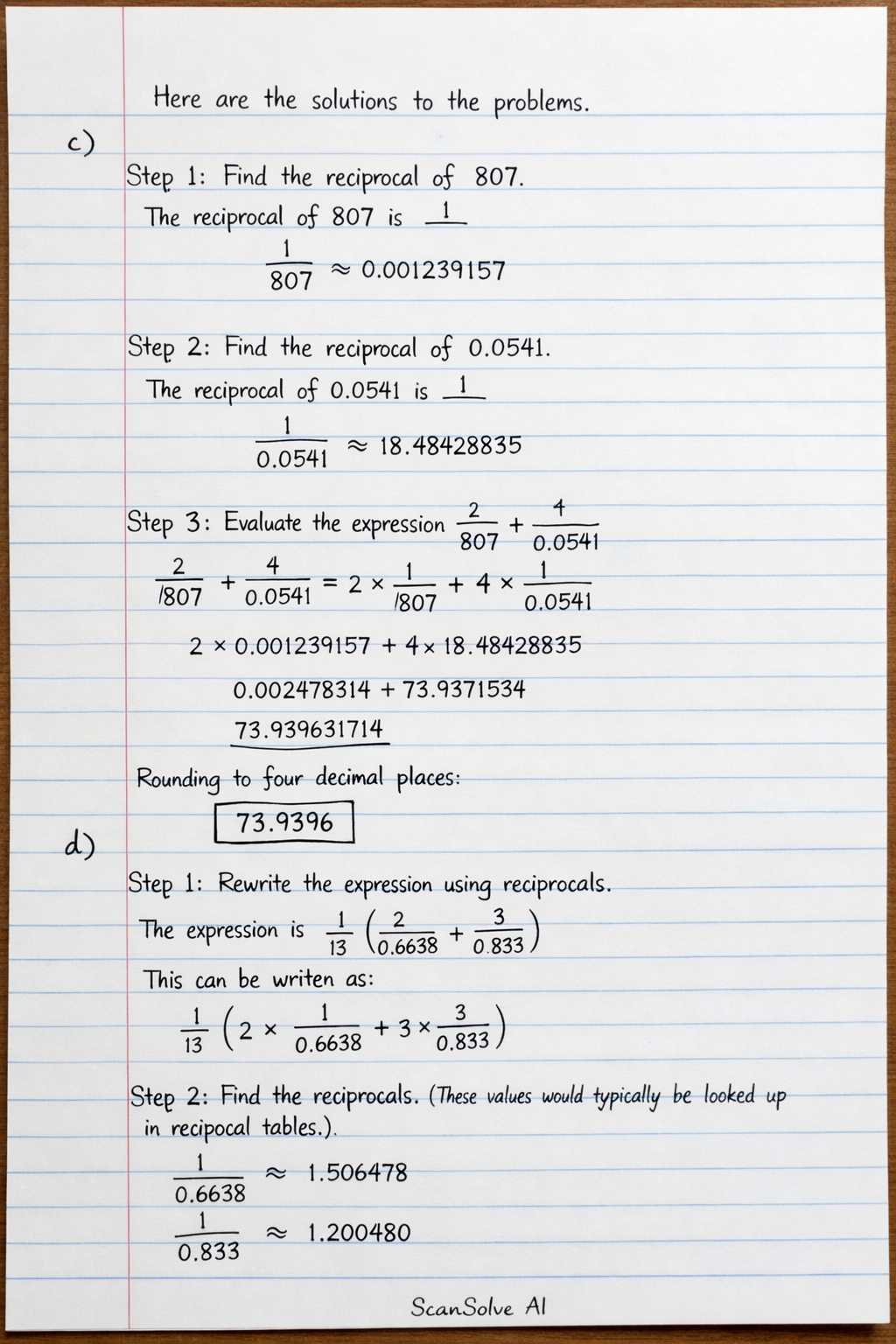
Here are the solutions to the problems.

Part c· 3 steps

  1. Find the reciprocal of 807.

    The reciprocal of 807 is 1807\frac{1}{807}.

    1807≈0.001239157\frac{1}{807} \approx 0.001239157
  2. Find the reciprocal of 0.0541.

    The reciprocal of 0.0541 is 10.0541\frac{1}{0.0541}.

    10.0541≈18.48428835\frac{1}{0.0541} \approx 18.48428835
  3. Evaluate the expression 2807+40.0541\frac{2}{807} + \frac{4}{0.0541}.

    2807+40.0541=2×1807+4×10.0541\frac{2}{807} + \frac{4}{0.0541} = 2 \times \frac{1}{807} + 4 \times \frac{1}{0.0541}

    Substitute the reciprocal values:

    2×0.001239157+4×18.484288352 \times 0.001239157 + 4 \times 18.48428835 0.002478314+73.93715340.002478314 + 73.9371534 73.93963171473.939631714

    Rounding to four decimal places:

    73.9396\boxed{\text{73.9396}}

Part d

2.2048\text{2.2048}

  1. Rewrite the expression using reciprocals.

    The expression is 13(20.6638+30.833)\frac{1}{3} \left( \frac{2}{0.6638} + \frac{3}{0.833} \right).
    This can be written as:

    13(2×10.6638+3×10.833)\frac{1}{3} \left( 2 \times \frac{1}{0.6638} + 3 \times \frac{1}{0.833} \right)
  2. Find the reciprocals.

    (These values would typically be looked up in reciprocal tables.)

    10.6638≈1.506478\frac{1}{0.6638} \approx 1.506478 10.833≈1.200480\frac{1}{0.833} \approx 1.200480
  3. Substitute the values and evaluate.

    13(2×1.506478+3×1.200480)\frac{1}{3} (2 \times 1.506478 + 3 \times 1.200480) 13(3.012956+3.60144)\frac{1}{3} (3.012956 + 3.60144) 13(6.614396)\frac{1}{3} (6.614396) 2.20479866...2.20479866...

    Rounding to four decimal places:

    2.2048\boxed{\text{2.2048}}

Part e

0.3165625\text{0.3165625}

  1. Evaluate the numerator without using a calculator.

    The numerator is 12.76625−12.4+0.3×312.76625 - 12.4 + 0.3 \times 3.
    First, calculate the multiplication:

    0.3×3=0.90.3 \times 3 = 0.9

    Next, perform the subtraction:

    12.76625−12.4=0.3662512.76625 - 12.4 = 0.36625

    Finally, perform the addition:

    0.36625+0.9=1.266250.36625 + 0.9 = 1.26625

    So, the numerator is 1.26625.

  2. Evaluate the denominator without using a calculator.

    The denominator is 18 of 2.56+3.68\frac{1}{8} \text{ of } 2.56 + 3.68.
    First, calculate 18 of 2.56\frac{1}{8} \text{ of } 2.56:

    18×2.56=2.568=0.32\frac{1}{8} \times 2.56 = \frac{2.56}{8} = 0.32

    Next, perform the addition:

    0.32+3.68=4.000.32 + 3.68 = 4.00

    So, the denominator is 4.00.

  3. Divide the numerator by the denominator without using a calculator.

    1.266254\frac{1.26625}{4} 1.26625÷4=0.31656251.26625 \div 4 = 0.3165625 0.3165625\boxed{\text{0.3165625}}
Was this helpful?

Try one yourself

A new problem that tests the same skill.

Still stuck on this one?

Ask a follow-up, and the answer starts from this question.

Got a different question?Ask your own question
Handwritten step-by-step solution preview

Handwritten Step-by-Step Solution

Get this as a handwritten image on WhatsApp — like a tutor wrote it for you.

Try on WhatsApp