We read your photo as:

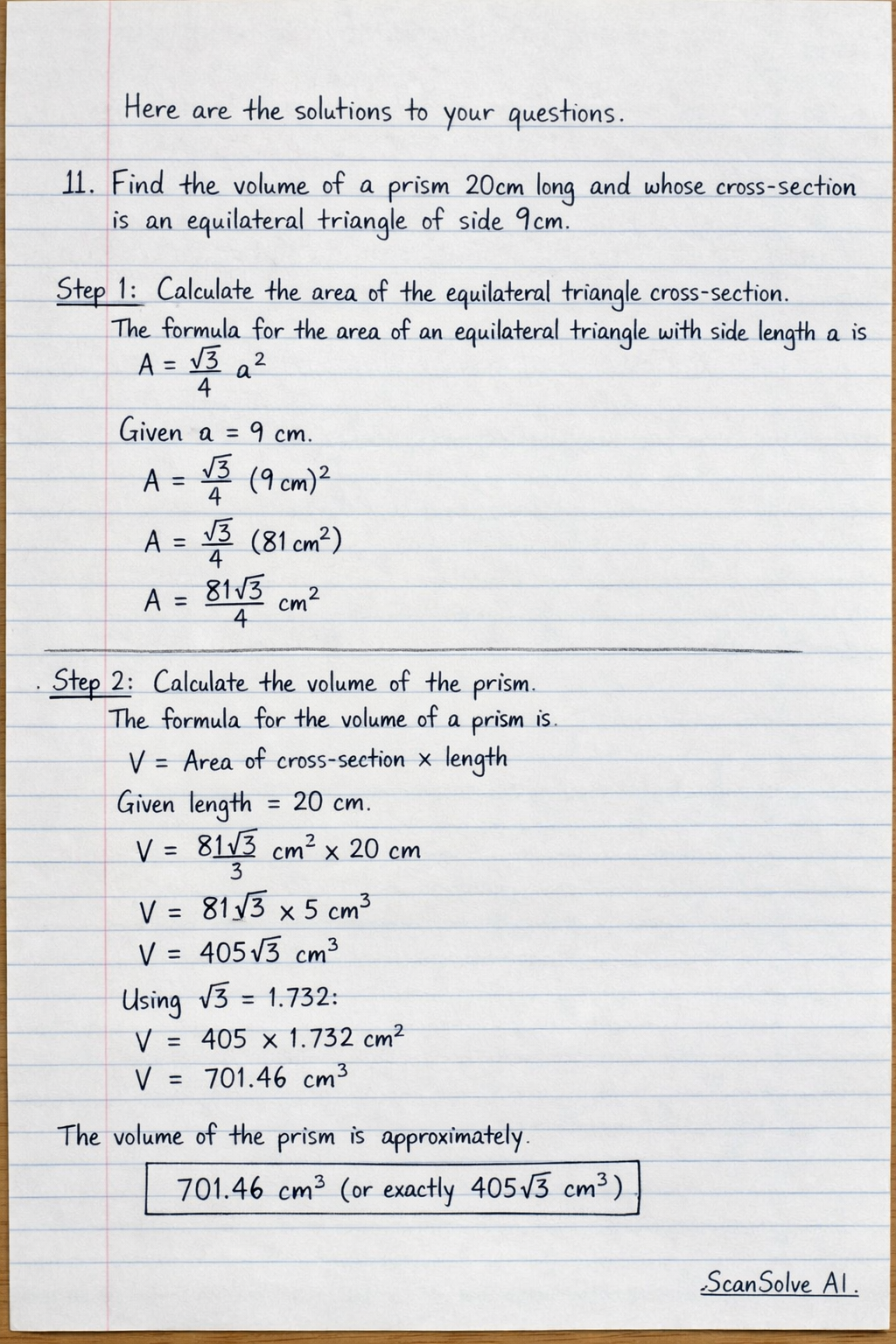
Find the volume of a prism 20cm long and whose cross-section is an equilateral triangle of side 9cm.

Mathematics

ScanSolve AI Answer

Step-by-step solution

13 steps

Here are the solutions to your questions.

11. Find the volume of a prism 20cm long and whose cross-section is an equilateral triangle of side 9cm.

  1. Calculate the area of the equilateral triangle cross-section.

    The formula for the area of an equilateral triangle with side length aa is A=34a2A = \frac{\sqrt{3}}{4}a^2.
    Given a=9a = 9 cm.

    A=34(9 cm)2A = \frac{\sqrt{3}}{4}(9 \text{ cm})^2 A=34(81 cm2)A = \frac{\sqrt{3}}{4}(81 \text{ cm}^2) A=8134 cm2A = \frac{81\sqrt{3}}{4} \text{ cm}^2
  2. Calculate the volume of the prism.

    The formula for the volume of a prism is V=Area of cross-section×lengthV = \text{Area of cross-section} \times \text{length}.
    Given length =20= 20 cm.

    V=8134 cm2×20 cmV = \frac{81\sqrt{3}}{4} \text{ cm}^2 \times 20 \text{ cm} V=813×5 cm3V = 81\sqrt{3} \times 5 \text{ cm}^3 V=4053 cm3V = 405\sqrt{3} \text{ cm}^3

    Using 3≈1.732\sqrt{3} \approx 1.732:

    V≈405×1.732 cm3V \approx 405 \times 1.732 \text{ cm}^3 V≈701.46 cm3V \approx 701.46 \text{ cm}^3

    The volume of the prism is approximately 701.46 cm3\boxed{701.46 \text{ cm}^3} (or exactly 4053 cm3\boxed{405\sqrt{3} \text{ cm}^3}).

    12. The equation of a line L1 is 4y−3x+8=04y - 3x + 8 = 0. Find the equation of line L2 which is perpendicular to L1 and passes through (2, 7).

  3. Find the slope of line L1.

    Rearrange the equation 4y−3x+8=04y - 3x + 8 = 0 into the slope-intercept form y=mx+cy = mx + c.

    4y=3x−84y = 3x - 8 y=34x−2y = \frac{3}{4}x - 2

    The slope of L1 is m1=34m_1 = \frac{3}{4}.

  4. Find the slope of line L2.

    Since L2 is perpendicular to L1, its slope m2m_2 is the negative reciprocal of m1m_1.

    m2=−1m1m_2 = -\frac{1}{m_1} m2=−13/4m_2 = -\frac{1}{3/4} m2=−43m_2 = -\frac{4}{3}
  5. Find the equation of line L2.

    Use the point-slope form y−y1=m(x−x1)y - y_1 = m(x - x_1) with m2=−43m_2 = -\frac{4}{3} and the point (x1,y1)=(2,7)(x_1, y_1) = (2, 7).

    y−7=−43(x−2)y - 7 = -\frac{4}{3}(x - 2)

    Multiply both sides by 3 to eliminate the fraction:

    3(y−7)=−4(x−2)3(y - 7) = -4(x - 2) 3y−21=−4x+83y - 21 = -4x + 8

    Rearrange into the general form Ax+By+C=0Ax + By + C = 0:

    4x+3y−21−8=04x + 3y - 21 - 8 = 0 4x+3y−29=04x + 3y - 29 = 0

    The equation of line L2 is 4x+3y−29=0\boxed{4x + 3y - 29 = 0}.

    13. Solve for x in 32x+1+5(3x)−2=03^{2x+1} + 5(3^x) - 2 = 0.

  6. Rewrite the exponential term using exponent rules.

    32x+1=32x⋅31=(3x)2⋅33^{2x+1} = 3^{2x} \cdot 3^1 = (3^x)^2 \cdot 3

    Substitute this back into the equation:

    3(3x)2+5(3x)−2=03(3^x)^2 + 5(3^x) - 2 = 0
  7. Make a substitution to form a quadratic equation.

    Let y=3xy = 3^x. Since 3x3^x is always positive, y>0y > 0.

    3y2+5y−2=03y^2 + 5y - 2 = 0
  8. Solve the quadratic equation for yy.

    Factor the quadratic equation:

    (3y−1)(y+2)=0(3y - 1)(y + 2) = 0

    This gives two possible solutions for yy:

    3y−1=0  ⟹  3y=1  ⟹  y=133y - 1 = 0 \implies 3y = 1 \implies y = \frac{1}{3} y+2=0  ⟹  y=−2y + 2 = 0 \implies y = -2
  9. Substitute back y=3xy = 3^x and solve for xx.

    Since yy must be positive, we discard y=−2y = -2.
    Using y=13y = \frac{1}{3}:

    3x=133^x = \frac{1}{3} 3x=3−13^x = 3^{-1}

    Therefore,

    x=−1x = -1

    The solution for xx is −1\boxed{-1}.

    14. Express 2−32+3+4−32−3\frac{2-\sqrt{3}}{2+\sqrt{3}} + \frac{4-\sqrt{3}}{2-\sqrt{3}} in the form a+bca+b\sqrt{c}.

  10. Find a common denominator for the two fractions.

    The common denominator is (2+3)(2−3)(2+\sqrt{3})(2-\sqrt{3}).
    Using the difference of squares formula (A+B)(A−B)=A2−B2(A+B)(A-B) = A^2 - B^2:

    (2+3)(2−3)=22−(3)2=4−3=1(2+\sqrt{3})(2-\sqrt{3}) = 2^2 - (\sqrt{3})^2 = 4 - 3 = 1
  11. Rewrite each fraction with the common denominator and combine.

    2−32+3+4−32−3=(2−3)(2−3)(2+3)(2−3)+(4−3)(2+3)(2−3)(2+3)\frac{2-\sqrt{3}}{2+\sqrt{3}} + \frac{4-\sqrt{3}}{2-\sqrt{3}} = \frac{(2-\sqrt{3})(2-\sqrt{3})}{(2+\sqrt{3})(2-\sqrt{3})} + \frac{(4-\sqrt{3})(2+\sqrt{3})}{(2-\sqrt{3})(2+\sqrt{3})}

    Since the common denominator is 1, the expression simplifies to the sum of the new numerators:

    =(2−3)2+(4−3)(2+3)= (2-\sqrt{3})^2 + (4-\sqrt{3})(2+\sqrt{3})
  12. Expand and simplify each term in the numerator.

    For the first term, (2−3)2(2-\sqrt{3})^2:

    (2−3)2=22−2(2)(3)+(3)2=4−43+3=7−43(2-\sqrt{3})^2 = 2^2 - 2(2)(\sqrt{3}) + (\sqrt{3})^2 = 4 - 4\sqrt{3} + 3 = 7 - 4\sqrt{3}

    For the second term, (4−3)(2+3)(4-\sqrt{3})(2+\sqrt{3}):

    (4−3)(2+3)=4(2)+4(3)−3(2)−(3)(3)(4-\sqrt{3})(2+\sqrt{3}) = 4(2) + 4(\sqrt{3}) - \sqrt{3}(2) - (\sqrt{3})(\sqrt{3}) =8+43−23−3= 8 + 4\sqrt{3} - 2\sqrt{3} - 3 =5+23= 5 + 2\sqrt{3}
  13. Add the simplified terms.

    (7−43)+(5+23)(7 - 4\sqrt{3}) + (5 + 2\sqrt{3}) =7+5−43+23= 7 + 5 - 4\sqrt{3} + 2\sqrt{3} =12−23= 12 - 2\sqrt{3}

    The expression in the form a+bca+b\sqrt{c} is 12−23\boxed{12 - 2\sqrt{3}}.

Was this helpful?

Still stuck on this one?

Ask a follow-up, and the answer starts from this question.

Got a different question?Ask your own question
Handwritten step-by-step solution preview

Handwritten Step-by-Step Solution

Get this as a handwritten image on WhatsApp — like a tutor wrote it for you.

Try on WhatsApp