
We read your photo as:
Determine whether each of these integers is prime: a) 21 b) 29 c) 71
Mathematics
ScanSolve AI Answer
Step-by-step solution
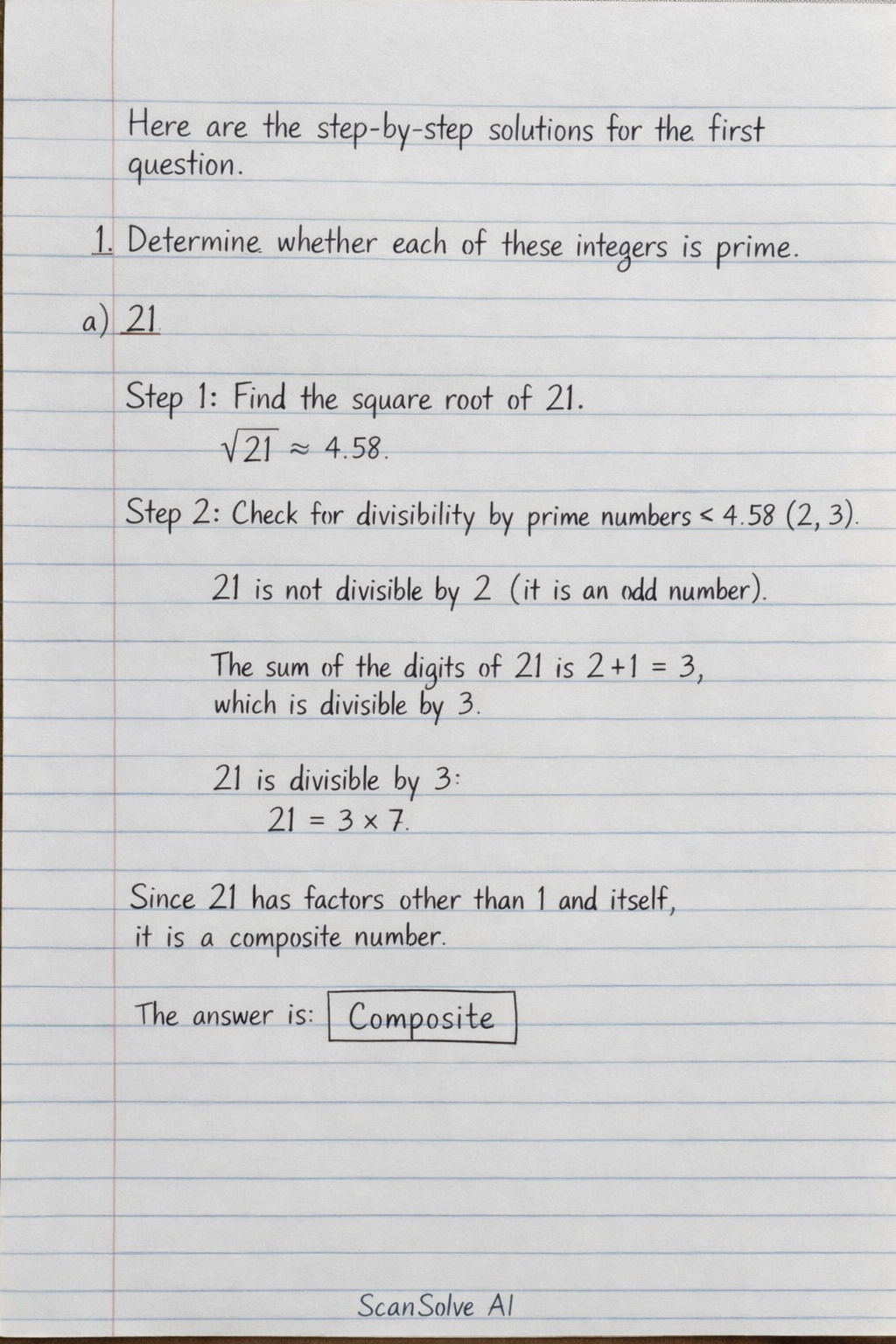
12 stepsHere are the step-by-step solutions for the first question.
1. Determine whether each of these integers is prime.
To determine if a number is prime, we check for divisibility by prime numbers up to its square root. If no such prime divides the number, it is prime. Otherwise, it is composite.
- a) 21
Find the square root of 21.
.
Check for divisibility by prime numbers less than or equal to 4.58 (i.e., 2, 3).
- 21 is not divisible by 2 (it is an odd number).
- The sum of the digits of 21 is , which is divisible by 3. So, 21 is divisible by 3 (). Since 21 has factors other than 1 and itself, it is a composite number. The answer is .
- b) 29
Find the square root of 29.
.
Check for divisibility by prime numbers less than or equal to 5.38 (i.e., 2, 3, 5).
- 29 is not divisible by 2 (it is an odd number).
- The sum of the digits of 29 is , which is not divisible by 3. So, 29 is not divisible by 3.
- 29 does not end in 0 or 5. So, 29 is not divisible by 5. Since 29 is not divisible by any prime number up to its square root, it is a prime number. The answer is .
- c) 71
Find the square root of 71.
.
Check for divisibility by prime numbers less than or equal to 8.42 (i.e., 2, 3, 5, 7).
- 71 is not divisible by 2 (it is an odd number).
- The sum of the digits of 71 is , which is not divisible by 3. So, 71 is not divisible by 3.
- 71 does not end in 0 or 5. So, 71 is not divisible by 5.
- with a remainder of 1. So, 71 is not divisible by 7. Since 71 is not divisible by any prime number up to its square root, it is a prime number. The answer is .
- d) 97
Find the square root of 97.
.
Check for divisibility by prime numbers less than or equal to 9.85 (i.e., 2, 3, 5, 7).
- 97 is not divisible by 2 (it is an odd number).
- The sum of the digits of 97 is , which is not divisible by 3. So, 97 is not divisible by 3.
- 97 does not end in 0 or 5. So, 97 is not divisible by 5.
- with a remainder of 6. So, 97 is not divisible by 7. Since 97 is not divisible by any prime number up to its square root, it is a prime number. The answer is .
- e) 111
Find the square root of 111.
.
Check for divisibility by prime numbers less than or equal to 10.53 (i.e., 2, 3, 5, 7).
- 111 is not divisible by 2 (it is an odd number).
- The sum of the digits of 111 is , which is divisible by 3. So, 111 is divisible by 3 (). Since 111 has factors other than 1 and itself, it is a composite number. The answer is .
- f) 143
Find the square root of 143.
.
Check for divisibility by prime numbers less than or equal to 11.96 (i.e., 2, 3, 5, 7, 11).
- 143 is not divisible by 2 (it is an odd number).
- The sum of the digits of 143 is , which is not divisible by 3. So, 143 is not divisible by 3.
- 143 does not end in 0 or 5. So, 143 is not divisible by 5.
- with a remainder of 3. So, 143 is not divisible by 7.
- . So, 143 is divisible by 11 (). Since 143 has factors other than 1 and itself, it is a composite number. The answer is .
Was this helpful?
Still stuck on this one?
Ask a follow-up, and the answer starts from this question.
Got a different question?Ask your own question
More Mathematics Questions
QExpress each of the following odd numbers as the sum of 3 prime numbers: a. 29, b. 83, c. 55, d. 53…QFind the prime factors for the following numbers: a) 27 b) 40 c) 50 d) 75 e) 90QClassify the following numbers as prime or composite: 201, 211, 55, 112, 73. Then, find the product…QComplete the prime factorizations for the following numbers: a. 1234, b. 2134, c. 1243, d. 2143, e…QList all prime factors of: a) 144 b) 90. Simplify and classify as rational or irrational: a) 25 b)…
Browse by topic:Number Theory
Handwritten Step-by-Step Solution
Get this as a handwritten image on WhatsApp — like a tutor wrote it for you.
Try on WhatsApp