
We read your photo as:
Determine whether or not the following vectors in R3 are linearly dependent: u = (1,2,5), v = (2,5,1), and w = (1,5,2).
ScanSolve AI Answer
Step-by-step solution
5 stepslet's determine the linear dependence of these vectors.
3. Determine whether or not the following vectors in are linearly dependent: , , and .
To determine if the vectors are linearly dependent, we can form a matrix with these vectors as columns and calculate its determinant. If the determinant is zero, the vectors are linearly dependent. If it's non-zero, they are linearly independent.
Form the matrix with the given vectors as columns.
Calculate the determinant of matrix .
We will use cofactor expansion along the first row:
Compute the determinants.
Substitute these values back into the determinant formula and simplify.
Conclude based on the determinant value.
Since , the vectors are linearly independent.
Still stuck on this one?
Ask a follow-up, and the answer starts from this question.
More Mathematics Questions
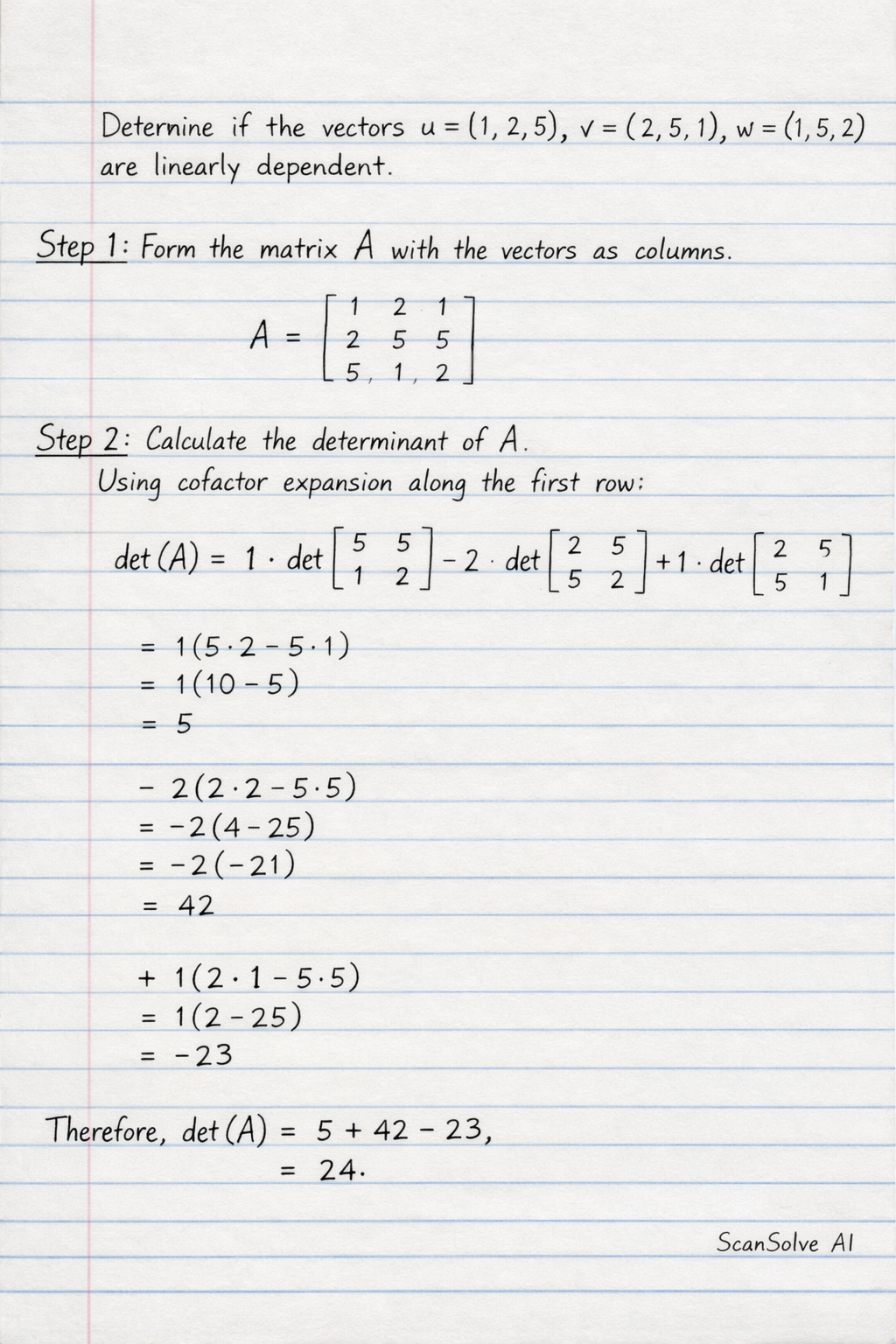
Handwritten Step-by-Step Solution
Get this as a handwritten image on WhatsApp — like a tutor wrote it for you.
Try on WhatsApp