We read your photo as:

Determine whether the limit exists: L :

Mathematics

ScanSolve AI Answer

Step-by-step solution

9 steps

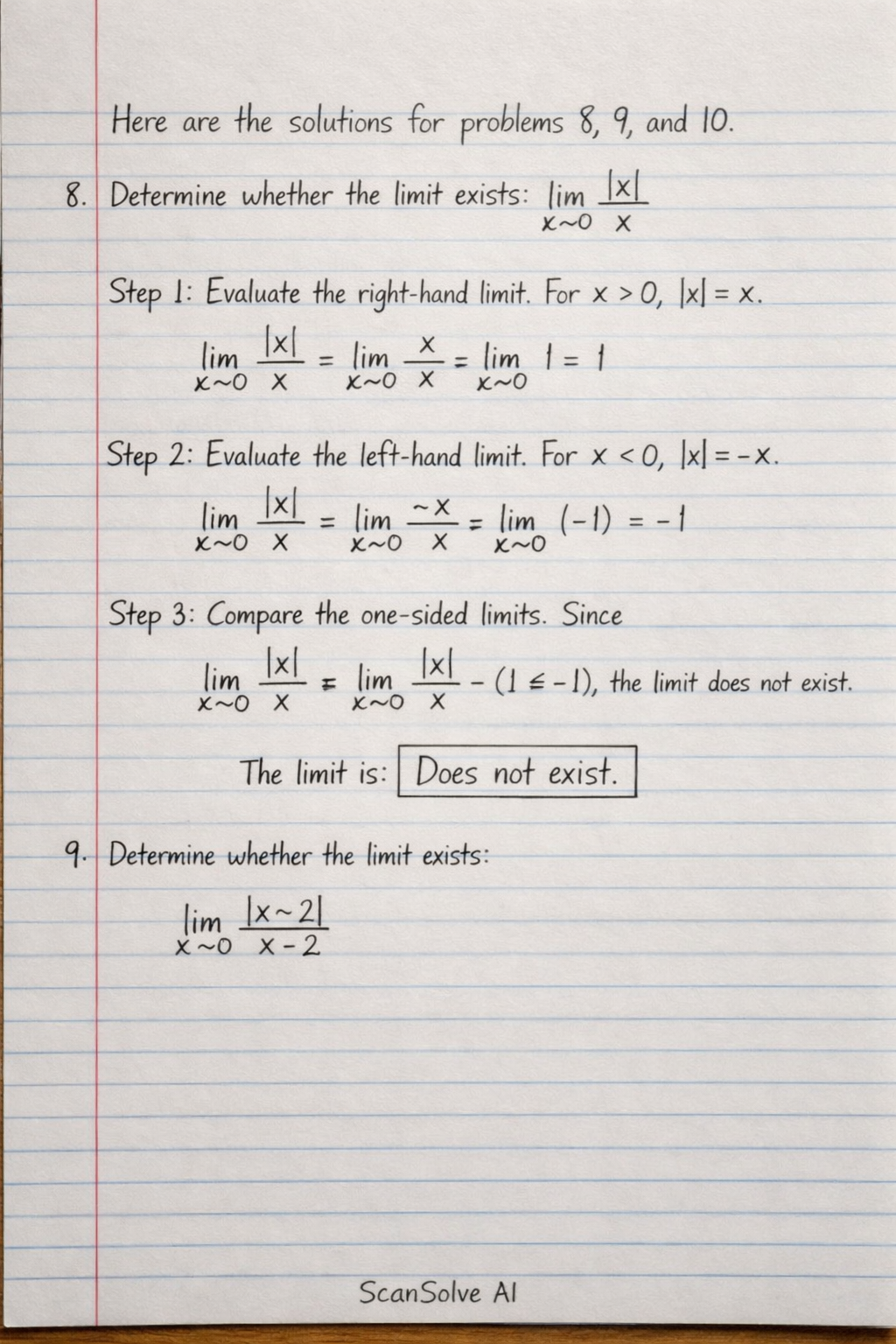
Here are the solutions for problems 8, 9, and 10.

8. Determine whether the limit exists: lim⁡x→0∣x∣x\lim_{x \to 0} \frac{|x|}{x}

  1. Evaluate the right-hand limit.

    For x>0x > 0, ∣x∣=x|x| = x.

    lim⁡x→0+∣x∣x=lim⁡x→0+xx=lim⁡x→0+1=1\lim_{x \to 0^+} \frac{|x|}{x} = \lim_{x \to 0^+} \frac{x}{x} = \lim_{x \to 0^+} 1 = 1
  2. Evaluate the left-hand limit.

    For x<0x < 0, ∣x∣=−x|x| = -x.

    lim⁡x→0−∣x∣x=lim⁡x→0−−xx=lim⁡x→0−(−1)=−1\lim_{x \to 0^-} \frac{|x|}{x} = \lim_{x \to 0^-} \frac{-x}{x} = \lim_{x \to 0^-} (-1) = -1
  3. Compare the one-sided limits.

    Since lim⁡x→0+∣x∣x≠lim⁡x→0−∣x∣x\lim_{x \to 0^+} \frac{|x|}{x} \neq \lim_{x \to 0^-} \frac{|x|}{x} (1≠−11 \neq -1), the limit does not exist.
    The limit is Does not exist\boxed{\text{Does not exist}}.

    9. Determine whether the limit exists: lim⁡x→2∣x−2∣x−2\lim_{x \to 2} \frac{|x - 2|}{x - 2}

  4. Evaluate the right-hand limit.

    For x>2x > 2, x−2>0x - 2 > 0, so ∣x−2∣=x−2|x - 2| = x - 2.

    lim⁡x→2+∣x−2∣x−2=lim⁡x→2+x−2x−2=lim⁡x→2+1=1\lim_{x \to 2^+} \frac{|x - 2|}{x - 2} = \lim_{x \to 2^+} \frac{x - 2}{x - 2} = \lim_{x \to 2^+} 1 = 1
  5. Evaluate the left-hand limit.

    For x<2x < 2, x−2<0x - 2 < 0, so ∣x−2∣=−(x−2)|x - 2| = -(x - 2).

    lim⁡x→2−∣x−2∣x−2=lim⁡x→2−−(x−2)x−2=lim⁡x→2−(−1)=−1\lim_{x \to 2^-} \frac{|x - 2|}{x - 2} = \lim_{x \to 2^-} \frac{-(x - 2)}{x - 2} = \lim_{x \to 2^-} (-1) = -1
  6. Compare the one-sided limits.

    Since lim⁡x→2+∣x−2∣x−2≠lim⁡x→2−∣x−2∣x−2\lim_{x \to 2^+} \frac{|x - 2|}{x - 2} \neq \lim_{x \to 2^-} \frac{|x - 2|}{x - 2} (1≠−11 \neq -1), the limit does not exist.
    The limit is Does not exist\boxed{\text{Does not exist}}.

    10. Determine whether the limit exists: lim⁡x→0x∣x∣\lim_{x \to 0} \frac{x}{|x|}

  7. Evaluate the right-hand limit.

    For x>0x > 0, ∣x∣=x|x| = x.

    lim⁡x→0+x∣x∣=lim⁡x→0+xx=lim⁡x→0+1=1\lim_{x \to 0^+} \frac{x}{|x|} = \lim_{x \to 0^+} \frac{x}{x} = \lim_{x \to 0^+} 1 = 1
  8. Evaluate the left-hand limit.

    For x<0x < 0, ∣x∣=−x|x| = -x.

    lim⁡x→0−x∣x∣=lim⁡x→0−x−x=lim⁡x→0−(−1)=−1\lim_{x \to 0^-} \frac{x}{|x|} = \lim_{x \to 0^-} \frac{x}{-x} = \lim_{x \to 0^-} (-1) = -1
  9. Compare the one-sided limits.

    Since lim⁡x→0+x∣x∣≠lim⁡x→0−x∣x∣\lim_{x \to 0^+} \frac{x}{|x|} \neq \lim_{x \to 0^-} \frac{x}{|x|} (1≠−11 \neq -1), the limit does not exist.
    The limit is Does not exist\boxed{\text{Does not exist}}.

Was this helpful?

Still stuck on this one?

Ask a follow-up, and the answer starts from this question.

Got a different question?Ask your own question
Handwritten step-by-step solution preview

Handwritten Step-by-Step Solution

Get this as a handwritten image on WhatsApp — like a tutor wrote it for you.

Try on WhatsApp