Why you don't square x and y

Mathematics

ScanSolve AI Answer

You're asking a great question about notation!

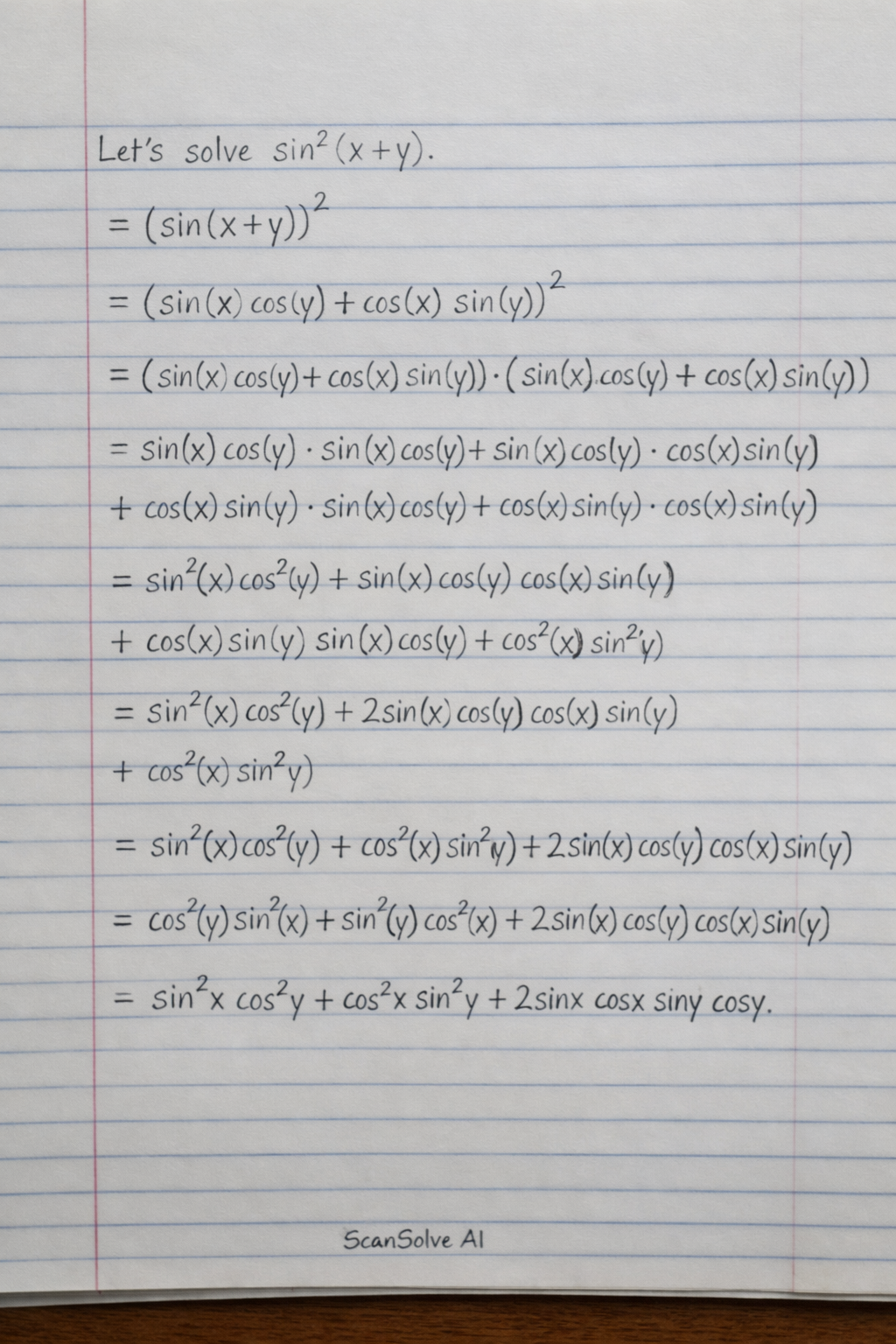
The expression sin2(x+y)\sin^2(x+y) means (sin(x+y))2(\sin(x+y))^2. It signifies that the entire value of sin(x+y)\sin(x+y) is squared, not the individual variables xx or yy within the argument of the sine function.

Similarly, cos2(x+y)\cos^2(x+y) means (cos(x+y))2(\cos(x+y))^2.

If we were to square xx and yy individually, the expression would look like sin(x2+y2)\sin(x^2+y^2) or cos(x2+y2)\cos(x^2+y^2), which is a different mathematical operation. In this problem, the squaring applies to the result of the sine or cosine function, not to its input angles.

Got more? Send 'em!

Was this helpful?

Need help with your own homework?

Get instant step-by-step solutions to any question. Free to start.

Ask Your Question
Handwritten step-by-step solution preview

Handwritten Step-by-Step Solution

Get this as a handwritten image on WhatsApp — like a tutor wrote it for you.

Try on WhatsApp

Still have questions?

Quick Answer

You're asking a great question about notation! The expression ^2(x+y) means ((x+y))^2.

Why you don't square x and y
Mathematics

This mathematics problem involves applying core mathematical principles and formulas. Below you will find a complete step-by-step solution with detailed explanations for each step, helping you understand not just the answer but the method behind it.

ScanSolve AI Answer
You're asking a great question about notation! The expression ^2(x+y) means ((x+y))^2. It signifies that the entire value of (x+y) is squared, not the individual variables x or y within the argument of the sine function. Similarly, ^2(x+y) means ((x+y))^2. If we were to square x and y individually, the expression would look like (x^2+y^2) or (x^2+y^2), which is a different mathematical operation. In this problem, the squaring applies to the result of the sine or cosine function, not to its input angles. Got more? Send 'em!