
We read your photo as:
Define atmospheric pressure as used in Physics.
ScanSolve AI Answer
Step-by-step solution
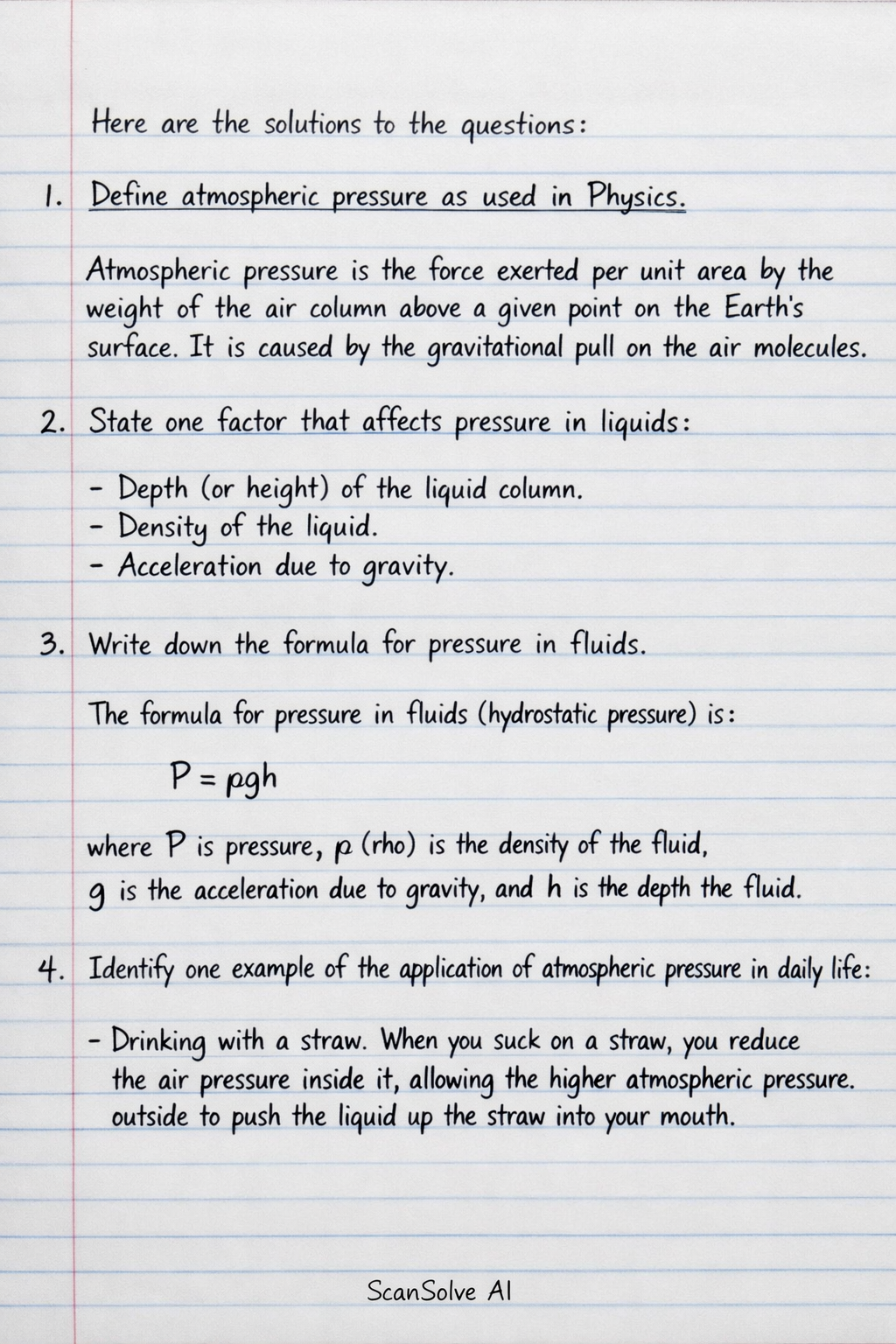
10 stepsHere are the solutions to the questions:
Define atmospheric pressure as used in Physics.
Atmospheric pressure is the force exerted per unit area by the weight of the air column above a given point on the Earth's surface. It is caused by the gravitational pull on the air molecules.
State one factor that affects pressure in liquids.
- Depth (or height) of the liquid column.
- Density of the liquid.
- Acceleration due to gravity.
Write down the formula for pressure in fluids.
The formula for pressure in fluids (hydrostatic pressure) is:
where is pressure, (rho) is the density of the fluid, is the acceleration due to gravity, and is the depth of the fluid.
Identify one example of the application of atmospheric pressure in daily life.
- Drinking with a straw. When you suck on a straw, you reduce the air pressure inside it, allowing the higher atmospheric pressure outside to push the liquid up the straw into your mouth.
Mention one device that demonstrates the transmission of pressure in fluids.
- Hydraulic press (or hydraulic jack).
List two examples of hydraulic machines.
- Hydraulic brakes
- Hydraulic jack
- Hydraulic lift
Define a syphon.
A syphon is a tube used to transfer liquid from a higher reservoir to a lower one, passing over an intermediate high point, by means of gravity and atmospheric pressure. It works by creating a pressure difference that pushes the liquid up and over the high point.
State the unit of pressure in the SI system.
The SI unit of pressure is the Pascal (Pa). It is equivalent to one Newton per square meter ().
Explain how the existence of atmospheric pressure can be demonstrated using...
(Assuming the question refers to a common demonstration like the crushing can experiment)
The existence of atmospheric pressure can be demonstrated using a crushing can experiment. A small amount of water is boiled in a thin metal can, filling it with steam and expelling most of the air. When the can is quickly sealed and cooled (e.g., by plunging it into cold water), the steam condenses, creating a partial vacuum inside. The much greater external atmospheric pressure then crushes the can inwards.a) Describe two effects of atmospheric pressure in nature.
- Weather patterns: Differences in atmospheric pressure create pressure gradients, leading to the movement of air (wind) and influencing weather phenomena like storms and high/low-pressure systems.
- Breathing in mammals: Atmospheric pressure plays a crucial role in respiration. When the diaphragm contracts, the volume of the chest cavity increases, reducing the pressure inside the lungs below atmospheric pressure, which causes air to rush in.
Still stuck on this one?
Ask a follow-up, and the answer starts from this question.
More Physics Questions
Handwritten Step-by-Step Solution
Get this as a handwritten image on WhatsApp — like a tutor wrote it for you.
Try on WhatsApp