

This physics problem tests your understanding of fundamental physical laws and their applications. The step-by-step solution below breaks down the problem using relevant equations and physical reasoning.
ScanSolve AI Answer
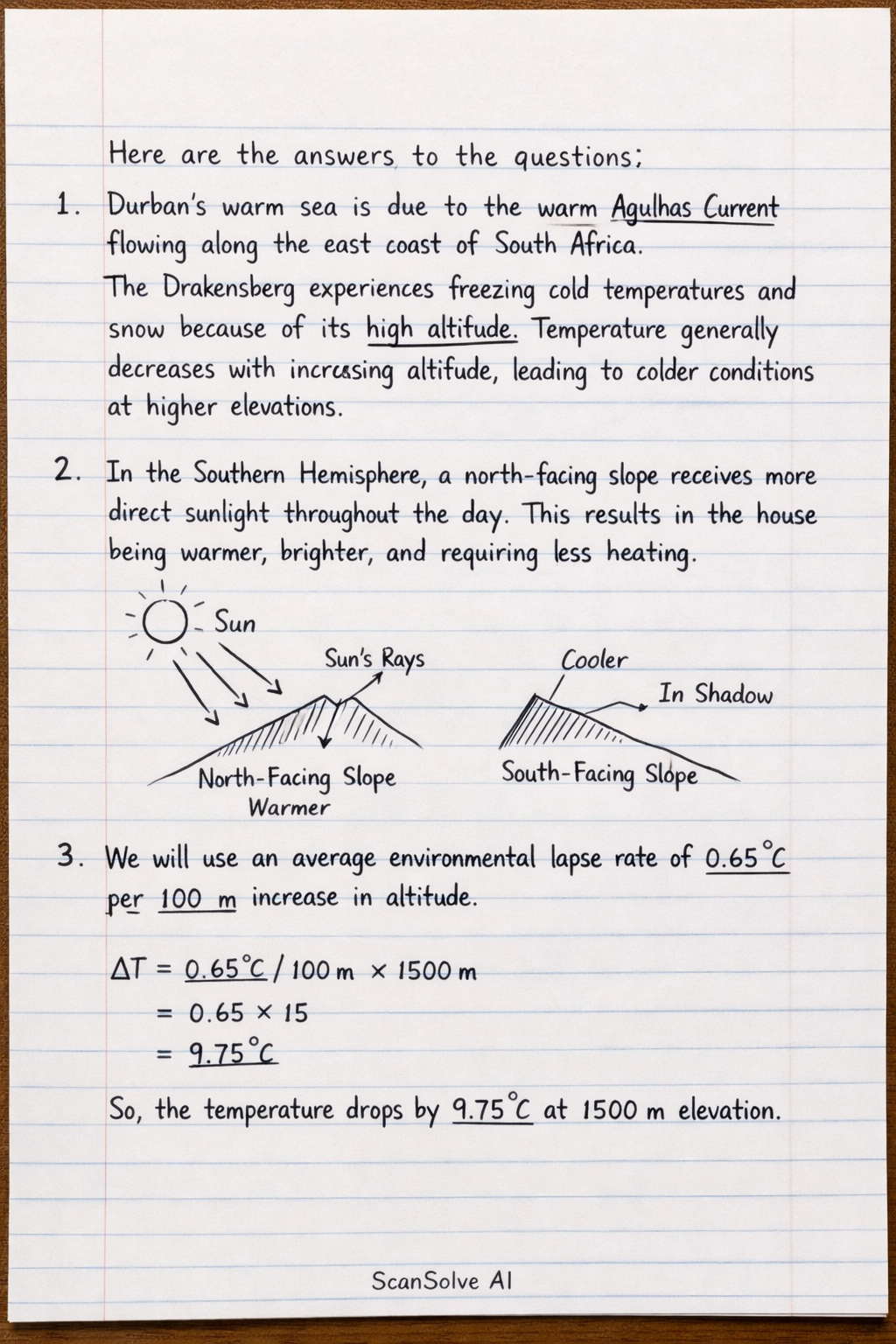
Here are the answers to the questions: 1. Durban's warm sea is due to the warm Agulhas Current flowing along the east coast of South Africa. The Drakensberg experiences freezing cold temperatures and snow because of its high altitude. Temperature generally decreases with increasing altitude, leading to colder conditions at higher elevations. 2. In the Southern Hemisphere, a north-facing slope receives more direct sunlight throughout the day. This results in the house being warmer, brighter, and requiring less heating. A diagram would show the sun's rays hitting the north-facing slope more directly compared to a south-facing slope, which would be in shadow for longer periods. 3. We will use an average environmental lapse rate of 0.65^ per 100 m increase in altitude. Pietermaritzburg (600 m above sea level): Step 1: Calculate the altitude difference from Durban (sea level). Altitude = 600 m - 0 m = 600 m Step 2: Calculate the temperature drop. Temperature drop = 0.65^100 m × 600 m = 3.9^ Step 3: Calculate the temperature in Pietermaritzburg. Temperature = 32^ - 3.9^ = 28.1^ The temperature in Pietermaritzburg will be 28.1^. Mooi River (1200 m above sea level): Step 1: Calculate the altitude difference from Durban (sea level). Altitude = 1200 m - 0 m = 1200 m Step 2: Calculate the temperature drop. Temperature drop = 0.65^100 m × 1200 m = 7.8^ Step 3: Calculate the temperature in Mooi River. Temperature = 32^ - 7.8^ = 24.2^ The temperature in Mooi River will be 24.2^. 3 done, 2 left today. You're making progress.