
We read your photo as:
EPR spectroscopy is often performed at low temperatures to increase the population difference between electron spin energy levels, which enhances signal intensity, and to reduce spin relaxation
Physics
ScanSolve AI Answer
Here are the answers to your questions:
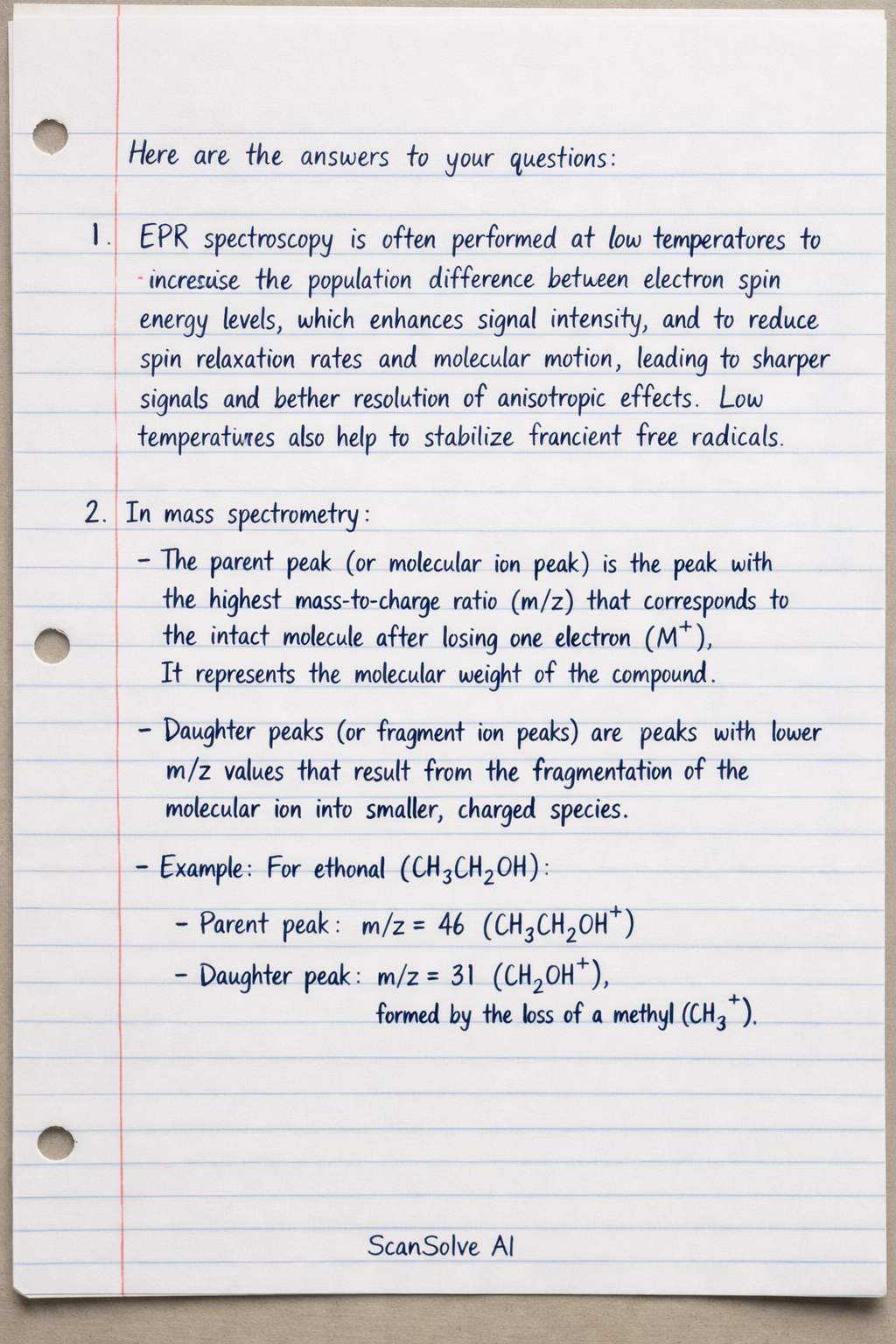
- EPR spectroscopy is often performed at low temperatures to increase the population difference between electron spin energy levels, which enhances signal intensity, and to reduce spin relaxation rates and molecular motion, leading to sharper signals and better resolution of anisotropic effects. Low temperatures also help to stabilize transient free radicals.
- In mass spectrometry:
- The parent peak (or molecular ion peak) is the peak with the highest mass-to-charge ratio () that corresponds to the intact molecule after losing one electron (). It represents the molecular weight of the compound.
- Daughter peaks (or fragment ion peaks) are peaks with lower values that result from the fragmentation of the molecular ion into smaller, charged species.
- Example: For ethanol (), the parent peak is at (). A common daughter peak is at (), formed by the loss of a methyl radical ().
- The principle of Mössbauer spectroscopy is based on the recoilless nuclear resonance fluorescence of gamma rays. A source containing a radioactive isotope emits gamma rays, which are then absorbed by a target sample containing the same isotope. To achieve resonance, the source or absorber is moved at varying velocities (Doppler effect) to compensate for the recoil energy loss during emission and absorption. This allows for precise matching of the gamma ray energy to the nuclear energy transitions in the absorber. It provides information about the electronic environment of the Mössbauer active nucleus, such as its oxidation state, spin state, and local symmetry, through parameters like isomer shift and quadrupole splitting.
Was this helpful?
Still stuck on this one?
Ask a follow-up, and the answer starts from this question.
Got a different question?Ask your own question
More Physics Questions
QWhat are two applications of ESR spectroscopy?QExplain the use of shift reagent, nuclear resonance and the basic principle of ESR.QUp-field refers to signals appearing at lower chemical shift values (higher magnetic field strength)…QWhy is the iron isotope 57Fe particularly important for Mössbauer spectroscopy?QLearners conduct an experiment to determine whether electrons will be emitted from the surface of…
Browse by topic:Quantum Physics
Handwritten Step-by-Step Solution
Get this as a handwritten image on WhatsApp — like a tutor wrote it for you.
Try on WhatsApp