
We read your photo as:
No Restoring Force Proportional to Displacement: Simple harmonic motion requires a restoring force that is directly proportional to the displacement from a fixed equilibrium position and always
Physics
ScanSolve AI Answer
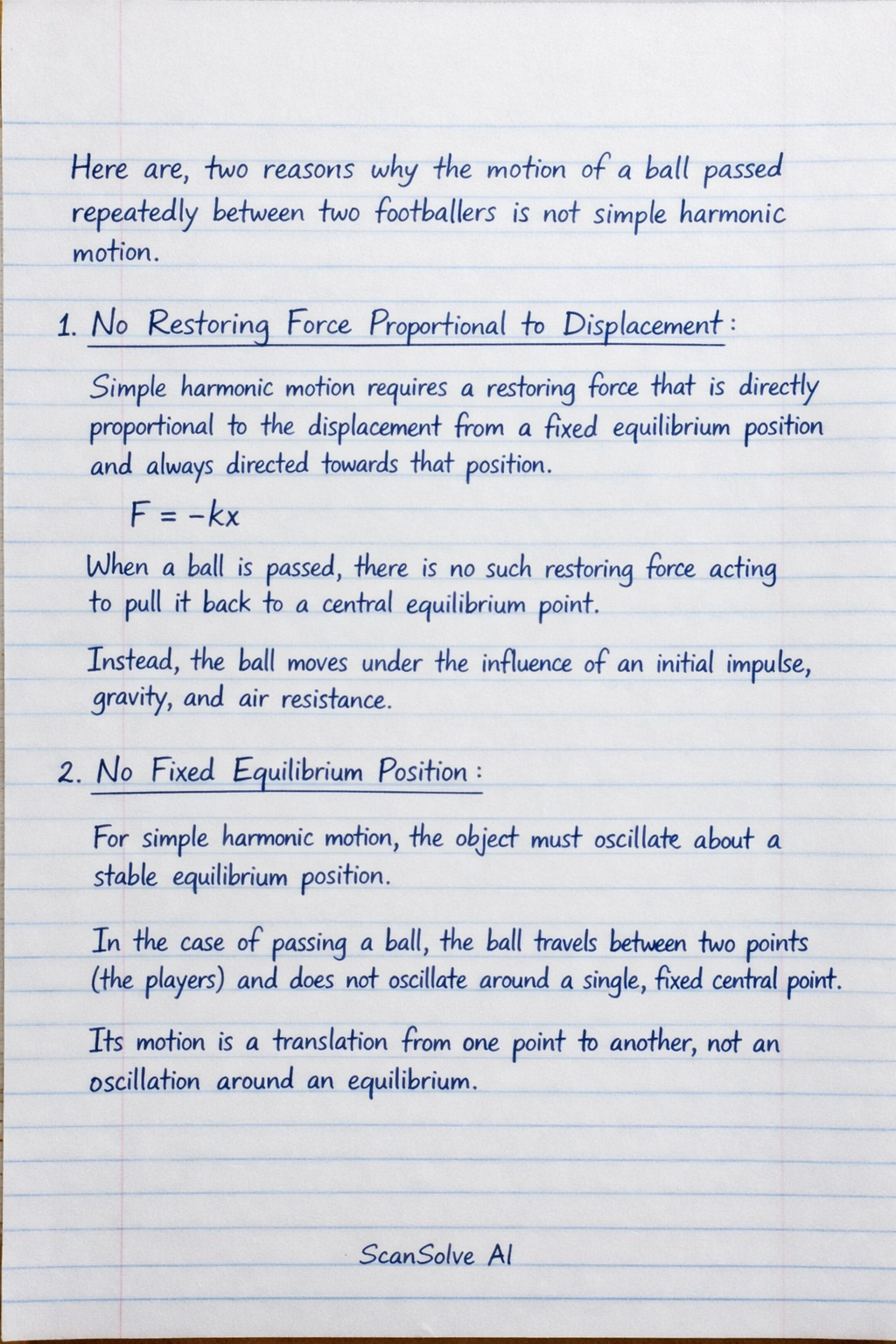
Here are two reasons why the motion of a ball passed repeatedly between two footballers is not simple harmonic motion:
- No Restoring Force Proportional to Displacement: Simple harmonic motion requires a restoring force that is directly proportional to the displacement from a fixed equilibrium position and always directed towards that position (). When a ball is passed, there is no such restoring force acting to pull it back to a central equilibrium point. Instead, the ball moves under the influence of an initial impulse, gravity, and air resistance.
- No Fixed Equilibrium Position: For simple harmonic motion, the object must oscillate about a stable equilibrium position. In the case of passing a ball, the ball travels between two points (the players) and does not oscillate around a single, fixed central point. Its motion is a translation from one point to another, not an oscillation around an equilibrium.
Was this helpful?
Still stuck on this one?
Ask a follow-up, and the answer starts from this question.
Got a different question?Ask your own question
More Physics Questions
QSimple Harmonic Motion (SHM)*: This occurs when the restoring force is directly proportional to the…QThe displacement y of a particle executing simple harmonic motion is given by the equation:QNo Middle Point Pull: The ball doesn't have a "middle point" that pulls it back. It just flies from…QWhat is restoring forceQDefine Simple Harmonic Motion. Give four examples of systems that undergo SHM. A 10kg mass attached…
Browse by topic:Mechanics
Handwritten Step-by-Step Solution
Get this as a handwritten image on WhatsApp — like a tutor wrote it for you.
Try on WhatsApp