
We read your photo as:
1 State the Principle of Conservation of Momentum. 7.2 Percy states that when he stops pedalling on his quad bike, the bike will continue to move at a constant velocity because the total momentum of t
ScanSolve AI Answer
Step-by-step solution
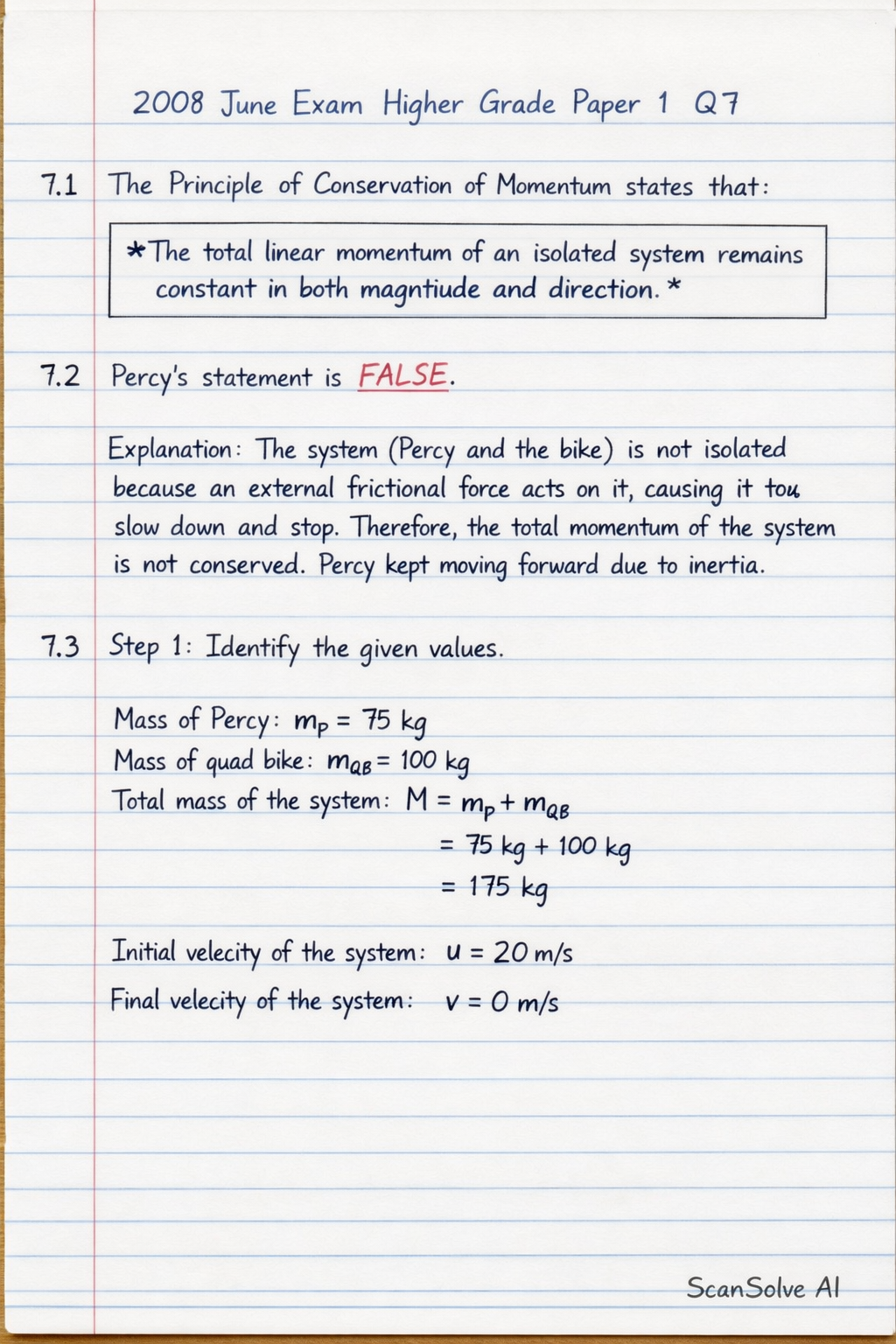
8 steps2008 June Exam Higher Grade Paper 1 Q 7
Part 7.1
The Principle of Conservation of Momentum states that
Part 7.2
Percy's statement is .
Explanation: The system (Percy and the bike) is not isolated because an external frictional force acts on it, causing it to slow down and stop. Therefore, the total momentum of the system is not conserved. Percy kept moving forward due to inertia.
Part 7.3· 1 step
Step 1: Identify the given values.
Mass of Percy
Mass of quad bike
Total mass of the system
Initial velocity of the system
Final velocity of the system
Calculate the change in momentum.
The change in momentum of Percy and the bike is
Part 7.4· 1 step
Step 1: Use the impulse-momentum theorem.
Given:
Change in momentum (from 7.3)
Time taken
Average frictional force
Calculate the average frictional force.
In this case, the net force is the frictional force.
The magnitude of the average frictional force is
Part 7.5· 1 step
Step 1: Calculate the distance travelled while stopping.
We need the acceleration first.
Now, calculate the distance using a kinematic equation:
Calculate the work done by the frictional force.
Work done . The frictional force acts opposite to the direction of motion, so and .
Alternatively, using the work-energy theorem:
The work done by the frictional force is (The negative sign indicates work done against motion).
2015 Free State Prelim Paper 1 Q4
Part 4.1
The Law of Conservation of Momentum states that
Part 4.2
The condition for an elastic collision is that
Part 4.3· 2 steps
Step 1: Identify the given values.
Mass of trolley
Initial velocity of trolley (east, let's take east as positive)
Mass of brick
Initial velocity of brick (dropped onto the trolley)
Apply the principle of conservation of linear momentum to find the final velocity of the combined system.
Calculate the change in momentum of the 5 kg trolley.
The change in momentum of the 5 kg trolley is (rounded to two decimal places).
2008 Exemplar Paper 1 Q 2
Part 2.1· 1 step
Step 1: Identify the given values and define a positive direction.
Let right be the positive direction.
Mass of car
Initial velocity of car (to the left)
Mass of minibus
Initial velocity of minibus (to the right)
The vehicles move together after the collision, so they have a common final velocity .
Apply the principle of conservation of linear momentum.
The velocity of the two vehicles after the collision is
Part 2.2· 2 steps
Step 1: Calculate the total initial kinetic energy.
Calculate the total final kinetic energy.
Compare initial and final kinetic energies.
Since and ,
Therefore, kinetic energy is not conserved, and the collision was
Still stuck on this one?
Ask a follow-up, and the answer starts from this question.
More Physics Questions
Handwritten Step-by-Step Solution
Get this as a handwritten image on WhatsApp — like a tutor wrote it for you.
Try on WhatsApp