
We read your photo as:
The slope of a distance-time graph represents the rate of change of distance with respect to time, which is velocity.
ScanSolve AI Answer
Step-by-step solution
2 stepsHere are the solutions to the questions:
-
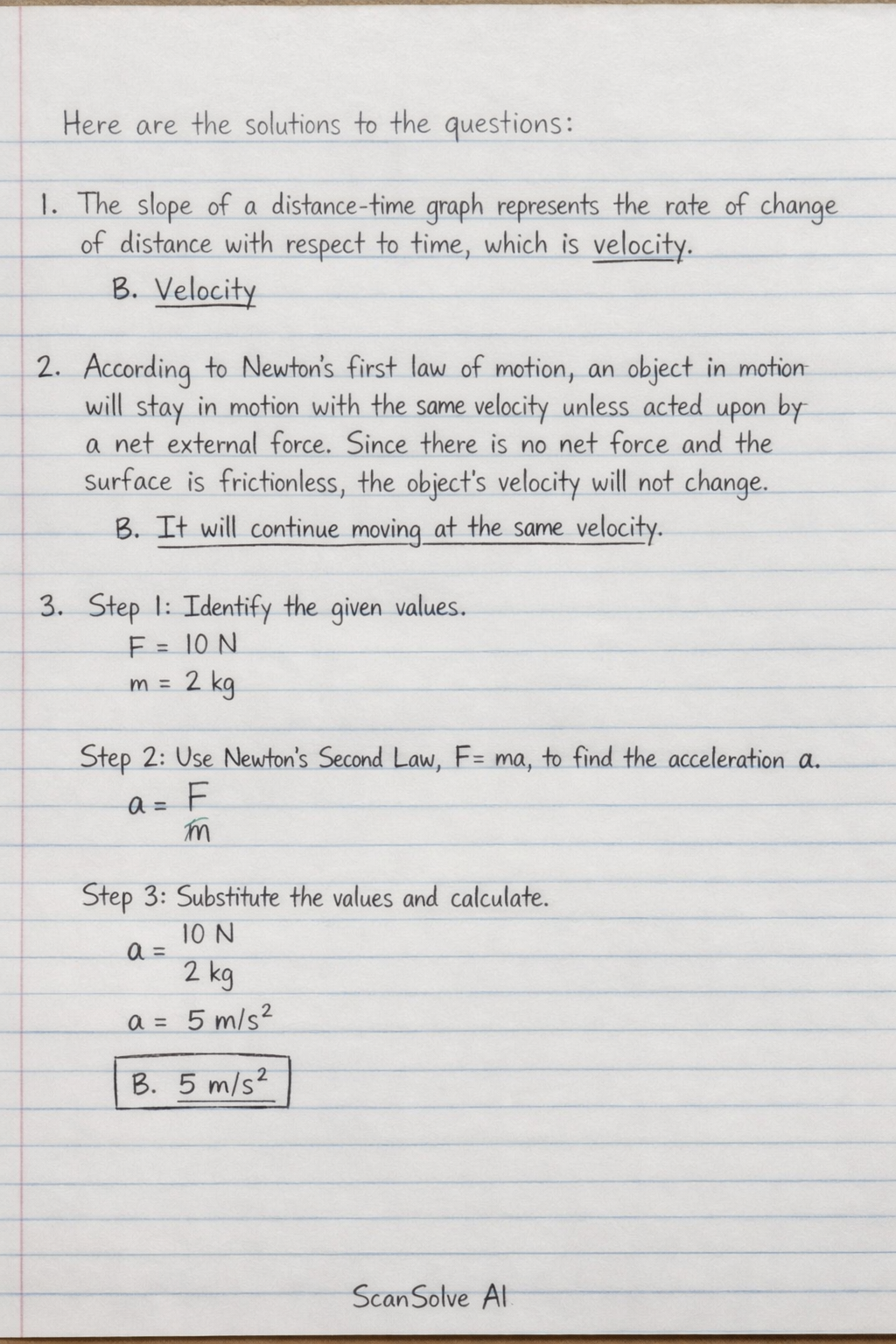
The slope of a distance-time graph represents the rate of change of distance with respect to time, which is velocity. B. Velocity
-
According to Newton's first law of motion, an object in motion will stay in motion with the same velocity unless acted upon by a net external force. Since there is no net force and the surface is frictionless, the object's velocity will not change. B. It will continue moving at the same velocity.
-
Step 1: Identify the given values.
Use Newton's Second Law of Motion, , to find the acceleration .
$$ a = \frac{F}{m} $$Substitute the values and calculate.
$$ a = \frac{10 \text{ N}}{2 \text{ kg}} $$ $$ a = 5 \text{ m/s}^2 $$ B. $\boxed{\text{5 m/s}^2}$4. In any collision where no external forces are acting on the system, the total momentum of the system is conserved. In a completely inelastic collision, the objects stick together, and kinetic energy is not conserved because some of it is converted into other forms of energy (like heat or sound) during the deformation. A. Momentum
Still stuck on this one?
Ask a follow-up, and the answer starts from this question.
More Physics Questions
Handwritten Step-by-Step Solution
Get this as a handwritten image on WhatsApp — like a tutor wrote it for you.
Try on WhatsApp