

This physics problem tests your understanding of fundamental physical laws and their applications. The step-by-step solution below breaks down the problem using relevant equations and physical reasoning.
ScanSolve AI Answer
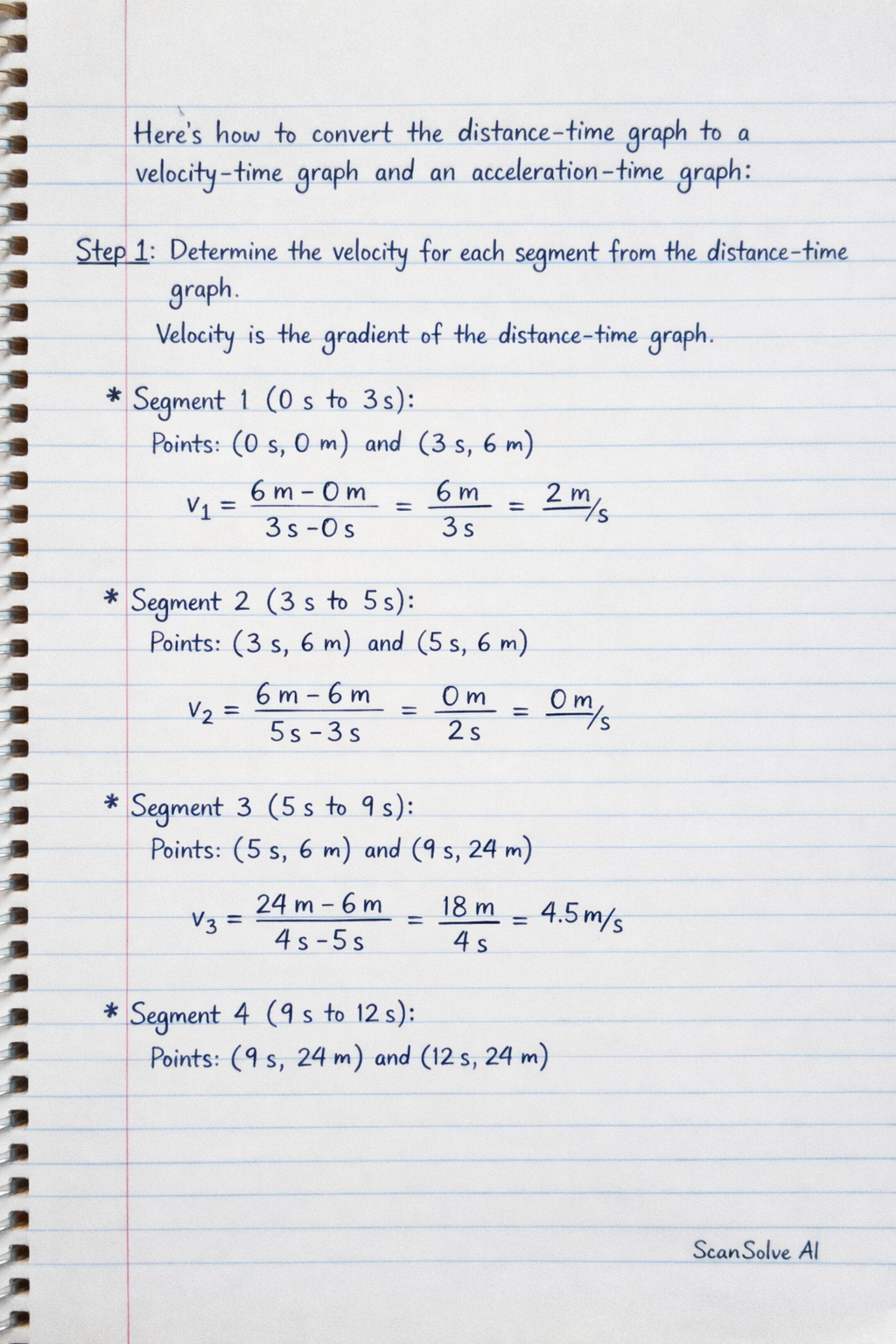
Here's how to convert the distance-time graph to a velocity-time graph and an acceleration-time graph: Step 1: Determine the velocity for each segment from the distance-time graph. Velocity is the gradient of the distance-time graph. Segment 1 (0 s to 3 s): Points: (0 s, 0 m) and (3 s, 6 m) v_1 = 6 m - 0 m3 s - 0 s = 6 m3 s = 2 m/s Segment 2 (3 s to 5 s): Points: (3 s, 6 m) and (5 s, 6 m) v_2 = 6 m - 6 m5 s - 3 s = 0 m2 s = 0 m/s Segment 3 (5 s to 9 s): Points: (5 s, 6 m) and (9 s, 24 m) v_3 = 24 m - 6 m9 s - 5 s = 18 m4 s = 4.5 m/s Segment 4 (9 s to 12 s): Points: (9 s, 24 m) and (12 s, 24 m) v_4 = 24 m - 24 m12 s - 9 s = 0 m3 s = 0 m/s Step 2: Describe the Velocity-Time Graph. The velocity-time graph (with velocity on the y-axis in m/s and time on the x-axis in s) would show: A horizontal line at v = 2 m/s from t=0 s to t=3 s. A horizontal line at v = 0 m/s (on the time axis) from t=3 s to t=5 s. A horizontal line at v = 4.5 m/s from t=5 s to t=9 s. A horizontal line at v = 0 m/s (on the time axis) from t=9 s to t=12 s. Step 3: Determine the acceleration for each segment from the calculated velocities. Acceleration is the gradient of the velocity-time graph. Since the velocity is constant in each segment, the acceleration within each segment is zero. Segment 1 (0 s to 3 s): Velocity is constant at 2 m/s. a_1 = ( v)/( t) = 0 m/s^2 Segment 2 (3 s to 5 s): Velocity is constant at 0 m/s. a_2 = ( v)/( t) = 0 m/s^2 Segment 3 (5 s to 9 s): Velocity is constant at 4.5 m/s. a_3 = ( v)/( t) = 0 m/s^2 Segment 4 (9 s to 12 s): Velocity is constant at 0 m/s. a_4 = ( v)/( t) = 0 m/s^2 Step 4: Describe the Acceleration-Time Graph. The acceleration-time graph (with acceleration on the y-axis in m/s^2 and time on the x-axis in s) would show: A horizontal line at a = 0 m/s^2 (on the time axis) from t=0 s to t=12 s. Summary of Graph Conversions: l Velocity-Time Graph: \\ • From t=0 s to t=3 s, velocity is 2 m/s. \\ • From t=3 s to t=5 s, velocity is 0 m/s. \\ • From t=5 s to t=9 s, velocity is 4.5 m/s. \\ • From t=9 s to t=12 s, velocity is 0 m/s. \\ The graph consists of horizontal segments at these velocity values. \\ \\ Acceleration-Time Graph: \\ • From t=0 s to t=12 s, acceleration is 0 m/s^2. \\ The graph is a horizontal line along the time axis.