
We read your photo as:
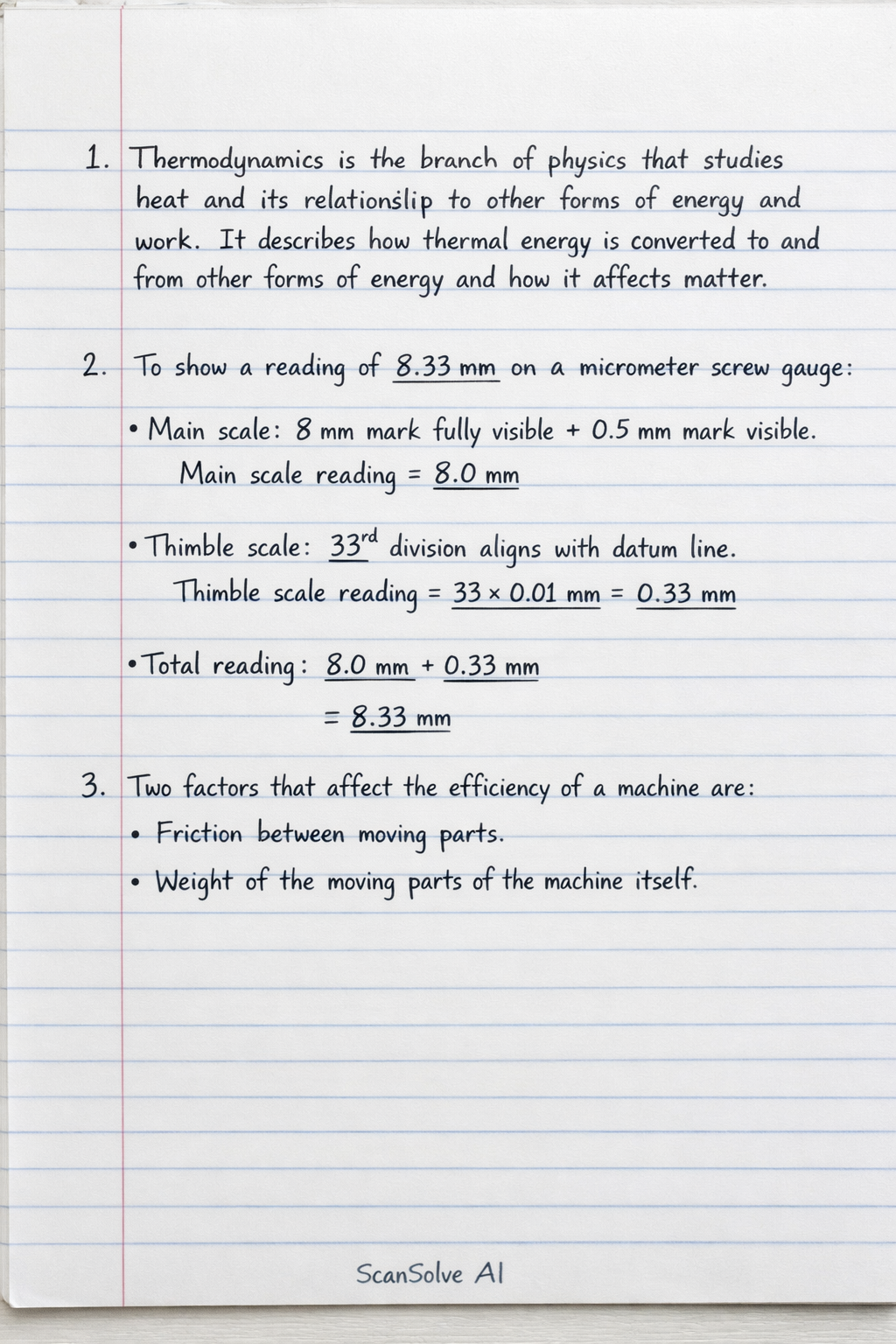
Thermodynamics is the branch of physics that studies heat and its relationship to other forms of energy and work. It describes how thermal energy is converted to and from other forms of e
ScanSolve AI Answer
Answer
Step-by-step solution
4 steps1. Thermodynamics is the branch of physics that studies heat and its relationship to other forms of energy and work. It describes how thermal energy is converted to and from other forms of energy and how it affects matter.
2. To show a reading of on a micrometer screw gauge:
- The main scale (sleeve) should show the mark fully visible, and the mark after it should also be visible. This gives a main scale reading of .
- The thimble scale should be rotated so that the division aligns with the datum line on the sleeve. This gives a thimble scale reading of .
- The total reading is the sum of the main scale and thimble scale readings: .
3. Two factors that affect the efficiency of a machine are:
- Friction between moving parts.
- Weight of the moving parts of the machine itself.
4.
- If the temperature of end B (ammonia end) is lowered and end A (HCl end) is maintained, the new white deposit will form closer to end B. An arrow indicating this shift would point from the original position of the white fumes towards end B.
- Reason: Lowering the temperature at end B decreases the kinetic energy of the ammonia gas molecules, which in turn reduces their rate of diffusion. Since the temperature at end A is maintained, the rate of diffusion of hydrogen chloride gas remains unchanged. As ammonia diffuses slower, the meeting point of the two gases, where the white ammonium chloride fumes form, shifts towards the ammonia end (end B).
5.
Identify the forces and distances from the pivot.
The beam is uniform, so its weight () acts at its center of gravity, which is at the midpoint of its length.
Length of beam .
Center of gravity (CG) is at from either end.
The pivot is () from the right end.
The spring balance is () from the left end.
The reading of the spring balance .Calculate the distances of the forces from the pivot.
Distance from the left end to the pivot = .
Distance of the spring balance from the pivot (anticlockwise moment arm) = .
Distance of the center of gravity from the pivot (clockwise moment arm) = .Apply the principle of moments.
For the beam to be in equilibrium, the sum of clockwise moments about the pivot must equal the sum of anticlockwise moments about the pivot.
Solve for the weight of the beam ().
The weight of the beam is .
Try one yourself
A new problem that tests the same skill.
Still stuck on this one?
Ask a follow-up, and the answer starts from this question.
More Physics Questions
Handwritten Step-by-Step Solution
Get this as a handwritten image on WhatsApp — like a tutor wrote it for you.
Try on WhatsApp