

This physics problem tests your understanding of fundamental physical laws and their applications. The step-by-step solution below breaks down the problem using relevant equations and physical reasoning.
ScanSolve AI Answer
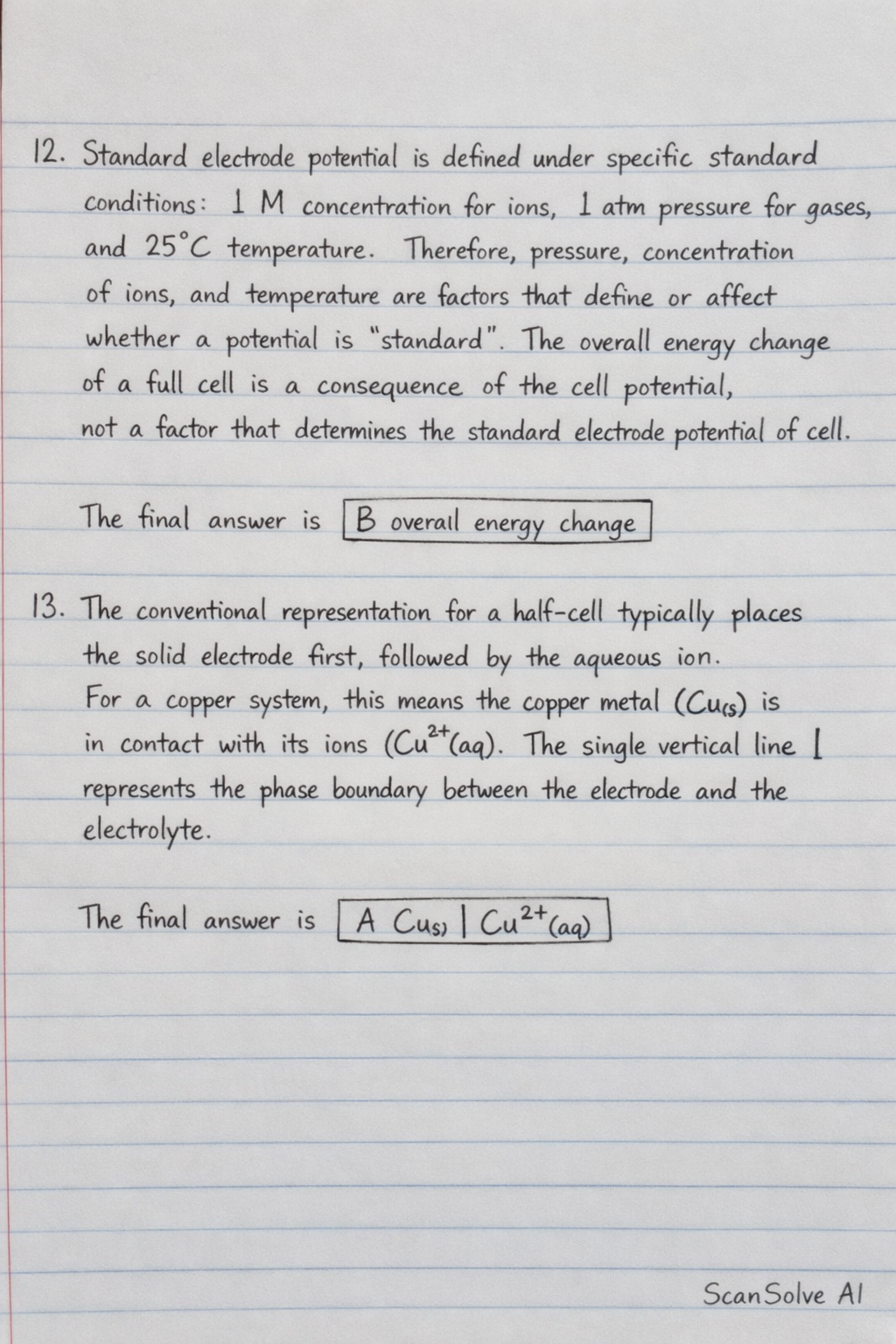
12. Standard electrode potential is defined under specific standard conditions: 1 M concentration for ions, 1 atm pressure for gases, and 25^ C temperature. Therefore, pressure, concentration of ions, and temperature are factors that define or affect whether a potential is "standard". The overall energy change of a full cell is a consequence of the cell potential, not a factor that determines the standard electrode potential of a half-cell. The final answer is B overall energy change. 13. The conventional representation for a half-cell typically places the solid electrode first, followed by the aqueous ion. For a copper system, this means the copper metal (Cu_(s)) is in contact with its ions (Cu^2+_(aq)). The single vertical line | represents the phase boundary between the electrode and the electrolyte. The final answer is A Cu_(s) | Cu^2+_(aq). 14. A device consisting of two half-cells that converts chemical energy into electrical energy through spontaneous redox reactions is called an electrochemical cell (specifically, a galvanic or voltaic cell). The final answer is B electrochemical cell.