12a (i). What is meant by resultant force? (ii). Consider four forces acting at a point as shown in figure 3. Find the magnitude and direction of the resultant force.

Physics
12a (i). What is meant by resultant force? (ii). Consider four forces acting at a point as shown in figure 3. Find the magnitude and direction of the resultant force.

ScanSolve AI Answer

Answer

0.015 J

Here's the solution to question 13b:

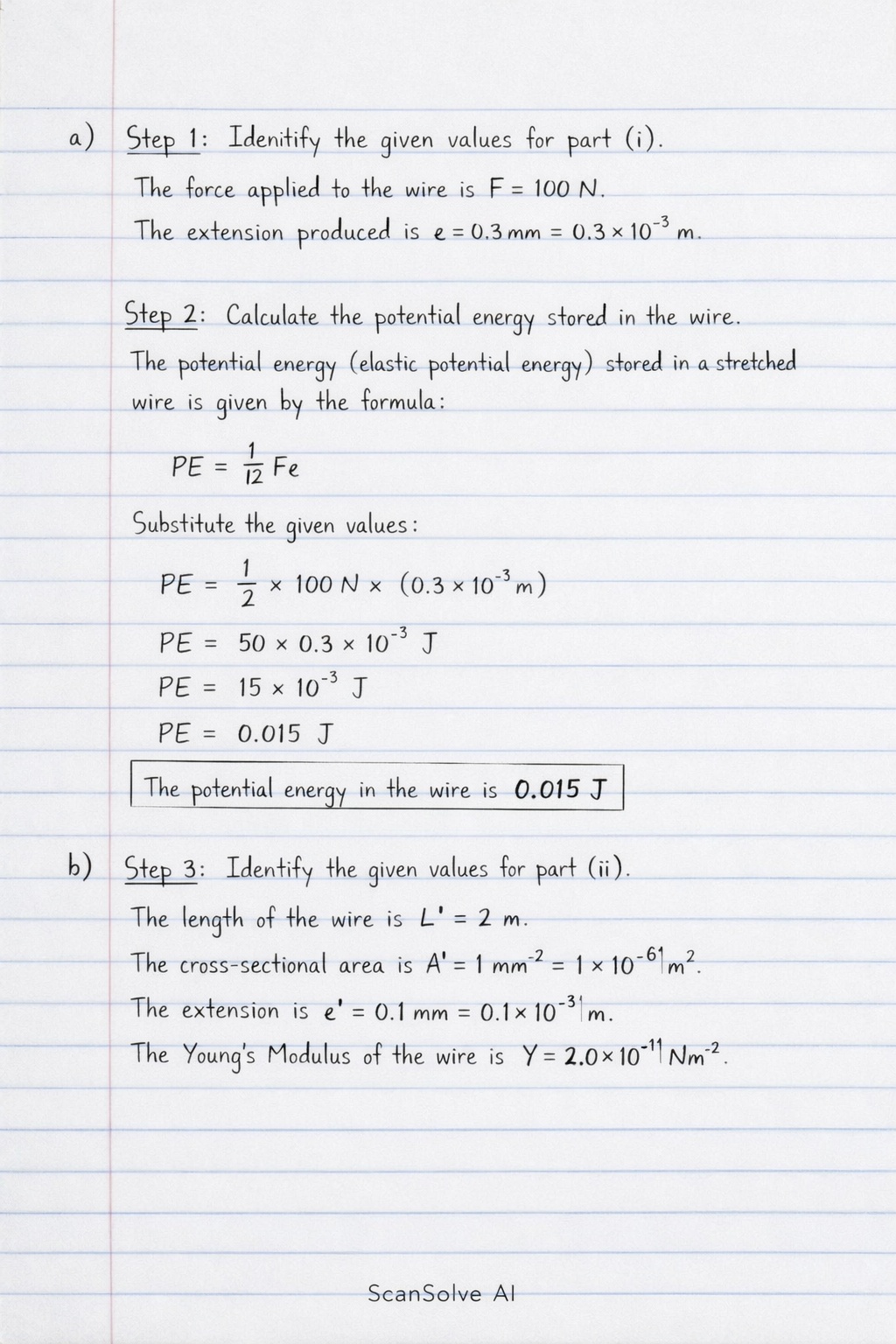
a) Step 1: Identify the given values for part (i). The force applied to the wire is F=100NF = 100 \, \text{N}. The extension produced is e=0.3mm=0.3×10³me = 0.3 \, mm = 0.3 \times 10^{-3} \, \text{m}.

Step 2: Calculate the potential energy stored in the wire. The potential energy (elastic potential energy) stored in a stretched wire is given by the formula: PE=12FePE = \frac{1}{2} F e Substitute the given values: PE=12×100N×(0.3×103m)PE = \frac{1}{2} \times 100 \, N \times (0.3 \times 10^{-3} \, m) PE=50×0.3×103JPE = 50 \times 0.3 \times 10^{-3} \, \text{J} PE=15×103JPE = 15 \times 10^{-3} \, \text{J} PE=0.015JPE = 0.015 \, \text{J} The potential energy in the wire is 0.015J\boxed{0.015 J}.

b) Step 3: Identify the given values for part (ii). The length of the wire is L=2mL' = 2 \, \text{m}. The cross-sectional area is A=1mm2=1×(103)2m2=1×10⁶m2A' = 1 \, mm^2 = 1 \times (10^{-3})^2 \, m^2 = 1 \times 10^{-6} \, m^2. The extension is e=0.1mm=0.1×10³me' = 0.1 \, mm = 0.1 \times 10^{-3} \, \text{m}. The Young's Modulus of the wire is Y=2.0×10¹¹Nm2Y = 2.0 \times 10^{11} \, Nm^{-2}.

Step 4: Calculate the work done in stretching the wire. The work done in stretching a wire is equal to the elastic potential energy stored, which can be expressed using Young's Modulus: W=12AYL(e)2W = \frac{1}{2} \frac{A'Y}{L'} (e')^2 Substitute the given values: W=12×(1×106m2)×(2.0×1011Nm2)2m×(0.1×103m)2W = \frac{1}{2} \times \frac{(1 \times 10^{-6} \, m^2) \times (2.0 \times 10^{11} \, Nm^{-2})}{2 \, m} \times (0.1 \times 10^{-3} \, m)^2 W=12×2.0×105N2×(1×102×106m2)W = \frac{1}{2} \times \frac{2.0 \times 10^{5} \, N}{2} \times (1 \times 10^{-2} \times 10^{-6} \, m^2) W=12×(1.0×105N)×(1×10⁸m2)W = \frac{1}{2} \times (1.0 \times 10^{5} \, N) \times (1 \times 10^{-8} \, m^2) W=0.5×10³JW = 0.5 \times 10^{-3} \, \text{J} W=0.0005JW = 0.0005 \, \text{J} The work done in stretching the wire is 0.0005J\boxed{0.0005 J}.

Send me the next one 📸

Was this helpful?

Need help with your own homework?

Get instant step-by-step solutions to any question. Free to start.

Ask Your Question
Handwritten step-by-step solution preview

Handwritten Step-by-Step Solution

Get this as a handwritten image on WhatsApp — like a tutor wrote it for you.

Try on WhatsApp

Still have questions?

Quick Answer

Here's the solution to question 13b: a) Step 1: Identify the given values for part (i).

12a (i). What is meant by resultant force? (ii). Consider four forces acting at a point as shown in figure 3. Find the magnitude and direction of the resultant force.
Physics

This physics problem tests your understanding of fundamental physical laws and their applications. The step-by-step solution below breaks down the problem using relevant equations and physical reasoning.

ScanSolve AI Answer
Here's the solution to question 13b: a) Step 1: Identify the given values for part (i). The force applied to the wire is F = 100 \, N. The extension produced is e = 0.3 \, mm = 0.3 × 10^-3 \, m. Step 2: Calculate the potential energy stored in the wire. The potential energy (elastic potential energy) stored in a stretched wire is given by the formula: PE = (1)/(2) F e Substitute the given values: PE = (1)/(2) × 100 \, N × (0.3 × 10^-3 \, m) PE = 50 × 0.3 × 10^-3 \, J PE = 15 × 10^-3 \, J PE = 0.015 \, J The potential energy in the wire is 0.015 J. b) Step 3: Identify the given values for part (ii). The length of the wire is L' = 2 \, m. The cross-sectional area is A' = 1 \, mm^2 = 1 × (10^-3)^2 \, m^2 = 1 × 10^-6 \, m^2. The extension is e' = 0.1 \, mm = 0.1 × 10^-3 \, m. The Young's Modulus of the wire is Y = 2.0 × 10^11 \, Nm^-2. Step 4: Calculate the work done in stretching the wire. The work done in stretching a wire is equal to the elastic potential energy stored, which can be expressed using Young's Modulus: W = (1)/(2) (A'Y)/(L') (e')^2 Substitute the given values: W = (1)/(2) × (1 × 10^-6 \, m^2) × (2.0 × 10^11 \, Nm^-2)2 \, m × (0.1 × 10^-3 \, m)^2 W = (1)/(2) × 2.0 × 10^5 \, N2 × (1 × 10^-2 × 10^-6 \, m^2) W = (1)/(2) × (1.0 × 10^5 \, N) × (1 × 10^-8 \, m^2) W = 0.5 × 10^-3 \, J W = 0.0005 \, J The work done in stretching the wire is 0.0005 J. Send me the next one 📸