
We read your photo as:
A wheel and axle have radii 80cm and 10 cm respectively. If the efficiency of the machine is 0.85, what load will an applied force of 1200N to the wheel raise?
ScanSolve AI Answer
Answer
Step-by-step solution
3 steps18. A wheel and axle have radii 80cm and 10 cm respectively. If the efficiency of the machine is 0.85, what load will an applied force of 1200N to the wheel raise?
Given:
Wheel radius
Axle radius
Efficiency
Applied force (Effort)
Calculate the Velocity Ratio (VR).
The velocity ratio for a wheel and axle is the ratio of the wheel's radius to the axle's radius.
Calculate the Mechanical Advantage (MA).
The efficiency of a machine is given by the ratio of its mechanical advantage to its velocity ratio.
Rearrange to solve for MA:
Calculate the Load ().
The mechanical advantage is also defined as the ratio of the load to the effort.
Rearrange to solve for :
The load that an applied force of will raise is .
Try one yourself
A new problem that tests the same skill.
Still stuck on this one?
Ask a follow-up, and the answer starts from this question.
More Physics Questions
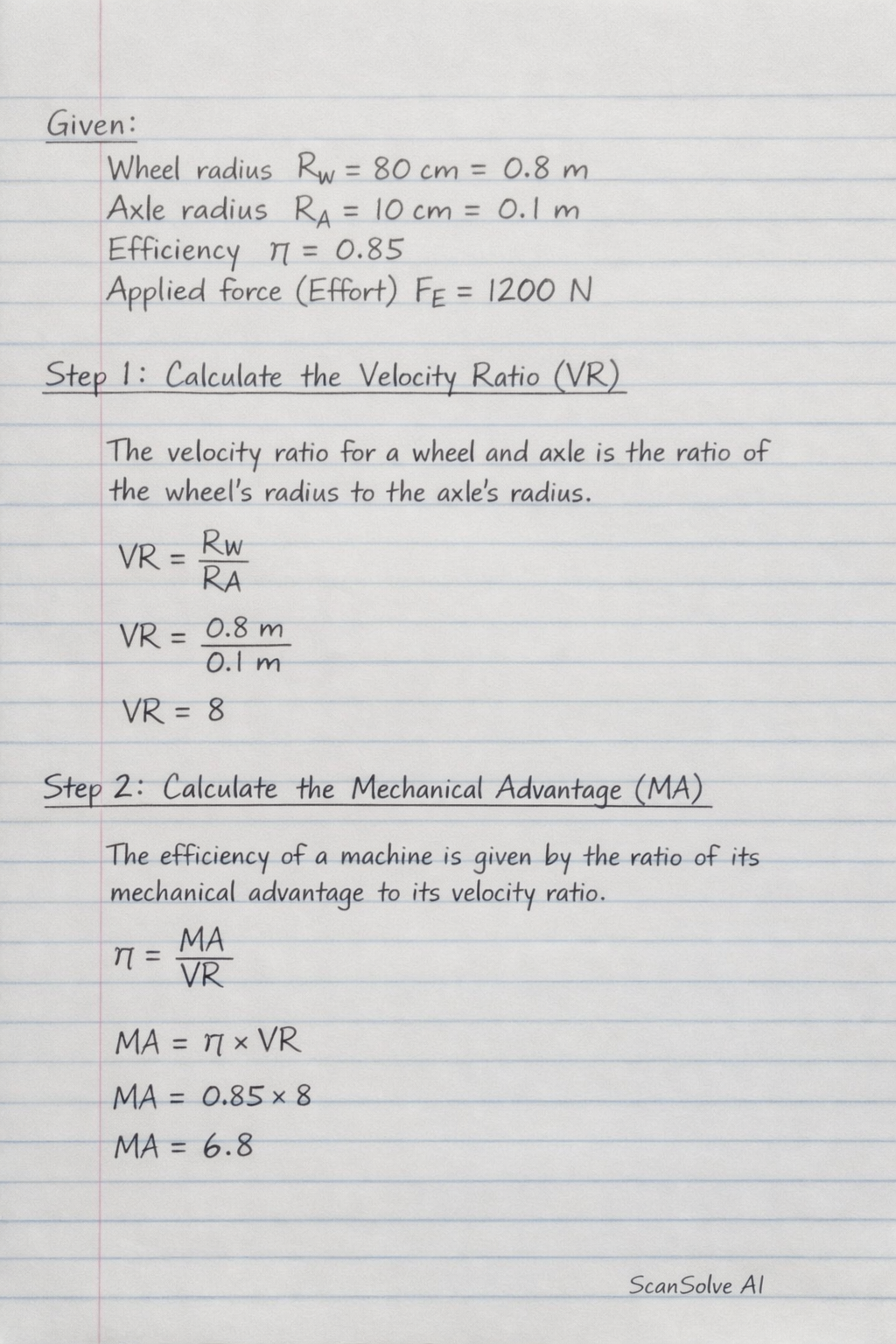
Handwritten Step-by-Step Solution
Get this as a handwritten image on WhatsApp — like a tutor wrote it for you.
Try on WhatsApp