
We read your photo as:
The specific heat capacity of a substance is an intrinsic property that describes how much heat energy is required to raise the temperature of a unit mass of that substance by one degree Kelvin (o
ScanSolve AI Answer
Answer
Step-by-step solution
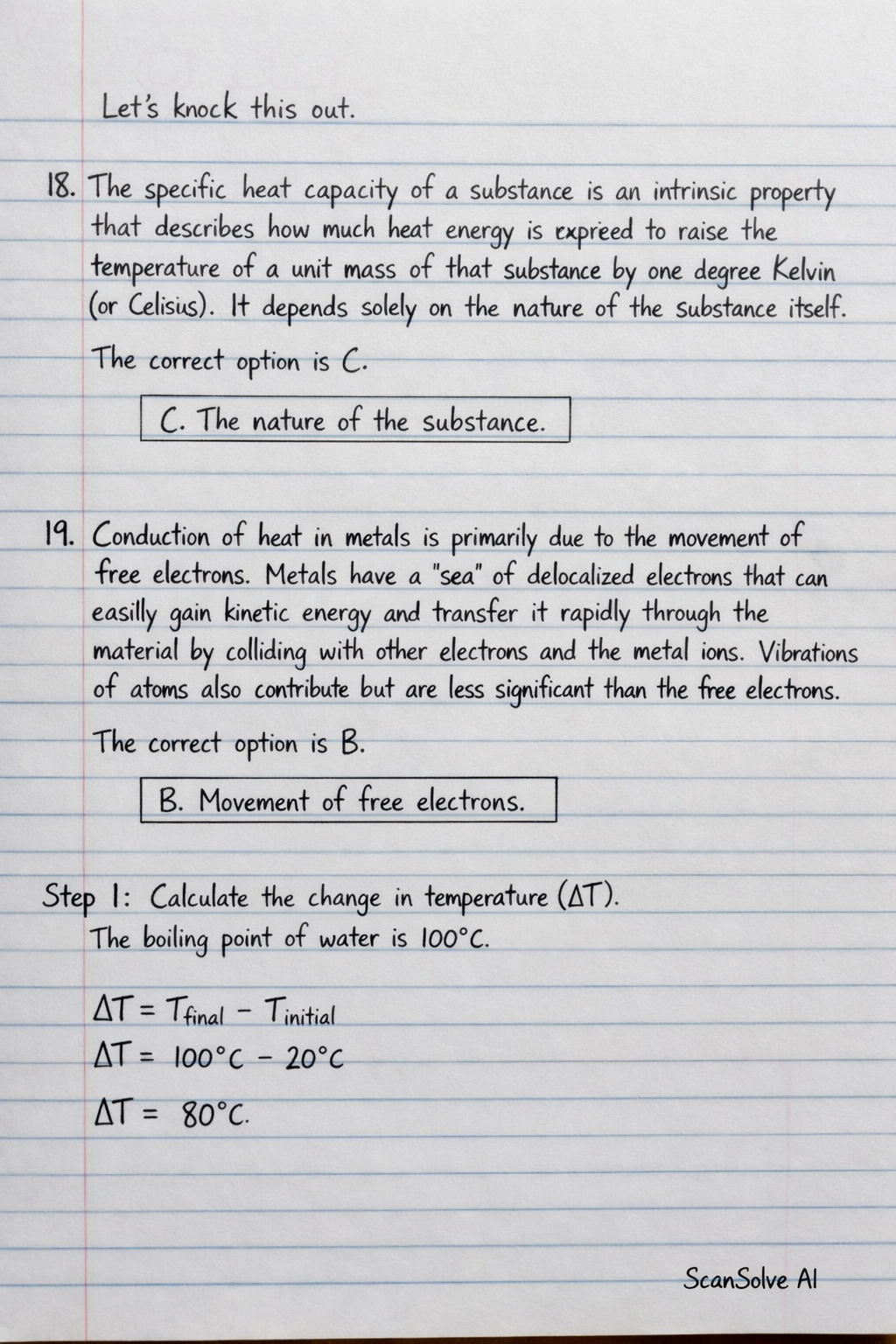
3 stepsLet's knock this out. 18. The specific heat capacity of a substance is an intrinsic property that describes how much heat energy is required to raise the temperature of a unit mass of that substance by one degree Kelvin (or Celsius). It depends solely on the nature of the substance itself.
The correct option is C.
- Conduction of heat in metals is primarily due to the movement of free electrons. Metals have a 'sea' of delocalized electrons that can easily gain kinetic energy and transfer it rapidly through the material by colliding with other electrons and the metal ions. Vibrations of atoms also contribute but are less significant than the free electrons.
The correct option is B.
Calculate the change in temperature ().
The boiling point of water is .
Calculate the total heat energy () required to raise the temperature of the water.
The formula for heat energy is .
Given:- Mass of water () =
- Specific heat capacity of water () = (or )
- Change in temperature () =
Substitute the values:
Calculate the time () taken using the power rating of the kettle.
Power () is the rate at which energy is transferred, so .
Rearrange to solve for : .
Given:- Power () = (since )
- Heat energy () =
Substitute the values:
The correct option is A.
- The statement "The increase in the internal energy of a system is equal to the heat added to the system plus the work done on the system" is the definition of the First Law of Thermodynamics. This law is a statement of the conservation of energy.
The correct option is A.
Try one yourself
A new problem that tests the same skill.
Still stuck on this one?
Ask a follow-up, and the answer starts from this question.
More Physics Questions
Handwritten Step-by-Step Solution
Get this as a handwritten image on WhatsApp — like a tutor wrote it for you.
Try on WhatsApp