
We read your photo as:
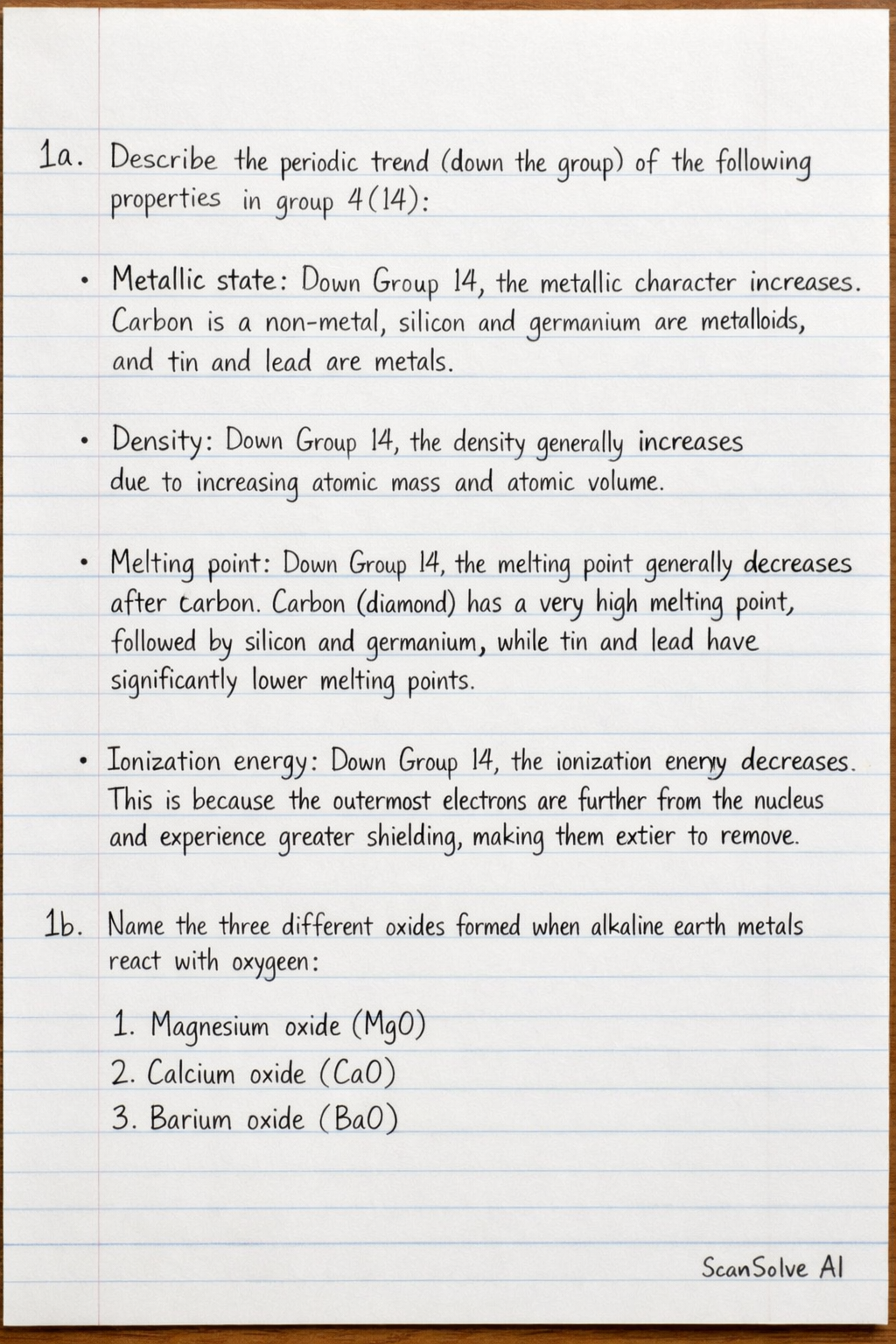
1a. Describe the periodic trend (down the group) of the following properties (metallic state, density, melting point, ionization energy) in group 4(14).
Physics
ScanSolve AI Answer
1a. Describe the periodic trend (down the group) of the following properties (metallic state, density, melting point, ionization energy) in group 4(14).
- Metallic state: Down Group 14, the metallic character increases. Carbon is a non-metal, silicon and germanium are metalloids, and tin and lead are metals.
- Density: Down Group 14, the density generally increases due to increasing atomic mass and atomic volume.
- Melting point: Down Group 14, the melting point generally decreases after carbon. Carbon (diamond) has a very high melting point, followed by silicon and germanium, while tin and lead have significantly lower melting points.
- Ionization energy: Down Group 14, the ionization energy decreases. This is because the outermost electrons are further from the nucleus and experience greater shielding, making them easier to remove.
1b. Name the three different oxides formed when alkaline earth metals react with oxygen.
The three different types of oxides formed by alkaline earth metals are:
- Normal oxides (MO): For example, , .
- Peroxides (MO): For example, , .
- Superoxides (M(O)): For example, (less common and less stable for Group 2 compared to Group 1).
1c. Write the difference between alkali metals and alkaline earth metals in terms of the following properties.
- Reactivity: Alkali metals are more reactive than alkaline earth metals due to their lower first ionization energy and larger atomic radii, making it easier to lose their single valence electron.
- Oxidation state: Alkali metals exhibit a characteristic oxidation state of +1. Alkaline earth metals exhibit a characteristic oxidation state of +2.
- Electropositivity: Alkali metals are more electropositive than alkaline earth metals because they have a greater tendency to lose electrons and form positive ions.
- Ionization energy: Alkali metals have lower first ionization energies compared to alkaline earth metals in the same period, as they only need to remove one electron to achieve a stable noble gas configuration.
2a. Briefly explain the following behaviour of group 1 metals in liquid ammonia.
- i) Solubility: Group 1 metals are highly soluble in liquid ammonia. They dissolve to form deep blue solutions.
- ii) Colour of solution: The deep blue color of the solution is due to the presence of ammoniated electrons (). At higher concentrations, the solutions become bronze-colored due to the formation of electron clusters.
- iii) Electrical conductivity: The solutions are highly electrically conductive. This is attributed to the presence of both ammoniated metal cations () and free ammoniated electrons (), which can move freely through the solution.
2b. Define the following.
- i) Electronegativity: Electronegativity is the tendency of an atom to attract a shared pair of electrons towards itself in a chemical bond.
- **ii) Ionization energy
Was this helpful?
Still stuck on this one?
Ask a follow-up, and the answer starts from this question.
Got a different question?Ask your own question
More Physics Questions
QI) Atomic radius increases down a group and decreases across a period. Element F is in Group 1…QExplain the trends in melting points, reactivity, and bonding for elements based on their position…QExplain the trends in ionization energy across a period and down a group, and how these trends…QExplain the reactivity trend in Group II elements.QI) The Group VII elements (Halogens) in order of increasing atomic number with their physical states…
Handwritten Step-by-Step Solution
Get this as a handwritten image on WhatsApp — like a tutor wrote it for you.
Try on WhatsApp