
1st law of thermodynamics??
Physics
ScanSolve AI Answer
Answer
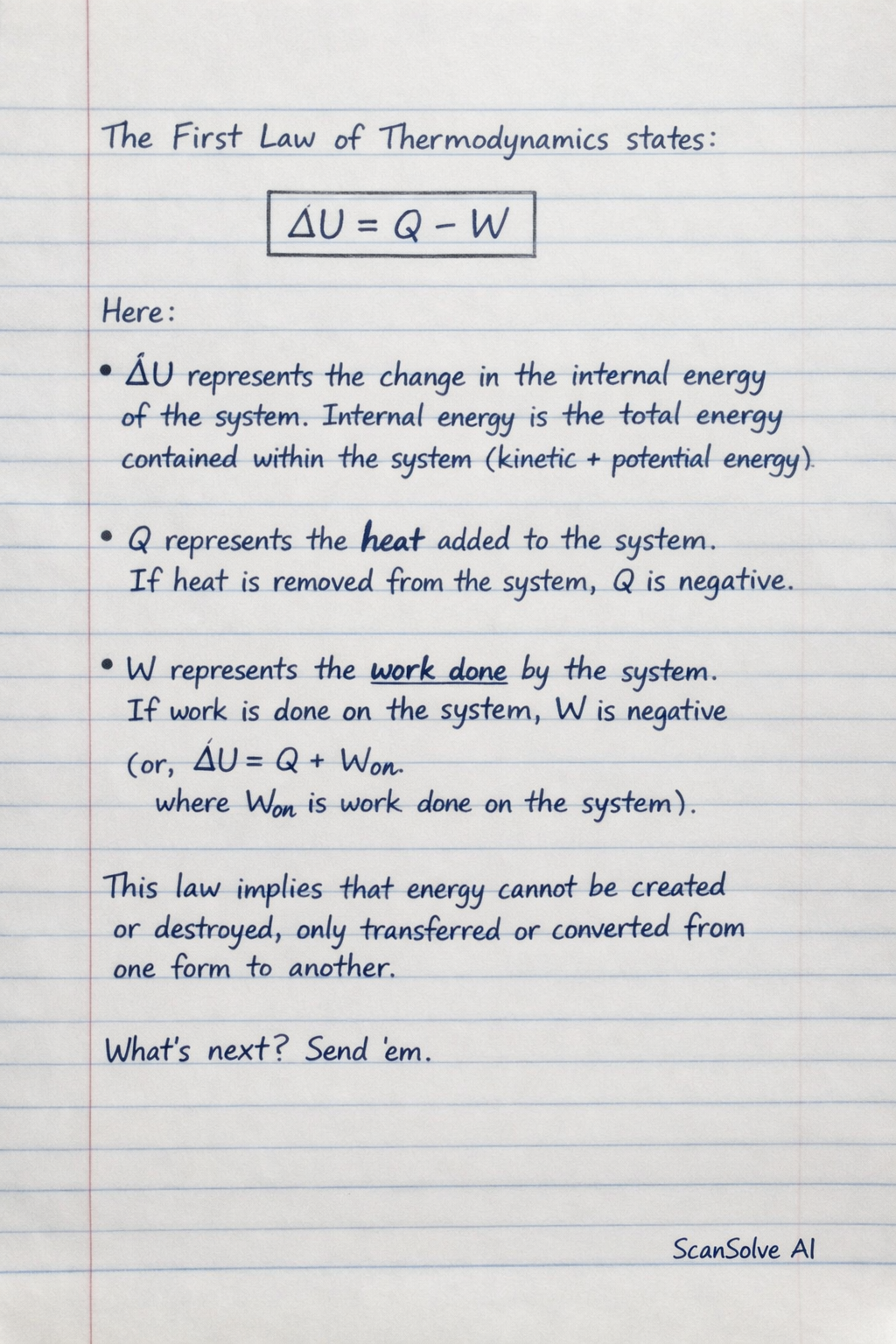
The First Law of Thermodynamics is a statement of the conservation of energy. It states that the change in the internal energy of a system () is equal to the heat added to the system () minus the work done by the system ().
Mathematically, it is expressed as:
Here:
- represents the change in the internal energy of the system. Internal energy is the total energy contained within a thermodynamic system, including the kinetic and potential energies of its molecules.
- represents the heat added to the system. If heat is removed from the system, is negative.
- represents the work done by the system. If work is done on the system, is negative (or the equation can be written as , where is work done on the system).
This law implies that energy cannot be created or destroyed, only transferred or converted from one form to another.
Was this helpful?
Try one yourself
A new problem that tests the same skill.
Still stuck on this one?
Ask a follow-up, and the answer starts from this question.
Got a different question?Ask your own question
More Physics Questions
QWhat is the first law of thermodynamics?QFirst law of thermodynamicsQQ5a.) State the first law of Thermodynamics and represent it with an Equation. b.) Give two(2)…QThe First and Second Laws of Thermodynamics are fundamental principles governing energy and matter…QState the First Law of Thermodynamics and definitions for an ideal gas.
Browse by topic:Thermodynamics
Handwritten Step-by-Step Solution
Get this as a handwritten image on WhatsApp — like a tutor wrote it for you.
Try on WhatsApp