
We read your photo as:
The energy change accompanying the addition of an electron to a gaseous atom is called
ScanSolve AI Answer
Answer
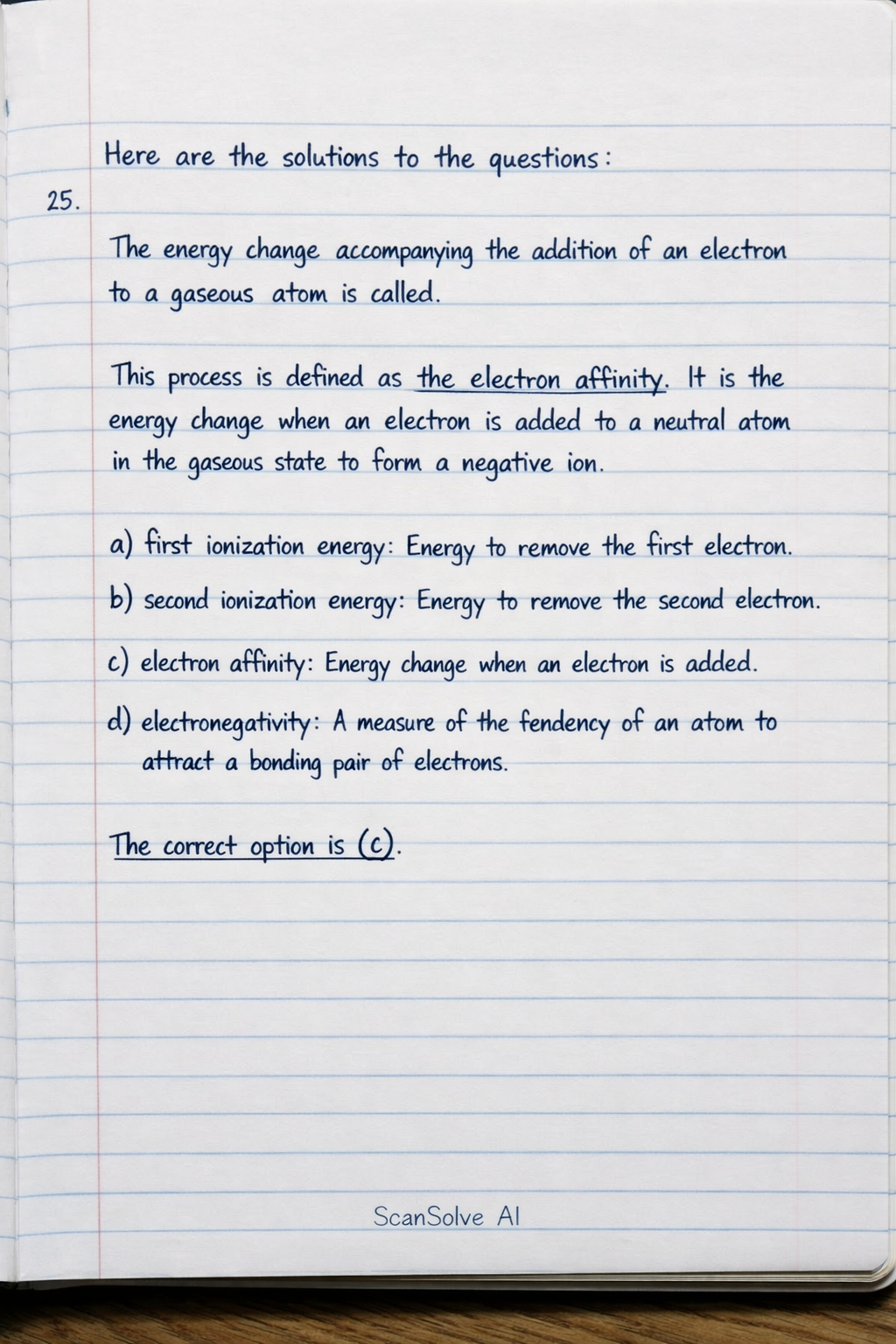
Here are the solutions to the questions:
25. The energy change accompanying the addition of an electron to a gaseous atom is called
- This process is defined as the electron affinity. It is the energy change when an electron is added to a neutral atom in the gaseous state to form a negative ion.
- a) first ionization energy: Energy to remove the first electron.
- b) second ionization energy: Energy to remove the second electron.
- c) electron affinity: Energy change when an electron is added.
- d) electronegativity: A measure of the tendency of an atom to attract a bonding pair of electrons.
- The correct option is (c).
26. Four elements P, Q, R and S have atomic numbers of 4, 10, 12 and 14 respectively. Which of these elements is a noble gas?
- Let's identify the elements based on their atomic numbers:
- P: Atomic number 4 is Beryllium (Be).
- Q: Atomic number 10 is Neon (Ne).
- R: Atomic number 12 is Magnesium (Mg).
- S: Atomic number 14 is Silicon (Si).
- Noble gases are elements in Group 18 of the periodic table, characterized by a full outermost electron shell. Neon (Ne) is a noble gas.
- The correct option is (b).
27. The type of energy involved in the above transformation is
- This equation shows a gaseous atom () losing an electron to form a gaseous positive ion (). This process is known as ionization.
- a) ionization energy: The energy required to remove an electron from a gaseous atom or ion.
- b) sublimation energy: Energy required to change a substance from solid to gas.
- c) lattice energy: Energy released when gaseous ions combine to form an ionic solid.
- d) electron affinity: Energy change when an electron is added to a gaseous atom.
- The correct option is (a).
28. Which of the following is arranged in order of increasing electronegativity?
- Electronegativity generally increases from left to right across a period in the periodic table. The elements listed (Sodium, Magnesium, Aluminum, Phosphorus, Chlorine) are all in Period 3.
- Their order in Period 3 is: Na (Group 1) < Mg (Group 2) < Al (Group 13) < P (Group 15) < Cl (Group 17).
- Therefore, the order of increasing electronegativity for these elements is Na < Mg < Al < P < Cl.
- Let's check the options:
- (a) chlorine, aluminum, magnesium, phosphorus, sodium: This is not in increasing order.
- (b) sodium, aluminum, phosphorus, chlorine: This sequence (Na < Al < P < Cl) correctly shows increasing electronegativity for the listed elements.
- (c) chlorine, phosphorus, magnesium, aluminum, sodium: This is not in increasing order.
- (d) sodium, chlorine, phosphorus, magnesium, aluminum: This is not in increasing order.
- The correct option is (b).
29. Four elements P, Q, R, and S, have 1, 2, 3, and 7 electrons in their outermost shells respectively. The element which is unlikely to be a metal is
- Metals typically have 1, 2, or 3 valence electrons and tend to lose these electrons to form positive ions.
- Non-metals typically have 4, 5, 6, 7, or 8 valence electrons (excluding hydrogen and helium) and tend to gain or share electrons.
- Based on the number of outermost electrons:
- P: 1 electron (likely a metal, e.g., alkali metal).
- Q: 2 electrons (likely a metal, e.g., alkaline earth metal).
- R: 3 electrons (likely a metal, e.g., aluminum).
- S: 7 electrons (likely a non-metal, e.g., halogen).
- Therefore, element S, with 7 valence electrons, is most unlikely to be a metal.
- The correct option is (d).
Try one yourself
A new problem that tests the same skill.
Still stuck on this one?
Ask a follow-up, and the answer starts from this question.
More Physics Questions
Handwritten Step-by-Step Solution
Get this as a handwritten image on WhatsApp — like a tutor wrote it for you.
Try on WhatsApp