

This physics problem tests your understanding of fundamental physical laws and their applications. The step-by-step solution below breaks down the problem using relevant equations and physical reasoning.
ScanSolve AI Answer
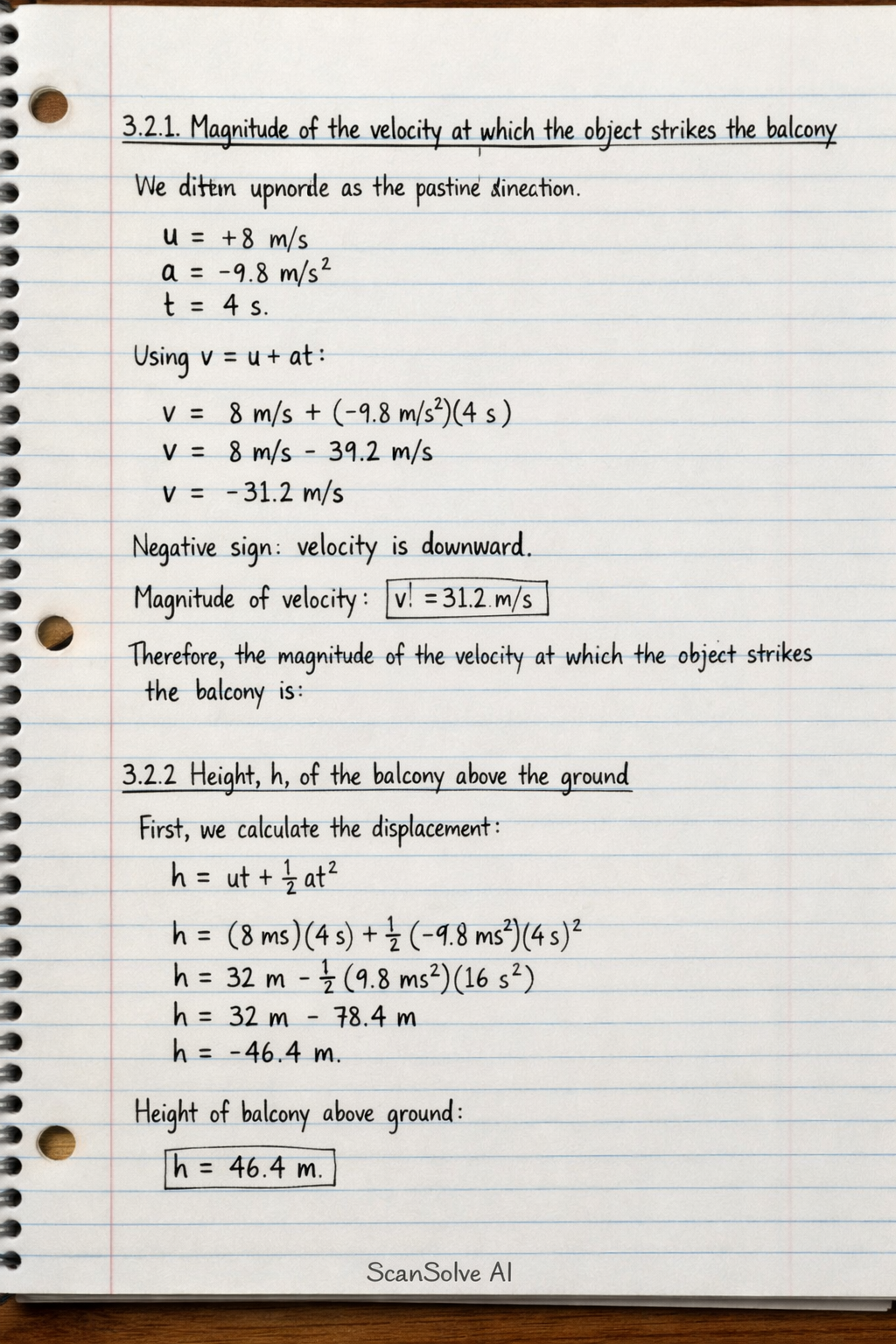
Here's the continuation of the solution: --- 3.2.1 Magnitude of the velocity at which the object strikes the balcony We define upwards as the positive direction. Initial velocity, u = +8 m/s Acceleration due to gravity, a = -9.8 m/s^2 Time to strike the balcony, t = 4 s Using the kinematic equation v = u + at: v = 8 m/s + (-9.8 m/s^2)(4 s) v = 8 m/s - 39.2 m/s v = -31.2 m/s The negative sign indicates the velocity is directed downwards. The question asks for the magnitude. The magnitude of the velocity at which the object strikes the balcony is 31.2 m/s. --- 3.2.2 Height, h, of the balcony above the ground First, we calculate the displacement of the object from the roof to the balcony. Initial velocity, u = +8 m/s Acceleration, a = -9.8 m/s^2 Time, t = 4 s Using the kinematic equation y = ut + (1)/(2)at^2: y = (8 m/s)(4 s) + (1)/(2)(-9.8 m/s^2)(4 s)^2 y = 32 m + (1)/(2)(-9.8 m/s^2)(16 s^2) y = 32 m - 78.4 m y = -46.4 m The negative sign indicates that the balcony is 46.4 m below the starting point (the roof). The height of the building is 60 m. The height of the balcony above the ground, h, is the building's height minus the magnitude of the downward displacement to the balcony: h = Height of building + y h = 60 m + (-46.4 m) h = 13.6 m The height, h, of the balcony above the ground is 13.6 m. --- 3.3 Sketch a velocity-time graph to represent the motion of the object from the moment it is projected from the ROOF of the building until it strikes the GROUND. Indicate the following velocity and time values on the graph: The initial velocity at which the object was projected from the roof of the building The velocity at which the object strikes the balcony The time when the object strikes the balcony The velocity at which the object bounces off the balcony The time when the